

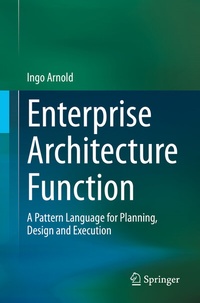
Enterprise Architecture Function
Description

This book provides a method to plan, develop, validate, or evolve the design of an enterprise architecture function so that it fully meets the organization's needs. The reader will benefit from this book in two ways. First, it provides a structured overview and orientation to the subject of architecture from an architecture function perspective. Second, it guides through the process of planning, building, and operating your own architecture organization based on a generic architecture function blueprint presented in the form of a pattern language offering a structured means for navigating, contextualizing, combining, and composing the architecture function patterns.
The book is structured in six chapters. Chapter 1 "Introduction" explains the starting position and objectives of the book and introduces key concepts that will be explained further in subsequent chapters. Chapter 2 "Architecture Function Pattern Language" introduces the concepts of pattern, pattern catalogue, pattern topology, and ontology and explains how these concepts are combined to form a pattern language for planning, designing, and operating an architecture function. Next, Chapter 3 "Architecture Function - Context" introduces concepts that are crucial for understanding the challenges that an architecture function faces and presents a generic schema for the business organizations and value chain. Chapter 4 "Architecture Function - Challenge" looks at an architecture function from a black box perspective and outlines the expectations and requirements that companies place on architecture organizations. It discusses the building blocks of an architecture function, the services it provides along the enterprise value chain, and the quality attributes that enterprises expect from their functions. Chapter 5 "Architecture Function - Constitution" then shifts from a black-box perspective to a white-box perspective and outlines the generic design of an architecture function in order to realize functional and quality-related requirements. Chapter 6 "Pattern Catalogue" eventually introduces the pattern catalogue with a total of 48 architecture function patterns. These patterns suggest designs for collaboration between the architecture function and enterprise organizations, for the elaboration and development of enterprise services along the enterprise value chain, or for aligning architecture governance with enterprise governance.
The book is intended for a broad readership, including enterprise, domain, and solution architects, lecturers and students, and anyone else interested in understanding the value proposition, responsibilities, outcomes, methods, and practices of architecture functions. It introduces the basic concepts and theories needed to understand the pattern language presented and the patterns it summarizes.
Reviews / Votes
"An extremely engaging text from a though leader in the field of Enterprise Architecture. Ingo Arnold manages to connect the dots from an abstract representation of enterprise architecture to a concrete instantiation of the architecture function in an organization to make it real and deliver business value." (Gautam Hotti, Head of Architecture Governance, Novartis Business Services, Dublin, Ireland)"Ingo Arnold presents a rich pattern language to share his holistic understand-ing and practical experience on how to plan, design and evolve the enterprise architecture function to meet the specific demands and expectations of its stake-holders in a particular organization." (Prof. Dr. Florian Matthes, Technical University of Munich, Chair for Software Engineering of Business Information Systems (sebis))
More details
Other editions
Additional editions
Person
Ingo Arnold shaped the Enterprise Architecture Function of a global fortune 50s, holding a variety of Architecture Management positions over the last 25 years. In addition to his roles in the industry, Ingo is an Assistant Professor at Universities in Switzerland and Germany sharing his insights and experience with several generations of computer science students. He is also a well-known speaker at professional IT conferences, where he holds presentations on topics such as architecture management and governance, enterprise architecture, and solution architecture for international audiences.
