

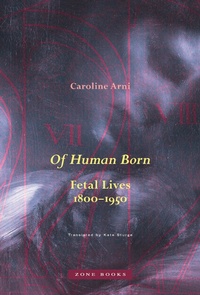
Of Human Born
Description

A new history of the concept of fetal life in the human sciences At a time when the becoming of a human being in a woman's body has, once again, become a fraught issue-from abortion debates and surrogacy controversies to prenatal diagnoses and assessments of fetal risk-Of Human Born presents the largely unknown history of how the human sciences came to imagine the unborn in terms of "life before birth." Caroline Arni shows how these sciences created the concept of "fetal life" by way of experimenting on animals, pregnant women, and newborns; how they worried about the influence of the expectant mother's living conditions; and how they lingered on the question of the beginnings of human subjectivity. Such were the concerns of physiologists, pediatricians, psychologists, and psychoanalysts as they advanced the novel discipline of embryology while, at the same time, grappling with age-old questions about the coming-into-being of a human person. Of Human Born thus draws attention to the fundamental way in which modern approaches to the unborn have been intertwined with the configuration of "the human" in the age of scientific empiricism. Arni revises the narrative that the "modern embryo" is quintessentially an embryo disembedded from the pregnant woman's body. On the contrary, she argues that the concept of fetal life cannot be separated from its dependency on the maternal organism, countering the rhetorical discourses that have fueled the recent rollback of abortion rights in the United States.
More details
Other editions
Additional editions
Persons
Content
- Cover
- Contents
- Preface
- Part One: Situating Fetal Life
- I. Paris 1870/71: Trauma in the Womb
- II. Children, Fetal Life, and the Prenatal
- III. The Unborn and the Human Sciences
- Part Two: Living Beings
- IV. The Life of the Fetus
- V. Pregnancy as Relation
- VI. Prenatal Danger
- Part Three: Inner Life
- VII. How the Pregnant Woman Feels
- VIII. If the Fetus Senses
- IX. What the Environment Does
- Part Four: Politics of the Unborn
- X. Thresholds in Time
- XI. Of Human Born
- Acknowledgments
- Notes
- Bibliography
- List of Illustrations
- Index
- A
- B
- C
- D
- E
- F
- G
- H
- I
- J
- K
- L
- M
- N
- O
- P
- R
- S
- T
- U
- V
- W
