

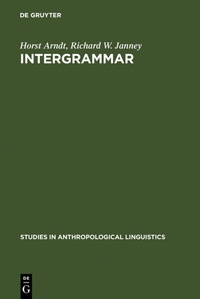
InterGrammar
Toward an Integrative Model of Verbal, Prosodic and Kinesic Choices in Speech
1st Edition
Published on 22. July 2011
XVI, 458 pages
978-3-11-087291-0 (ISBN)
Description

No detailed description available for "InterGrammar".
More details
Series
Edition
Reprint 2011
Language
English
Place of publication
Berlin/Boston
Germany
Publishing group
de Gruyter Mouton
Target group
Professional and scholarly
US School Grade: College Graduate Student
Illustrations
16 Abbildungen, 60 s/w Tabellen
16 ill., 60 tbl.
File size
16,53 MB
ISBN-13
978-3-11-087291-0 (9783110872910)
Schweitzer Classification
Other editions
Additional editions
Horst Arndt | Richard W. Janney
InterGrammar
Toward an Integrative Model of Verbal, Prosodic and Kinesic Choices in Speech
Book
07/2011
1st Edition
De Gruyter Mouton
€309.00
Withdrawn from sale
Horst Arndt | Richard W. Janney
InterGrammar
Toward an Integrative Model of Verbal, Prosodic and Kinesic Choices in Speech
Book
09/1987
1st Edition
De Gruyter Mouton
€220.00
Shipment within 7-9 days
Content
- Intro
- List of figures
- Introduction
- 1. The Context of InterGrammar
- 1.1 Linguistic models, model objects, and designated realities
- 1.2 Autonomous and nonautonomous linguistic exemplars
- 1.3 Linguistic ideologies
- 1.4 Introspection and observation in linguistic theory
- 2. Choice and Constraint in Linguistic Theory
- 2.1 Abductive reasoning
- 2.2 An abductive rationale for communicative choices and constraints
- 2.3 Global assumptions
- 2.4 Situational assumptions
- 2.5 The perception of communicative acts
- 2.6 Attitudinal dimensions of communicative decisions
- 2.7 Intentional dimensions of communicative decisions
- 3. Communicative Choices
- 3.1 Multimodal dimensions of communicative choice
- 3.2 Verbal, prosodic, and kinesic choices
- 3.3 Reflective and projective aspects of communicative choices
- 3.4 The modulation and modification of communicative choices
- 4. Interpretive Choices
- 4.1 Interpretive consensus and interpretive variation
- 4.2 Meaning, understanding, and interpretation
- 4.3 Interpretive processes
- 5. The Interpretation of Verbal Choices
- 5.1 Style
- 5.2 The perception of verbal formality and directness
- 5.3 The interpretation of variations in verbal formality
- 5.4 The interpretation of variations in verbal directness
- 6. The Interpretation of Prosodic Choices
- 6.1 Prosody
- 6.2 The interpretation of pitch nucleus placement
- 6.3 The interpretation of pitch nucleus prominence
- 6.4 The interpretation of pitch nucleus direction
- 7. The Interpretation of Kinesic Choices
- 7.1 Kinesics
- 7.2 Smiling-frowning expression
- 7.3 Gaze and gaze aversion
- 7.4 Body tension-relaxation
- 7.5 Kinesic cue combinations
- 8. Trimodal Patterning in Speech
- 8.1 Emotive dimensions of speech
- 8.2 Trimodal interaction
- Conclusion
- Bibliography
- Author Index
- Subject Index
