

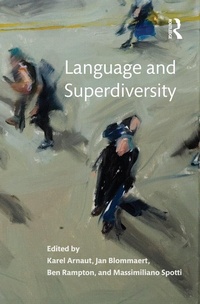
Language and Superdiversity
Published on 22. December 2015
296 pages
978-1-317-54833-1 (ISBN)
Description

A first synthesis of work done in sociolinguistic superdiversity, this volume offers a substantial introduction to the field and the issues and state-of-the-art research papers organized around three themes: Sketching the paradigm, Sociolinguistic complexity, Policing complexity. The focus is to show how complexity rather than plurality can serve as a lens through which an equally vast range of topics, sites, and issues can be tied together.
Superdiversity captures the acceleration and intensification of processes of social 'mixing' and 'fragmentation' since the early 1990s, as an outcome of two different but related processes: new post-Cold War migration flows, and the advent and spread of the Internet and mobile technologies. The confluence of these forces have created entirely new sociolinguistic environments, leading to research in the past decade that has brought a mixture of new empirical terrain-extreme diversity in language and literacy resources, complex repertoires and practices of participants in interaction-and conceptual challenges.
Language and Superdiversity is a landmark volume bringing together the work of the scholars and researchers who spearhead the development of the sociolinguistics of superdiversity.
Superdiversity captures the acceleration and intensification of processes of social 'mixing' and 'fragmentation' since the early 1990s, as an outcome of two different but related processes: new post-Cold War migration flows, and the advent and spread of the Internet and mobile technologies. The confluence of these forces have created entirely new sociolinguistic environments, leading to research in the past decade that has brought a mixture of new empirical terrain-extreme diversity in language and literacy resources, complex repertoires and practices of participants in interaction-and conceptual challenges.
Language and Superdiversity is a landmark volume bringing together the work of the scholars and researchers who spearhead the development of the sociolinguistics of superdiversity.
More details
Language
English
Place of publication
London
United Kingdom
Publishing group
Taylor & Francis Ltd
Target group
College/higher education
Product notice
Reflowable
Illustrations
27 s/w Abbildungen, 5 s/w Tabellen, 24 s/w Photographien bzw. Rasterbilder, 3 s/w Zeichnungen
5 Tables, black and white; 3 Line drawings, black and white; 24 Halftones, black and white; 27 Illustrations, black and white
File size
3,68 MB
ISBN-13
978-1-317-54833-1 (9781317548331)
Copyright in bibliographic data and cover images is held by Nielsen Book Services Limited or by the publishers or by their respective licensors: all rights reserved.
Schweitzer Classification
Other editions
Additional editions
Karel Arnaut | Jan Blommaert | Ben Rampton
Language and Superdiversity
Book
12/2015
1st Edition
Routledge
€379.00
Shipment within 10-20 days
Karel Arnaut | Jan Blommaert | Ben Rampton
Language and Superdiversity
Book
12/2015
1st Edition
Routledge
€74.80
Shipment within 10-20 days
Persons
Karel Arnaut is Associate Professor, Interculturalism, Migration and Minorities Research Centre (IMMRC) | Faculty of Social Sciences, K.U.Leuven (Belgium).
Jan Blommaert is Professor of Language, Culture and Globalization and Director of the Babylon Center at Tilburg University (The Netherlands). He coordinates the INCOLAS consortium and is one of the group leaders of the Max Planck Sociolinguistic Diversity Working Group.
Ben Rampton is Professor of Applied and Sociolinguistics at King's College, London (UK). He is the Founding Convenor of the UK Linguistic Ethnography Forum, a Fellow of the Academy of Social Sciences and an Honorary Doctor at Copenhagen University.
Massimiliano Spotti is Assistant Professor in Sociolinguistics and Deputy Director of the Babylon Center at Tilburg University (The Netherlands).
Jan Blommaert is Professor of Language, Culture and Globalization and Director of the Babylon Center at Tilburg University (The Netherlands). He coordinates the INCOLAS consortium and is one of the group leaders of the Max Planck Sociolinguistic Diversity Working Group.
Ben Rampton is Professor of Applied and Sociolinguistics at King's College, London (UK). He is the Founding Convenor of the UK Linguistic Ethnography Forum, a Fellow of the Academy of Social Sciences and an Honorary Doctor at Copenhagen University.
Massimiliano Spotti is Assistant Professor in Sociolinguistics and Deputy Director of the Babylon Center at Tilburg University (The Netherlands).
Content
CONTENTS
1. Introduction
Karel Arnaut , Jan Blommaert, Ben Rampton, and Massimiliano Spotti
Part 1: Sketching the paradigm
2. Language and superdiversity
Jan Blommaert and Ben Rampton
3. Super-diversity: Elements of an emerging perspective
Karel Arnaut
4. From multilingual classification to translingual ontology: A turning point
David Parkin
Part II: Sociolinguistic complexity
5. Drilling down to the grain in superdiversity
Ben Rampton
6. Buffalaxing the other: Superdiversity in action on YouTube
Sirpa Leppaenen and Ari Haekkinen
7. Polylanguaging in super-diversity
Jens Normann Jorgensen, Martha Sif Karrebaek, Lian Malai Madsen, and Janus Spindler Moller
8. 'A typical gentleman': Metapragmatic stereotypes as systems of distinction
Adrian Blackledge and Angela Creese
9. Mobility, voice, and symbolic restratification: An ethnography of 'elite migrants' in urban China
Jie Dong
Part III: Policing complexity
10. Ethnographic linguistic landscape analysis and social change: A case study
Jan Blommaert and Ico Maly
11. Superdiversity on the Internet: A case from China
Piia Varis and Xuan Wang
12. Translating global experience into institutional models of competency: Linguistic inequalities in the job interview
Celia Roberts
13. Sociolinguistic shibboleths at the institutional gate: Language, origin and the construction of asylum seekers' identities
Massimiliano Spotti
1. Introduction
Karel Arnaut , Jan Blommaert, Ben Rampton, and Massimiliano Spotti
Part 1: Sketching the paradigm
2. Language and superdiversity
Jan Blommaert and Ben Rampton
3. Super-diversity: Elements of an emerging perspective
Karel Arnaut
4. From multilingual classification to translingual ontology: A turning point
David Parkin
Part II: Sociolinguistic complexity
5. Drilling down to the grain in superdiversity
Ben Rampton
6. Buffalaxing the other: Superdiversity in action on YouTube
Sirpa Leppaenen and Ari Haekkinen
7. Polylanguaging in super-diversity
Jens Normann Jorgensen, Martha Sif Karrebaek, Lian Malai Madsen, and Janus Spindler Moller
8. 'A typical gentleman': Metapragmatic stereotypes as systems of distinction
Adrian Blackledge and Angela Creese
9. Mobility, voice, and symbolic restratification: An ethnography of 'elite migrants' in urban China
Jie Dong
Part III: Policing complexity
10. Ethnographic linguistic landscape analysis and social change: A case study
Jan Blommaert and Ico Maly
11. Superdiversity on the Internet: A case from China
Piia Varis and Xuan Wang
12. Translating global experience into institutional models of competency: Linguistic inequalities in the job interview
Celia Roberts
13. Sociolinguistic shibboleths at the institutional gate: Language, origin and the construction of asylum seekers' identities
Massimiliano Spotti
