

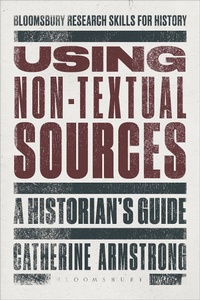
Using Non-Textual Sources
A Historian's Guide
1st Edition
Published on 17. December 2015
192 pages
978-1-4725-0571-2 (ISBN)
Description

Using Non-Textual Sources provides history students with the theoretical background and skills to interpret non-textual sources. It introduces the full range of non-textual sources used by historians and offers practical guidance on how to interpret them and incorporate them into essays and dissertations. In addition to this, the book posits a theoretical framework that justifies the use of these items as historical sources and explains how they can be used to further understand the past.
There is coverage of the creation, production and distribution of non-textual sources; the acquisition of skills to 'read' these sources analytically; and the meaning, significance and reliability of these forms of evidence. Using Non-Textual Sources includes a section on interdisciplinary non-textual source work, outlining what historians borrow from disciplines such as art history, archaeology, geography and media studies, as well as a discussion of how to locate these resources online and elsewhere in order to use them in essays and dissertations.
Case studies, such as the Tudor religious propaganda painting Edward VI and the Pope, the 1954 John Ford Western The Searchers and the Hereford Mappa Mundi, are employed throughout to illustrate the functions of main source types. Photographs, cartoons, maps, artwork, audio clips, film, places and artifacts are all explored in a text that provides students with a comprehensive, cohesive and practical guide to using non-textual sources.
There is coverage of the creation, production and distribution of non-textual sources; the acquisition of skills to 'read' these sources analytically; and the meaning, significance and reliability of these forms of evidence. Using Non-Textual Sources includes a section on interdisciplinary non-textual source work, outlining what historians borrow from disciplines such as art history, archaeology, geography and media studies, as well as a discussion of how to locate these resources online and elsewhere in order to use them in essays and dissertations.
Case studies, such as the Tudor religious propaganda painting Edward VI and the Pope, the 1954 John Ford Western The Searchers and the Hereford Mappa Mundi, are employed throughout to illustrate the functions of main source types. Photographs, cartoons, maps, artwork, audio clips, film, places and artifacts are all explored in a text that provides students with a comprehensive, cohesive and practical guide to using non-textual sources.
More details
Series
Edition
1. Auflage
Language
English
Place of publication
London
United Kingdom
Publishing group
Bloomsbury Publishing PLC
Target group
Professional and scholarly
College/higher education
Illustrations
20 bw illus
ISBN-13
978-1-4725-0571-2 (9781472505712)
Copyright in bibliographic data and cover images is held by Nielsen Book Services Limited or by the publishers or by their respective licensors: all rights reserved.
Schweitzer Classification
Other editions
Additional editions
Book
12/2015
Bloomsbury Academic
€53.41
Shipment within 15-20 days
Person
Catherine Armstrong is Lecturer in American History at Loughborough University, UK. She is the author of Writing North America in the Seventeenth Century (2007) and, along with Laura M. Chmielewski, The Atlantic Experience: People, Places, Ideas (2013).
Content
Introduction
1. Borrowing from Other Disciplines
2. Reading Images
3. Film, TV and Audio Sources
4. Material Culture and the Built Environment
5. Practical Applications
Notes
Bibliography
Index
1. Borrowing from Other Disciplines
2. Reading Images
3. Film, TV and Audio Sources
4. Material Culture and the Built Environment
5. Practical Applications
Notes
Bibliography
Index
