

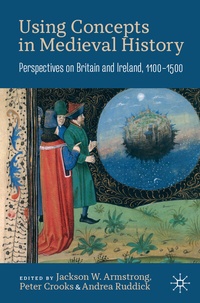
Using Concepts in Medieval History
Description

This book is the first of its kind to engage explicitly with the practice of conceptual history as it relates to the study of the Middle Ages, exploring the pay-offs and pitfalls of using concepts in medieval history. Concepts are indispensable to historians as a means of understanding past societies, but those concepts conjured in an effort to bring order to the infinite complexity of the past have a bad habit of taking on a life of their own and inordinately influencing historical interpretation. The most famous example is 'feudalism', whose fate as a concept is reviewed here by E.A.R. Brown nearly fifty years after her seminal article on the topic. The volume's contributors offer a series of case studies of other concepts - 'colony', 'crisis', 'frontier', 'identity', 'magic', 'networks' and 'politics' - that have been influential, particularly among historians of Britain and Ireland in the later Middle Ages. The book explores the creative friction between historical ideas and analytical categories, and the potential for fresh and meaningful understandings to emerge from their dialogue.
Reviews / Votes
"This is an exciting collection of essays, surveying an approach to the history of late medieval Britain and Ireland which has long been integral to some areas of enquiry but has only recently come into play in others, especially the history of politics and political society. This exploration of the actual and potential use of concepts will instruct and stimulate both students and practising historians." -Christine Carpenter, University of Cambridge, UK "This invigorating volume will inspire students and academics to interrogate much more rigorously the use of established concepts and terminology in their historical research. The grounding of each chapter in the medieval sources and the sustained discussion of the interplay between medieval and modern terminology and concepts make this collection convincing and richly textured. It is an optimistic collection as the contributors demonstrate positive ways to move forward with greater awareness of the rewards and the pitfalls of conceptual history." -Sparky Booker, Dublin City University, IrelandMore details
Other editions
Additional editions
Persons
Jackson W. Armstrong is Senior Lecturer in History at the University of Aberdeen, UK.
Peter Crooks is Senior Lecturer in Medieval History at Trinity College Dublin, the University of Dublin, Ireland.
Andrea Ruddick is a History teacher at St Paul's School, London, UK. She previously worked as a lecturer and research fellow at the University of Cambridge and the University of Oxford.
