

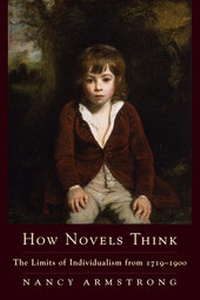
How Novels Think
The Limits of Individualism from 1719-1900
1st Edition
Published on 11. January 2006
208 pages
978-0-231-50387-7 (ISBN)
Description

Nancy Armstrong argues that the history of the novel and the history of the modern individual are, quite literally, one and the same. She suggests that certain works of fiction created a subject, one displaying wit, will, or energy capable of shifting the social order to grant the exceptional person a place commensurate with his or her individual worth. Once the novel had created this figure, readers understood themselves in terms of a narrative that produced a self-governing subject.
In the decades following the revolutions in British North America and France, the major novelists distinguished themselves as authors by questioning the fantasy of a self-made individual. To show how novels by Defoe, Austen, Scott, Brontë, Dickens, Eliot, Hardy, Haggard, and Stoker participated in the process of making, updating, and perpetuating the figure of the individual, Armstrong puts them in dialogue with the writings of Locke, Hume, Rousseau, Malthus, Darwin, Kant, and Freud. Such theorists as Althusser, Balibar, Foucault, and Deleuze help her make the point that the individual was not one but several different figures. The delineation and potential of the modern subject depended as much upon what it had to incorporate as what alternatives it had to keep at bay to address the conflicts raging in and around the British novel.
In the decades following the revolutions in British North America and France, the major novelists distinguished themselves as authors by questioning the fantasy of a self-made individual. To show how novels by Defoe, Austen, Scott, Brontë, Dickens, Eliot, Hardy, Haggard, and Stoker participated in the process of making, updating, and perpetuating the figure of the individual, Armstrong puts them in dialogue with the writings of Locke, Hume, Rousseau, Malthus, Darwin, Kant, and Freud. Such theorists as Althusser, Balibar, Foucault, and Deleuze help her make the point that the individual was not one but several different figures. The delineation and potential of the modern subject depended as much upon what it had to incorporate as what alternatives it had to keep at bay to address the conflicts raging in and around the British novel.
All prices
More details
Other editions
Additional editions
Book
01/2006
Columbia University Press
€113.89
Shipment within 10-20 days
Book
01/2006
Columbia University Press
€34.72
Shipment within 10-20 days
Person
Nancy Armstrong is chair of the English department and Nancy Duke Lewis Professor of Comparative Literature, English, Modern Culture and Media, and Gender Studies at Brown University. She is the author of several books including, Fiction in the Age of Photography: The Legacy of British Realism and Desire and Domestic Fiction: A Political History of the Novel.
Content
Acknowledgments
Introduction. How Novels Think
1. How the Misfit Became a Moral Protagonist
2. When Novels Made Nations
3. Why a Good Man Is Hard to Find in Victorian Fiction
4. The Polygenetic Imagination
5. The Necessary Gothic
Notes
Index
Introduction. How Novels Think
1. How the Misfit Became a Moral Protagonist
2. When Novels Made Nations
3. Why a Good Man Is Hard to Find in Victorian Fiction
4. The Polygenetic Imagination
5. The Necessary Gothic
Notes
Index
