

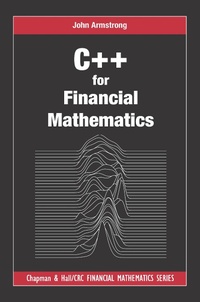
C++ for Financial Mathematics
Published on 6. January 2017
410 pages
978-1-4987-5007-3 (ISBN)
Description

If you know a little bit about financial mathematics but don't yet know a lot about programming, then C++ for Financial Mathematics is for you.
C++ is an essential skill for many jobs in quantitative finance, but learning it can be a daunting prospect. This book gathers together everything you need to know to price derivatives in C++ without unnecessary complexities or technicalities. It leads the reader step-by-step from programming novice to writing a sophisticated and flexible financial mathematics library. At every step, each new idea is motivated and illustrated with concrete financial examples.
As employers understand, there is more to programming than knowing a computer language. As well as covering the core language features of C++, this book teaches the skills needed to write truly high quality software. These include topics such as unit tests, debugging, design patterns and data structures.
The book teaches everything you need to know to solve realistic financial problems in C++. It can be used for self-study or as a textbook for an advanced undergraduate or master's level course.
C++ is an essential skill for many jobs in quantitative finance, but learning it can be a daunting prospect. This book gathers together everything you need to know to price derivatives in C++ without unnecessary complexities or technicalities. It leads the reader step-by-step from programming novice to writing a sophisticated and flexible financial mathematics library. At every step, each new idea is motivated and illustrated with concrete financial examples.
As employers understand, there is more to programming than knowing a computer language. As well as covering the core language features of C++, this book teaches the skills needed to write truly high quality software. These include topics such as unit tests, debugging, design patterns and data structures.
The book teaches everything you need to know to solve realistic financial problems in C++. It can be used for self-study or as a textbook for an advanced undergraduate or master's level course.
Reviews / Votes
"OOP in C++ remains a difficult programming language and paradigm to learn and develop. There remains a shortage of high-quality, easy to follow texts in C++ for mathematical finance. Dr Armstrong has successfully produced a self-contained publication that begins with the basics and patiently guides the student to advanced object-oriented C++ programming in a quant finance setting. The writing style is very user-friendly and immediately reassures the reader, while numerous exercises allow solid progression. The author's extensive background in academia and as a practitioner is apparent throughout; the latter being a key accomplishment in setting the book apart from others. As a teacher of mathematical and computational finance, Armstrong's book will feature at the top of my list of recommended textbooks."- Dr. Riaz Ahmad, The Fitch Group and University College London (Departments of Mathematics and Computer Science) "OOP in C++ remains a difficult programming language and paradigm to learn and develop. There remains a shortage of high-quality, easy to follow texts in C++ for mathematical finance. Dr Armstrong has successfully produced a self-contained publication that begins with the basics and patiently guides the student to advanced object-oriented C++ programming in a quant finance setting. The writing style is very user-friendly and immediately reassures the reader, while numerous exercises allow solid progression. The author's extensive background in academia and as a practitioner is apparent throughout; the latter being a key accomplishment in setting the book apart from others. As a teacher of mathematical and computational finance, Armstrong's book will feature at the top of my list of recommended textbooks."
- Dr. Riaz Ahmad, The Fitch Group and University College London (Departments of Mathematics and Computer Science)
More details
Series
Language
English
Place of publication
Philadelphia, PA
United States
Publishing group
Taylor & Francis Inc
Target group
College/higher education
Product notice
Reflowable
Illustrations
60 Illustrations, black and white
File size
2,49 MB
ISBN-13
978-1-4987-5007-3 (9781498750073)
Copyright in bibliographic data and cover images is held by Nielsen Book Services Limited or by the publishers or by their respective licensors: all rights reserved.
Schweitzer Classification
Other editions
Additional editions
John Armstrong
C++ for Financial Mathematics
Book
06/2021
1st Edition
Chapman & Hall/CRC
€75.60
Shipment within 10-20 days
John Armstrong
C++ for Financial Mathematics
Book
12/2016
1st Edition
Chapman & Hall/CRC
€134.40
Shipment within 15-20 days
Person
John Armstrong is a Lecturer in financial mathematics, probability and statistics at King's College London. He has 15 years experience in the financial industry working as a software architect. He co-founded Yolus and designed their innovative risk management system which was adopted by numerous major banks. He has also worked for ION Trading, Dresdner Kleinwort Wasserstein and was an executive director at Goldman Sachs.
Content
Introduction. Getting Started. Basic Data Types and Operators. Functions. Flow of Control. Working with Multiple Files. Unit Testing. Using C++ Classes. User-Defined Types. Monte Carlo Pricing in C++. Interfaces. Arrays, Strings, and Pointers. More Sophisticated Classes. The Portfolio Class. Delta Hedging. Debugging and Development ToolsA Matrix Class. An Overview of Templates. The Standard Template Library. Function Objects and Lambda Functions. Threads. Next Steps. Appendix: Risk-Neutral Pricing
