

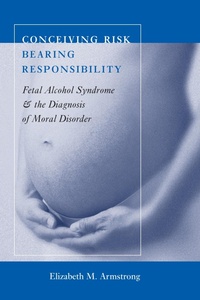
Conceiving Risk, Bearing Responsibility
Fetal Alcohol Syndrome and the Diagnosis of Moral Disorder
Published on 22. September 2008
296 pages
978-0-8018-9941-6 (ISBN)
Description

In American society, the consumption of alcohol during pregnancy is considered dangerous, irresponsible, and in some cases illegal. Pregnant women who have even a single drink routinely face openly voiced reproach. Yet fetal alcohol syndrome (FAS) in infants and children is notoriously difficult to diagnose, and the relationship between alcohol and adverse birth outcomes is riddled with puzzles and paradoxes.
Sociologist Elizabeth M. Armstrong uses fetal alcohol syndrome and the problem of drinking during pregnancy to examine the assumed relationship between somatic and social disorder, the ways in which social problems are individualized, and the intertwining of health and morality that characterizes American society. She traces the evolution of medical knowledge about the effects of alcohol on fetal development, from nineteenth-century debates about drinking and heredity to the modern diagnosis of FAS and its kindred syndromes. She argues that issues of race, class, and gender have influenced medical findings about alcohol and reproduction and that these findings have always reflected broader social and moral preoccupations and, in particular, concerns about women's roles and place in society, as well as the fitness of future generations. Medical beliefs about drinking during pregnancy have often ignored the poverty, chaos, and insufficiency of some women's lives-factors that may be more responsible than alcohol for adverse outcomes in babies and children.
Using primary sources and interviews to explore relationships between doctors and patients and women and their unborn children, Armstrong offers a provocative and detailed analysis of how drinking during pregnancy came to be considered a pervasive social problem, despite the uncertainties surrounding the epidemiology and etiology of fetal alcohol syndrome.
Sociologist Elizabeth M. Armstrong uses fetal alcohol syndrome and the problem of drinking during pregnancy to examine the assumed relationship between somatic and social disorder, the ways in which social problems are individualized, and the intertwining of health and morality that characterizes American society. She traces the evolution of medical knowledge about the effects of alcohol on fetal development, from nineteenth-century debates about drinking and heredity to the modern diagnosis of FAS and its kindred syndromes. She argues that issues of race, class, and gender have influenced medical findings about alcohol and reproduction and that these findings have always reflected broader social and moral preoccupations and, in particular, concerns about women's roles and place in society, as well as the fitness of future generations. Medical beliefs about drinking during pregnancy have often ignored the poverty, chaos, and insufficiency of some women's lives-factors that may be more responsible than alcohol for adverse outcomes in babies and children.
Using primary sources and interviews to explore relationships between doctors and patients and women and their unborn children, Armstrong offers a provocative and detailed analysis of how drinking during pregnancy came to be considered a pervasive social problem, despite the uncertainties surrounding the epidemiology and etiology of fetal alcohol syndrome.
More details
Language
English
Place of publication
Baltimore
United States
Target group
Professional and scholarly
Illustrations
12 s/w Abbildungen
12 Illustrations, black and white
File size
8,27 MB
ISBN-13
978-0-8018-9941-6 (9780801899416)
DOI
10.56021/9780801873454
Copyright in bibliographic data and cover images is held by Nielsen Book Services Limited or by the publishers or by their respective licensors: all rights reserved.
Schweitzer Classification
Other editions
Additional editions
Elizabeth M. Armstrong
Conceiving Risk, Bearing Responsibility
Fetal Alcohol Syndrome and the Diagnosis of Moral Disorder
Book
09/2008
Johns Hopkins University Press
€36.50
Article not available for order

Elizabeth M. Armstrong
Conceiving Risk, Bearing Responsibility
Fetal Alcohol Syndrome and the Diagnosis of Moral Disorder
Book
01/2004
Johns Hopkins University Press
€65.81
Article exhausted; check different version
Person
Elizabeth M. Armstrong is an assistant professor of sociology and public affairs at Princeton University.
Content
List of Illustrations and Tables
Acknowledgements
Chapter 1. Conceiving Risk
Chapter 2. The "Question of Alcohol and Offspring" in the Nineteenth Century
Chapter 3. Diagnosing Moral Disorder
Chapter 4. Charting Uncertainty through Doctors' Lenses
Chapter 5. Discordant Depictions of Risk
Chapter 6. Medical-Moral Authority and the Redefinition of Risk in the Twentieth Century
Chapter 7. Bearing Responsibility
Appendix: Data and Methodology for chapter 5 Analyses
Notes
Index
Acknowledgements
Chapter 1. Conceiving Risk
Chapter 2. The "Question of Alcohol and Offspring" in the Nineteenth Century
Chapter 3. Diagnosing Moral Disorder
Chapter 4. Charting Uncertainty through Doctors' Lenses
Chapter 5. Discordant Depictions of Risk
Chapter 6. Medical-Moral Authority and the Redefinition of Risk in the Twentieth Century
Chapter 7. Bearing Responsibility
Appendix: Data and Methodology for chapter 5 Analyses
Notes
Index
