

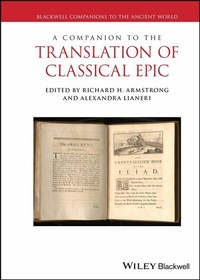
A Companion to the Translation of Classical Epic
Description

The first volume of its kind to integrate trends in Translation Studies with Classical Reception Studies
A Companion to the Translation of Classical Epic provides a comprehensive and wide-ranging account of key debates and case studies centered the translation of Greek and Latin epics. Rather than situating translation studies as a complementary field or an aspect of classical reception, the Companion offers a systematic framework for adapting and incorporating translation studies fully into classical studies. Its many chapters elaborate how translation is a central element in the epic's reception trajectories across the globe and addresses theoretical and methodological concerns arising from this conjunction.
The Companion does not just provide a comprehensive overview of the translation theories it covers, but also offers fresh insights into theoretical and methodological issues currently at the top of the interdisciplinary agenda of scholars studying the global routes of ancient epic. In its sections, leading classicists, translation theorists, classical reception scholars, and cultural historians from Europe and North and South America reconfigure questions this research faces today, highlighting methods for an integrated approach. It explores how this integrated perspective responds to key challenges in the study of the epic's reception, emphasizing topics of temporality, gender, agency, community, target-language politics, and material production. A special section also features detailed dialogues with active translators such as Emily Wilson, Stanley Lombardo, and Susanna Braund, who speak extensively and frankly about their work.
This is a key volume for all students and scholars who want to engage with research reflecting the contemporary agenda in classical reception, translation studies, and the study of epic in its global literary and cultural routes.
More details
Other editions
Additional editions
Persons
Richard H. Armstrong is Associate Professor of Classical Studies, Department of Modern and Classical Languages, University of Houston, USA. He is co-editor of Remusings: Essays on the Translation of Classical Poetry and author of A Compulsion for Antiquity: Freud and the Ancient World.
Alexandra Lianeri is Assistant Professor of Classics and Translation, Department of Classics, The Aristotle University of Thessaloniki, Greece. She is the editor of Knowing Future Time in and through Greek Historiography and The Western Time of Ancient History. Historiographical Encounters with the Greek and Roman Pasts.
Content
Notes on Contributors xi
Acknowledgements xvi
1 General Introduction 1 Richard H. Armstrong
Part I Disciplinary Openings 19
2 Introduction to Part I: Conceptual Openings In and Through Epic Translation Histories 21 Alexandra Lianeri
3 Defying the Odds: How Classical Epics Continue to Survive in the Modern World 26 Susan Bassnett
4 Between Translation and Reception: Reading and Writing Forward and Backward in Translations ofEpic 36 Lorna Hardwick
5 Entangling Historical Time In and Through the Epics' Translated Presence 52 Alexandra Lianeri
Part II Explorations in Reception 69
6 Introduction to Part II 71 Richard H. Armstrong
7 What Is Translation in the Ancient World? 77 Siobhán McElduff
8 Reading the Aeneid in the Italian Middle Ages: Vernacularizations and Abridgements 94 Veronica Ricotta and Giulio Vaccaro
9 The Ideological Significance of Choice of Meter in Translations of the Aeneid 109 Susanna Braund
10 The Fighting Words Business: Thoughts on Equivalence, Localization, and Epic in English Translation 129 Richard H. Armstrong
11 Women and the Translation of Classical Texts in the Italian Renaissance: Between Humanism and Divulgation, Academies, and the Printing Press 148 Francesca D'Alessandro Behr
12 Anne Dacier's Homer: Epic Force 164 Julie Candler Hayes
13 Marie Cosnay - Les Métamorphoses 179 Fiona Cox
14 Translating on the Edge: Irish- Language Translations of Greek and Roman Epic 188 Michael Cronin
15 "Intreat them Gently, Trayne them to that Ayre"; George Sandys's Savage Verses and Civilized Commentary at Jamestown 198 Benjamin Haller
16 The Translation of Greek and Latin Epic into the Other Languages of Spain 215 Ramiro González Delgado
17 From Scheria: An Emerging Tradition of Portuguese Translations of the Odyssey 231 Leonardo Antunes
18 An Epic Leap: Translating The Iliad to the Stage in the Twenty- First Century 243 Thomas E. Jenkins
19 Film Translations of Greek and Roman Epic 257 Benjamin E. Stevens
20 Epic Translation and Self- Scrutiny in Imperial Britain 281 Annmarie Drury
21 Lucretius in Modern Greek Costume: Language and Ideology in Konstantinos Theotokis' ¿e¿? Fyse¿¿ 295 George Kazantzidis
22 Epic, Translation, and World Literature 313 Alexander Beecroft
Part III Dialogues with Translators 323
23 Introduction to Part III: Dialogues with Translators: A Voice Too Many 325 Alexandra Lianeri
24 Stanley Lombardo, Interviewed by Richard H. Armstrong 330
25 Emily Wilson, Interviewed by Fiona Cox 343
26 Dialogue with Susanna Braund 357
27 Dialogue with Herbert Jordan 362
28 Dialogue with Theodore Papanghelis 365
Part IV Future Prospects 371
29 Global Sideways of Epic Translation and Critical Cosmopolitanism 373 Alexandra Lianeri
Index 389
