

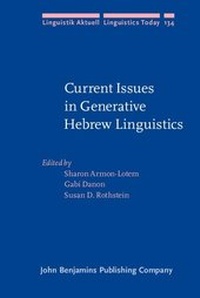
Current Issues in Generative Hebrew Linguistics
1st Edition
Published on 19. December 2008
VII, 393 pages
978-90-272-8965-0 (ISBN)
Description

This volume presents a collection of specially commissioned papers devoted to analyzing the linguistics of Modern Hebrew from a number of perspectives. Various aspects of Modern Hebrew grammar are discussed including the structure of the lexicon, grammatical features and inflectional morphology, as well as the grammaticalization of semantic and pragmatic distinctions. The psycholinguistic issues addressed include the acquisition of morphological knowledge, the pro-drop parameter and question formation, as well as language use in hearing-impaired native speakers. The collection of these papers together in a single volume allows these phenomena to be considered not in isolation but in the context of the grammatical system of which the language is an expression. As a consequence, more general issues connected to Modern Hebrew begin to emerge, such as the role of the inflectional morphological system in the grammar, and a rich set of facts and analyses relevant for many related issues are made available to the reader.
More details
Other editions
Additional editions
Sharon Armon-Lotem | Gabi Danon | Susan Rothstein
Current Issues in Generative Hebrew Linguistics
Book
12/2008
John Benjamins Publishing Co
€116.60
Shipment within 10-15 days
Persons
Content
- Current Issues in Generative Hebrew Linguistics
- Editorial page
- Title page
- LCC data
- Table of contents
- Acknowledgement
- Current issues in Generative Hebrew Linguistics
- 1 Overview
- 1.1 The structure of the lexicon and derivational morphology
- 1.2 Features, agreement and inflectional morphology
- 1.2.1 Tense, subject-verb agreement and the realization of subjects
- 1.2.2 Features and agreement in the pronominal system
- 1.2.3 Agreement in other domains and the distribution of features
- 1.3 The grammaticalization of semantic and pragmatic distinctions
- 1.4 Summary
- 2 The papers
- References
- Part 1. The structure of the lexicon
- Morphologically conditioned V-Ø alternation in Hebrew
- 1. Introduction
- 2. Paradigmatic relations
- 2.1 Noun idiosyncrasies: Evidence for a lexical base
- 2.1.1 Selection of inflectional suffixes
- 2.1.2 Stress
- 2.2 Adjectives, participles, and verbs
- 2.2.1 Verbs: Evidence for OO relation
- 2.2.2 Participles: Evidence for OO relation
- 3. V-Ø alternation
- 3.1 A historical perspective and learnability
- 3.2 Descriptive generalizations
- 3.3 An Optimality Theoretic analysis
- 3.3.1 The trigger of V-Ø alternation
- 3.3.2 Verbs
- 3.3.3 Participles and adjectives
- 3.3.4 Nouns
- 3.3.5 Category specific phonology
- 4. Concluding remarks
- References
- The special status of nif'al in Hebrew
- 1. Introduction
- 2. The structural uniqueness of nif'al
- 2.1 The syllabic structures of nif'al within the verb system
- 2.2 Tense distribution
- 2.3 Morphophonemic alternations
- 2.3.1 Resemblance to passive templates
- 2.3.2 Resemblance to non-passive templates
- 3. The semantic load of nif'al
- 3.1 Real passive and pseudo-passive
- 3.2 Hitpa'el and nif'al resemblance
- 4. In conclusion
- References
- Object gap constructions
- Externalization and operator movement*
- 1 Introduction
- 2 Hebrew object gap nominal: Externalization
- 2.1 The properties of the object gap nominal
- 2.2 Previous analyses
- 2.3 Formation of object gap nominals
- 2.4 Accounting for the properties of object gap nominals
- 3 English object gap constituent: Op-movement
- 3.1 to" is not T
- 3.2 No subject position
- 3.3 Predicate formation
- 3.4 The consequences
- 4 Object gap constituents in the TCs: Formation of the complex AP predicate
- 4.1 The complex tough predicate
- 4.2 Supporting evidence
- 5 Concluding remarks
- References
- Active lexicon
- Adjectival and verbal passives*
- 1 Introduction
- 2 Adjectival versus verbal passives
- 2.1 Diagnostics
- 2.2 The subject: Internal or external?
- 3 Two gaps in the passive system
- 3.1 Adjectival but no verbal passive
- 3.2 No verbal and no adjectival passive
- 4 The solution: lexicon vs. syntax
- 4.1 Two types of unaccusatives
- 4.1.1 Underived vs. decausative unaccusatives
- 4.1.2 Against other views
- 4.2 Verbal passives
- 5 Additional evidence: idioms and semantic drift
- 6 Adjectival passives and adjectival de-causatives
- 6.1 Adjectival passives and adjectival decausatives in Hebrew
- 6.2 Locus of derivation
- 6.3 Idioms and semantic drift as evidence for lexical status
- 7 Conclusion
- References
- Part 2. Grammatical features and inflectional morphology
- Definiteness agreement with PP modifiers
- 1 Introduction
- 2 The phenomenon
- 2.1 Definite-indefinite asymmetries
- 2.2 Non-uniqueness
- 2.3 Factors affecting acceptability of non-agreeing pps
- 2.3.1 Heaviness of the pp
- 2.3.2 Quantifiers and numerals
- 2.3.3 Argument pps versus modifier pps
- 3 Agreeing modifiers: Semantic generalizations
- 4 Agreement and the interpretation of [±def]
- 5 Definiteness spreading
- 5.1 pps and the construct state
- 5.2 DS and the interpretability of [±def]
- 6 Conclusion
- References
- Predication and equation in Hebrew (Nonpseudocleft) copular sentences
- 1 Introduction
- 2 Puzzling contrasts between pronH and pronZ sentences
- 2.1 Grammaticality contrasts
- 2.2 Agreement contrasts
- 2.3 Semantic contrasts
- 3 Previously suggested underlying differences between the pronominal copulas
- 3.1 A semantic difference: Heller's 1999, 2002 H-predicative/ Z-equative hypothesis
- 3.1.1 Heller's analysis of pronH and pronZ in pseudoclefts
- 3.1.2 Application of Heller's H-predicative/Z-equative hypothesis to nonpseudocleft copular constructions
- 3.2 Agreement patterns of the pronominal copulas, and the existence of a second pronZ - Sichel 1997
- 3.3 The [-human] constraint (A modified version of Berman 1978)
- 3.4 Summary
- 4 The puzzling contrasts revisited
- 4.1 The hypothesis: The postcopular adjective as modifying a null noun
- 4.2 Explaining agreement contrasts
- 4.3 Explaining semantic contrasts
- 4.3.1 Heller's 1999 suggestion and its shortcomings
- 4.3.2 Obligatory and optional "denotation widening"
- 4.4 Explaining distributional differences
- 4.5 PronH and pronZ with postcopular NPs: Why "denotation widening" of the subject is blocked with pronH sentences
- 5 Concluding remarks, general implications and directions for further research
- Acknowledgements
- References
- Morphological knowledge without morphological structure
- 1. Introduction
- 2. The prosody-morphology interface in Hebrew verb paradigms
- 3. The acquisition of Hebrew prosodic structure
- 4. The puzzle
- 5. Morphological development
- 5.1 Affixes as constraints
- 5.2 The emergence of morphological knowledge
- 6. Conclusion
- References
- The interaction between question formation and verbal morphology in the acquisition of Hebrew - A minimalist perspective
- 1. Introduction
- 2. The theoretical framework - On phases
- 2.1 The structure of Hebrew - Verbal system and question formation
- 3. The corpus
- 3.1 Order of acquisition of verbal morphology and subjects in Hebrew
- 3.2. Verbal morphology and the acquisition of questions in Hebrew
- 4. Discussion - Saliency and frequency
- 5. Discussion - A minimalist account
- 5.1. A minimalist account and the acquisition of questions
- 6. Conclusion
- References
- On child subjects in a partially pro-drop language
- 1 Introduction
- 2 Background
- 2.1 Non-pro-drop - RI correlation
- 2.2 RI - underspecified subject correlation
- 2.3 Previous approaches - syntactic accounts
- 2.4 Adult Hebrew
- 3 Method
- 3.1 Subjects
- 3.2 Materials
- 4 Results
- 5 Discussion
- 5.1 Underspecification of verbs
- 5.2 Underspecification of subjects
- 6 Conclusion
- References
- Resumptive pronouns as a last resort when movement is impaired
- Relative clauses in hearing impairment
- 1 Introduction
- 1.1.1 Participants
- 2 Comprehension of sentences that are derived by phrasal movement
- 2.1 Results
- 3 Production of relative clauses
- 3.1 Elicitation of relative clauses in a preference task
- 3.1.1 Results
- 3.2 Elicitation of relative clauses in a picture description task
- 3.2.1 Results
- 3.3 Doubling errors and ungrammatical resumptive pronouns
- 3.4 The use of resumptive pronouns in object relatives in the two elicitation tasks
- 3.5 Comprehension of object relatives with a resumptive pronoun
- References
- Part 3. Semantics, pragmatics and discourse
- Bare minimizers
- 1 The problem
- 2 Lexicalized minimizers as containing a covert even
- 2.1 Lexicalized minimizers under negation
- 2.2 Lexicalized minimizers in Yes/No questions
- 3 Do bare minimizers have a covert "even"?
- 4 Bare minimizers in other typical npi-licensing environments
- 5 Summary and discussion
- Appendix
- References
- Hebrew Negative Polarity Items - sum and af*
- 1 Overview of Negative Polarity Items
- 1.1 Free Choice any
- 2 Hebrew npIs - distributional properties
- 2.1 Introduction
- 2.2 Licensing by a clause mate negation in simple np V np sentences
- 2.3 Licensing of sum/af by non sentential negation
- 2.3.1 Constituent negation
- 2.3.2 Licensing by non negative downward entailing operators
- 2.3.3 Summary
- 3 um and af: are they synonymous?
- 3.1 A Kadmon and Landman based semantic theory of sum and af
- 3.1.1 Differences between the semantics of any and sum and af
- 4 A formal account of the semantics of sum and af
- 4.1 Non-kind readings of nouns
- 4.2 Kind readings of nouns
- 4.3 Summary
- 5 A derived prediction
- References
- A two-layered analysis of the Hebrew exceptive xuc mi
- 1 On the "minus" and "plus" interpretations of xuc mi
- 2 Von Fintel's analyses of except for and besides
- 3 The semantics and pragmatics of xuc mi
- 3.1 Non vacuous subtraction
- 3.2 Vacuous subtraction
- 3.3 Is the market open or closed on Wednesdays?
- 4 lema'et and milvad
- Acknowledgments
- References
- Codifying apparent inconsistencies in discourse
- The case of Hebrew ma
- 1. Introduction
- 2. Discourse markers
- 3. ma
- 3.1 ma as a DM
- 3.2 DM and WH ma
- 3.3 ma an analysis
- 4. Potential problems
- 5. Some answers
- 5.1 Non optionality
- 5.2 harey
- 5.3 but
- 5.4 English equivalents
- 5.5 ma tags
- 5.6 Non-ad-hocness (of constraints)
- 6. stam
- 7. Conclusion
- References
- Index
- The series Linguistik Aktuell/Linguistics Today
