

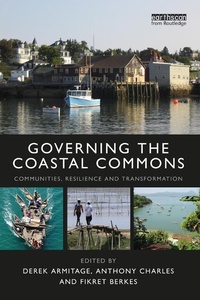
Governing the Coastal Commons
Communities, Resilience and Transformation
Published on 28. April 2017
286 pages
978-1-317-42127-6 (ISBN)
Description

Coastal communities depend on the marine environment for their livelihoods, but the common property nature of marine resources poses major challenges for the governance of such resources. Through detailed cases and consideration of broader global trends, this volume examines how coastal communities are adapting to environmental change, and the attributes of governance that foster deliberate transformations and help to build resilience of social and ecological systems.
Governance here reflects how communities, societies and organisations (e.g. fisher cooperatives, government agencies) choose to organise themselves to make decisions about important issues, such as the use and protection of coastal commons (e.g. fishery resources). The book shows how a governance approach generates insights into the specific forms and arrangements that enable coastal communities to steer away from unsustainable pathways. It also provides an analytical lens to consider important questions of power, knowledge and legitimacy in linked social-ecological systems. Chapters highlight examples in which communities are engaging in deliberative transformations to build resilience and enhance their well-being. These transformations and efforts to build resilience are emerging through multi-level collaboration, shared learning, innovative policies and institutional arrangements (such as new property rights regimes and co-management), methodologies that engage with indigenous cultural practices, and entrepreneurial activities, including income and livelihood diversification.
Case studies are included from a range of countries including Canada, Japan, Brazil, Indonesia, Mexico, South Africa, Thailand, the South Pacific and Europe. The authors integrate theory with practical examples to improve coastal marine policy and governance, and draw upon emerging concepts from social-ecological resilience and transformations, adaptive governance and the scholarship on the commons.
Governance here reflects how communities, societies and organisations (e.g. fisher cooperatives, government agencies) choose to organise themselves to make decisions about important issues, such as the use and protection of coastal commons (e.g. fishery resources). The book shows how a governance approach generates insights into the specific forms and arrangements that enable coastal communities to steer away from unsustainable pathways. It also provides an analytical lens to consider important questions of power, knowledge and legitimacy in linked social-ecological systems. Chapters highlight examples in which communities are engaging in deliberative transformations to build resilience and enhance their well-being. These transformations and efforts to build resilience are emerging through multi-level collaboration, shared learning, innovative policies and institutional arrangements (such as new property rights regimes and co-management), methodologies that engage with indigenous cultural practices, and entrepreneurial activities, including income and livelihood diversification.
Case studies are included from a range of countries including Canada, Japan, Brazil, Indonesia, Mexico, South Africa, Thailand, the South Pacific and Europe. The authors integrate theory with practical examples to improve coastal marine policy and governance, and draw upon emerging concepts from social-ecological resilience and transformations, adaptive governance and the scholarship on the commons.
More details
Series
Language
English
Place of publication
London
United Kingdom
Publishing group
Taylor & Francis Ltd
Target group
College/higher education
Product notice
Reflowable
Illustrations
51 s/w Abbildungen, 15 s/w Tabellen, 14 s/w Photographien bzw. Rasterbilder, 22 s/w Zeichnungen
15 Tables, black and white; 22 Line drawings, black and white; 14 Halftones, black and white; 51 Illustrations, black and white
File size
5,79 MB
ISBN-13
978-1-317-42127-6 (9781317421276)
Copyright in bibliographic data and cover images is held by Nielsen Book Services Limited or by the publishers or by their respective licensors: all rights reserved.
Schweitzer Classification
Other editions
Additional editions
Derek Armitage | Anthony Charles | Fikret Berkes
Governing the Coastal Commons
Communities, Resilience and Transformation
Book
05/2017
1st Edition
Routledge
€83.80
Shipment within 10-20 days
Derek Armitage | Anthony Charles | Fikret Berkes
Governing the Coastal Commons
Communities, Resilience and Transformation
Book
05/2017
1st Edition
Routledge
€206.70
Shipment within 10-20 days
Persons
Derek Armitage is Professor in the School of Environment, Resources and Sustainability, University of Waterloo, Canada, where he leads the Environmental Change and Governance Group.
Anthony Charles is Professor in the School of the Environment and the School of Business, Saint Mary's University, Halifax, Canada, and is Director of the Community Conservation Research Network.
Fikret Berkes is Distinguished Professor Emeritus and former Tier 1 Canada Research Chair in Community-based Research Management at the Natural Resources Institute, University of Manitoba, Winnipeg, Canada.
Anthony Charles is Professor in the School of the Environment and the School of Business, Saint Mary's University, Halifax, Canada, and is Director of the Community Conservation Research Network.
Fikret Berkes is Distinguished Professor Emeritus and former Tier 1 Canada Research Chair in Community-based Research Management at the Natural Resources Institute, University of Manitoba, Winnipeg, Canada.
Content
1. Toward Transformative Change in the Coastal Commons Derek Armitage, Anthony Charles and Fikret Berkes 2. Turning the Tide: Strategies, Innovation and Transformative Learning at the Olifants Estuary, South Africa Merle Sowman 3. Emergence of Community Science as a Transformative Process in Port Mouton Bay, Canada Laura Loucks, Fikret Berkes, Derek Armitage and Anthony Charles 4. Rights-based Coastal Ecosystem Use and Management: From Open Access to Community Managed Access Rights A. Minerva Arce-Ibarra, Juan Carlos Seijo, Maren Headley, Karla Infante-Ramirez, and Raul Villanueva-Poot 5. Transformations of the Reef, Transformations of the Mind: Marine Aquarium Trade in Bali, Indonesia Jack Frey and Fikret Berkes 6. The Path to Sustainable Fisheries in Japan and the Transformative Impact of the Shiretoko World Natural Heritage Site Eirini Ioanna Vlachopoulou and Mitsutaku Makino 7. Community Participation and Adaptation to Change in Biosphere Reserves: A Review and a Mediterranean European Coastal Wetland Case Study (Rhone Delta Biosphere Reserve, Southern France) Meriem Bouamrane, Raphael Mathevet, Harold Levrel, Heather Huntington and Arun Agrawal 8. Navigating the Transformation to Community-Based Resource Management Jessica Blythe, Philippa Cohen, Kirsten Abernethy and Louisa Evans 9. Navigating from Government-centralized Management to Adaptive Co-management in a Marine Protected Area, Paraty, Brazil: Turbulence, Winds of Opportunity, and Progress Towards Transformation Cristiana Simao Seixas, Ana Carolina Esteves Dias and Rodrigo Rodrigues de Freitas 10. Koh Pitak: A Community-Based, Environment and Tourism Initiative in Thailand Philip Dearden, Dachanee Emphandhu, Supawinee Songpornwanich and Amnat Ruksapol 11. Sasi Laut In Maluku: Transformation and Sustainability of Traditional Governance in the Face of Globalization Ahmad Mony, Arif Satria and Rilus A. Kinseng 12. The Messy Intertidal Zone: Transformation of Governance Thinking for Coastal Nova Scotia Jennifer Graham and Anthony Charles 13. Communities, Multi-level Networks and Governance Transformations in the Coastal Commons Derek Armitage, Steve Alexander, Mark Andrachuk, Samantha Berdej, Shandel Brown, Prateep Nayak, Jeremy Pittman and Kaitlyn Rathwell 14. Synthesis: Governing Coastal Transformations Derek Armitage, Fikret Berkes and Anthony Charles
