

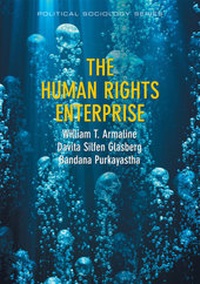
The Human Rights Enterprise
Description

This book presents a framework for understanding human rights asa terrain of struggle over power between states, private interests,and organized, "bottom-up" social movements. Theauthors develop a critical sociology of human rights focusing onthe concept of the human rights enterprise:the process through which rights are defined and realized. Whilestates are designated arbiters of human rights according to humanrights instruments, they do not exist in a vacuum. Politicalsociology helps us to understand how global neoliberalism andpowerful non-governmental actors (particularly economic actors suchas corporations and financial institutions) deeply affectstates' ability and likelihood to enforce human rightsstandards.
This book offers keen insights for understanding rights claims,and the institutionalization of, access to, and restrictions onhuman rights. It will be invaluable to human rights advocates, andundergraduate and graduate students across the social sciences.
More details
Other editions
Additional editions
Persons
Davita Silfen Glasberg is Professor of Sociology at theUniversity of Connecticut.
Bandana Purkayastha is Professor of Sociology and Asian AmericanStudies at the University of Connecticut. She is the AmericanSociological Association's representative to theInternational Sociological Association (2014-2018).
Content
1. The Human Rights Enterprise and a Critical Sociology of HumanRights
2. Power and the State: Global Economic Restructuring and theGlobal Recession
3. The Human Rights Enterprise: A Genealogy of ContinuingStruggles
4. Private Tyrannies: Rethinking the Rights of "CorporateCitizens"
5. Current Contexts and Implications for Human Rights Praxis
References
1
The Human Rights Enterprise and a Critical Sociology of Human Rights
Introduction
As teachers, we share the experience of students asking about the "point" of human rights in the United States, since no one seems to know or talk about them, and since they carry little weight in US courts. While we disagree with the notion that formal international human rights are irrelevant, we owe our students and readers the courtesy of honest reflection. The United States is far from internalizing and employing international human rights practice, and has a contradictory relationship to human rights as a body of international law.
This book goes into production as a leaked Senate Intelligence Committee report now details the extent and highly illegal nature of the CIA's use of "harsh interrogation techniques" - torture - at Guantánamo Bay and other secret "black sites" across the world, following the September 11, 2001, attacks in New York City. The Guantánamo Bay detention facility is in itself a direct challenge to the civil and political human rights to due process1 and protection from arbitrary arrest and detention.2 Of the 154 people still imprisoned at Guantánamo Bay from 22 different countries, 76 of them have long since been cleared for release by the US government, and 45 of them are being held even though the US government admitted that it lacked the necessary evidence to bring formal charges of any kind. In total, the US has imprisoned 779 people there - at least 21 have been children, the youngest of whom was only 13 years old (ACLU 2014). Techniques of torture used on suspects and detainees at Guantánamo and other detention/rendition sites "included waterboarding, which produces a sensation of drowning, stress positions, sleep deprivation for up to 11 days at a time, confinement in a cramped box, slaps and slamming detainees into walls" (Watkins, Landay, and Taylor 2014). The international community has repeatedly condemned CIA torture programs as a violation of international law (UDHR, Article 5; ICCPR, Article 7), but up until this point the US Justice department, CIA, and Department of Defense have argued vehemently that the interrogation techniques were legal, and did not amount to torture ("cruel and unusual punishment") as defined by the 8th Amendment of the US Constitution. Previous arguments by the Justice Department's Office of Legal Counsel stated that methods like waterboarding were not torture because those carrying out the interrogations "didn't have the specific intent of inflicting severe pain or suffering" (Watkins, Landay, and Taylor 2014).
However, the newly leaked report punches holes in these already questionable legal claims. It includes evidence that "The CIA used interrogation methods that weren't approved by the Justice Department of CIA headquarters. The agency impeded effective White House oversight and decision-making regarding the program. The CIA actively evaded or impeded congressional oversight of the program. The agency hindered oversight of the program by its own inspector general's office" (Watkins, Landay, and Taylor 2014). In addition, the report calls into question the thesis of former Bush administration officials and award-winning film Zero Dark Thirty - what comedian Bill Maher rightfully called a "despicable product placement for torture" - that techniques like waterboarding were somehow effective in the pursuit and prosecution of Bin Laden and other al-Qaeda leaders. Indeed, the defenders of US torture programs in pursuit of the disastrous "war on terror" in the Middle East and North Africa cannot argue their efficacy, even on the now tired basis of "national security" and "keeping people safe." These programs, and the efforts of Bush and Obama administration officials to passionately defend their legality and legitimacy, at the same time refusing to even consider criminal indictments of program architects, embody the completely contradictory and hypocritical stance of the US government with regard to the "rule of law," international law in particular. They also demonstrate a central flaw in how we go about "doing" human rights in the world - where state governments are assumed to reasonably represent the interests of their people (rather than, say, the interests of capital or the elite), and states are structurally positioned as the guarantors of human rights practice in the world.
Further, the international legal system designed to facilitate universal human rights through the actions of member states currently struggles to keep pace with threats to collective human survival, let alone rights practice (Chomsky 2007a; Schellnhuber 2012; Parenti 2011; IPCC 2013). Beyond such blunt responses, it's difficult to engage the common questions of our students in our professional roles since sociologists in the US have yet to engage fully with academic or applied work explicitly dedicated to human rights.
With all that in view, we have two goals for this book. We first aim to identify the potential contribution of (political) sociology to the studying and realizing of human rights, and to define a "critical sociology of human rights" as a maturing, relatively new3 concentration. Second, we'll demonstrate the utility of political sociology to interpret, critique, and re-envision contemporary human rights praxis. Human rights praxis refers to the process through which theory, scholarship, and/or cultural practice inform social action to realize human rights, and, in turn, how the empirical history of human rights struggles can and should inform scholarship. We hope our work provides a provocative and convincing argument on how to inform and participate in human rights struggles, while demonstrating in some detail how sociologists make significant contributions to contemporary human rights scholarship.
Political sociology is a strong and vibrant specialty in the broader discipline of sociology and social science. Political sociology evolved through investigations of power, particularly in describing the relationship between the state,4 the economy, and society. This specific body of political sociological literature is referred to as critical state theory, the subject of chapter 2. Simply speaking, political sociologists are concerned with understanding how power works in, through, and between human societies. Specifically, political sociologists tend to examine various forms of domination and resistance, measures of inequality, and the ways that ruling relationships between people and between societies are affected by social movements, as is demonstrated by social movement theory, the subject of chapter 3. Political sociologists have a great deal to offer human rights scholarship in that: (1) as sociologists Freeman (2009, 2011) and Woodiwiss (2005) suggest, laws and (human) rights are ultimately expressions and embodiments of state institutionalized power, which is a central concept for political sociologists; (2) international human rights law is a product of treaties and agreements between states, and conceptualizing the state is a primary goal of political sociologists; and (3) efforts to define and realize5 human rights have often taken the form of social movements. Indeed, the history of human rights can and should be seen as a history of social struggle over very real matters of power, resources, and political voice.6 These realizations should have significant implications for how one goes about doing intellectual and applied human rights work, and should place certain demands on previously dominant approaches.
Dominant approaches
Traditionally dominant human rights scholarship from the fields of law and political science has tended to focus primarily on: (1) formal legal approaches to defining and realizing human rights in our world (international law and international relations); (2) the various legal and philosophical traditions that provide the foundation for what we now understand as international human rights and humanitarian law (political theories); and (3) the relationships between state policy and politics at the national and international levels (international relations and comparative politics).7 In other words, the story of human rights is often focused on the story of the United Nations (UN), and the origins and evolution of human rights as a legal concept and body of international law.
From a legal standpoint, human rights are defined and articulated by human rights instruments, formal agreements between participating UN member states that sign (agree in principal with) and ratify (enter legally binding agreement with) the instrument. The most basic, original, legally fundamental set of human rights can be found in the cluster of instruments called the International Bill of Human Rights (IBHR), consisting of the original Universal Declaration of Human Rights (UDHR) and its binding Covenants, the International Covenant on Civil and...
