

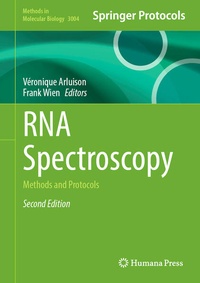
RNA Spectroscopy
Description

This updated edition explores different spectroscopic and biophysical methods used to study the structure and folding of RNA and to follow their interactions with proteins. The book expands into protocols for dynamic and single-molecule analyses, addressing the new challenges that have emerged since the discovery of novel RNAs and their interaction networks. Written in the highly successful Methods in Molecular Biology series format, chapters include introductions to their respective topics, lists of the necessary materials and reagents, step-by-step and readily reproducible laboratory protocols, and tips for troubleshooting and avoiding known pitfalls.
Cutting-edge and comprehensive, RNA Spectroscopy: Methods and Protocols, Second Edition is a valuable resource for researchers interested in learning more about this vital and growing field of study.
Chapter 14 is available open access under a Creative Commons Attribution 4.0 International License via link.springer.com.
More details
Other editions
Additional editions
Content
Tip-Enhanced Raman Spectroscopy of RNAs.- FAMP: A Software Framework for FRET-Based Integrative Modeling of RNA.- Application of Synchrotron Radiation Circular Dichroism for Structural Analysis of RNAs.- The Nucleic Acids Circular Dichroism and Fourier Transform Databases NACDDB and NAIRDB: New Tools for RNA Structural Analysis.- Analyzing Structural Heterogeneity in RNA Using Fluorescence-Detected Circular Dichroism Spectroscopy.- Analysis of Protein-RNA Interactions by Protein-Induced Fluorescence Enhancement (PIFE).- Couette Flow Linear Dichroism Spectroscopy.- Application of Ultraviolet (UV) and Circular Dichroism (CD) Spectroscopies to Study RNA-RNA Interactions of Regulatory RNAs of Bacteriophage Origin.- Combining UV-Vis Absorption and FRET Melting Curves to Screen the Thermodynamic Stability and Folding Pathways of Nucleic Acids In Vitro.- Application of Synchrotron Radiation Circular Dichroism for mRNA Structural Analysis.- A New Approach to Define Spectral References for Nucleic Acids Structural Groups.- Interpretation of Short RNA Thermal Unfolding Data Obtained by Circular Dichroism Using ChiraKit.- Analysis of Single Stranded Nucleic Acids in Nanochannels.- Crowding Effects in RNA Interactions.- Application of Fourier Transform InfraRed Spectroscopy for Structural Analysis of RNAs.- Exploring the Application of Nano-Differential Scanning Calorimetry in RNA Characterization.- Deep Learning in Modeling Tools for Structural Insights into Protein-RNA Complexes, Bridging Computational and Spectroscopic Approaches.- Inelastic Neutron Scattering: Prospects for Measuring Atomic Vibrations of Nucleic Acids.- Fluorescent Probes for the Quantification of RNA by Real-Time qPCR.
