

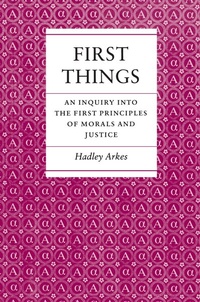
First Things
An Inquiry into the First Principles of Morals and Justice
1st Edition
Published on 7. September 2020
447 pages
978-0-691-21389-7 (ISBN)
Description

This book restores to us an understanding that was once settled in the "moral sciences": that there are propositions, in morals and law, which are not only true but which cannot be otherwise. It was understood in the past that, in morals or in mathematics, our knowledge begins with certain axioms that must hold true of necessity; that the principles drawn from these axioms hold true universally, unaffected by variations in local "cultures"; and that the presence of these axioms makes it possible to have, in the domain of morals, some right answers. Hadley Arkes restates the grounds of that older understanding and unfolds its implications for the most vexing political problems of our day.
The author turns first to the classic debate between Abraham Lincoln and Stephen Douglas. After establishing the groundwork and properties of moral propositions, he traces their application in such issues as selective conscientious objection, justifications for war, the war in Vietnam, a nation's obligation to intervene abroad, the notion of supererogatory acts, the claims of "privacy," and the problem of abortion.
The author turns first to the classic debate between Abraham Lincoln and Stephen Douglas. After establishing the groundwork and properties of moral propositions, he traces their application in such issues as selective conscientious objection, justifications for war, the war in Vietnam, a nation's obligation to intervene abroad, the notion of supererogatory acts, the claims of "privacy," and the problem of abortion.
More details
Other editions
Additional editions
Book
08/1986
Princeton University Press
€71.80
Article exhausted; check different version
Book
08/1986
Princeton University Press
€56.70
Article not available at the moment
Person
Hadley Arkes
Content
- Cover Page
- Half-title Page
- Title Page
- Copyright Page
- Dedication Page
- Contents
- Preface
- I. Introduction
- Part One: The Groundwork of Moral Judgment
- II. On the Capacity for Morals and the Origins of Law
- III. The "One and Only Legitimate Constitution": Government by Law and Government by Consent
- IV. On Necessary Truths and the Existence of Morals
- V. Moral Principles, Valid and Spurious
- VI. On "Vulgar Systems of Morality": The Myth of "Facts" and "Values
- VII. The Fallacies of Cultural Relativism
- or, Abbott and Costello Meet the Anthropologist
- VIII. First Principles: A Provisional Summary
- Part Two: Cases and Applications
- IX. On the Grounds for Exemption from the Law: Is Conscientious Objection Moral?
- X. Can There Be an Obligation to Risk One's Life for One's Country? The Attractions and Dangers of Hobbes's Teaching
- XI. On the Justifications of War and the Two Vietnams
- XII. The Morality of Intervention
- XIII. The Obligation to Rescue and Supererogatory Acts
- XIV. The Moral Case for Welfare, the Troubled Case for Redistribution
- XV. Privacy and the Reach of the Law
- XVI. The Question of Abortion and the Discipline of Moral Reasoning
- XVII. Abortion and the Framing of the Laws
- XVIII. Conclusion
- Index
