

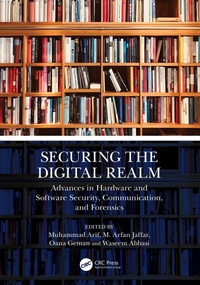
Securing the Digital Realm
Advances in Hardware and Software Security, Communication, and Forensics
1st Edition
Published on 17. March 2025
294 pages
978-1-040-18398-4 (ISBN)
Description

This book, Securing the Digital Realm: Advances in Hardware and Software Security, Communication, and Forensics, is a comprehensive guide that explores the intricate world of digital security and forensics. As our lives become increasingly digital, understanding how to protect our digital assets, communication systems, and investigate cybercrimes is more crucial than ever. This book begins by laying a strong foundation in the fundamental concepts of hardware and software security. It explains the design of modern computer systems and networks to defend against a myriad of threats, from malware to data breaches, in clear and accessible language.
One of the standout features of this book is its coverage of cutting-edge technologies like blockchain, artificial intelligence, and machine learning. It demonstrates how these innovations are used to enhance digital security and combat evolving threats.
Key features of the book include:
Comprehensive coverage of digital security, communication, and forensics
Exploration of cutting-edge technologies and trends
Emphasis on digital forensics techniques and tools
Coverage of ethical and legal aspects of digital security
Practical guidance for applying cybersecurity principles
Additionally, the book highlights the importance of secure communication in the digital age, discussing encryption, secure messaging protocols, and privacy-enhancing technologies. It empowers readers to make informed decisions about protecting their online communications. Written by experts in the field, this book addresses the ethical and legal dimensions of digital security and forensics, providing readers with a comprehensive understanding of these complex topics. This book is essential reading for anyone interested in understanding and navigating the complexities of digital security and forensics.
One of the standout features of this book is its coverage of cutting-edge technologies like blockchain, artificial intelligence, and machine learning. It demonstrates how these innovations are used to enhance digital security and combat evolving threats.
Key features of the book include:
Comprehensive coverage of digital security, communication, and forensics
Exploration of cutting-edge technologies and trends
Emphasis on digital forensics techniques and tools
Coverage of ethical and legal aspects of digital security
Practical guidance for applying cybersecurity principles
Additionally, the book highlights the importance of secure communication in the digital age, discussing encryption, secure messaging protocols, and privacy-enhancing technologies. It empowers readers to make informed decisions about protecting their online communications. Written by experts in the field, this book addresses the ethical and legal dimensions of digital security and forensics, providing readers with a comprehensive understanding of these complex topics. This book is essential reading for anyone interested in understanding and navigating the complexities of digital security and forensics.
More details
Edition
1. Auflage
Language
English
Place of publication
London
United Kingdom
Publishing group
Taylor & Francis Ltd
Target group
Professional and scholarly
Illustrations
54 Tables, black and white; 116 Line drawings, black and white; 11 Halftones, black and white; 127 Illustrations, black and white
File size
22,06 MB
ISBN-13
978-1-040-18398-4 (9781040183984)
Copyright in bibliographic data and cover images is held by Nielsen Book Services Limited or by the publishers or by their respective licensors: all rights reserved.
Schweitzer Classification
Other editions
Additional editions
Muhammad Arif | M. Arfan Jaffar | Oana Geman
Securing the Digital Realm
Advances in Hardware and Software Security, Communication, and Forensics
Book
approx. 07/2026
1st Edition
CRC Press
€64.50
Not yet published
Muhammad Arif | M. Arfan Jaffar | Oana Geman
Securing the Digital Realm
Advances in Hardware and Software Security, Communication, and Forensics
Book
03/2025
1st Edition
CRC Press
€170.60
Shipment within 10-20 days
Persons
Dr. Muhammad Arif is an associate Professor at Superior University Lahore, Pakistan. His research interests include Artificial intelligence, big data, cloud computing, and cyberspace security, data mining, image processing, medical image processing, Privacy, Security, and E-learning. Currently, he is working privacy and security of vehicular networks. Previously he was a lecturer at the University of Gujrat, Gujrat, Pakistan. He completed masters and bachelor degrees in Pakistan. He received his BS degree in Computer Science from the University of Sargodha, Pakistan in 2011. He obtained his MS degree in Computer Science from COMSATS Islamabad 2013 Pakistan. He completed his PhD degree from Guangzhou University, China. He is the author of more than 220 SCIE journal publications, and more than 30 conference publications and a number of Best Paper Awards in the international conferences, including iSCI 2019. He has 4 SCI highly cited papers. He has more than 4500 citations, according to Google Scholar. His H-Index is 39 and the i10-Index is 85. He is the Editorial board member of International Journal of Advanced Intelligence Paradigms (IJAIP) and to International Journal of Computational Systems Engineering (IJCSysE). He has participated in many international conferences as Program committee member, Session Chair, Technical Program Committee, or International Program Committees. He is the program chair of The 2020 International Workshop on Smart Technologies for Intelligent Transportation and Communications (SmartITC 2020 and 2021).
Prof. Dr. M. Arfan Jaffar received the M.Sc. degree in computer science from Quaid-i-Azam University, Islamabad, Pakistan, in March 2003, and the M.S. and Ph.D. degrees in computer science from the FAST National University of Computer and Emerging Sciences, in 2006 and 2009, respectively. He was an Assistant Professor with Al-Imam Mohammad Ibn Saud Islamic University, Riyadh, Saudi Arabia, from March 2013 to August 2018. He is currently the Dean with the Faculty of Computer Science and Information Technology, Superior University, Lahore, Pakistan, where he is also the Director of intelligent data visual computing research (IDVCR). He received a Postdoctoral Research Fellowship from South Korea and carried out research at the top raking Korean university, such as the Gwangju Institute of Science and Technology, Gwangju, South Korea, from 2010 to 2013. His research interests include image processing, data science, machine learning, computer vision, artificial intelligence, and medical images. He is a Reviewer of 30 reputed international journals, such as IEEE Transactions on Pattern Analysis and Machine Intelligence, IEEE Transactions on Image Processing, IEEE Transactions on Industrial Electronics, Pattern Recognition, Knowledge, and Information Sciences. Dr. Arfan is serving the educational sector of Pakistan for the past 20 years. With over 130 Publications & 1 Book to his credit, he is undoubtedly the most experienced scholar of CS and IT in Pakistan.
Oana Geman (Senior Member, IEEE) received the Ph.D. degree in electronics and telecommunication, in 2005. She is currently an Associate Professor with the Human and Health Development Department, Stefan cel Mare University of Suceava, Romania. Her current research interests include the non-invasive measurements of biomedical signals, wireless sensors, signal processing, artificial intelligence, nonlinear dynamics, stochastic networks, neuro-fuzzy methods, bioinformatics, biostatistics, biomedicine, the detection of neurological disorders, and rehabilitation. She has served as a member for the Technical Committees and the chair for several international conferences. She is a Reviewer of many journals, including IEEE Transactions, IEEE Access, IEEE Internet of Things Journal, Sensors, and Symmetry.
Dr. Waseem Abbasi is an accomplished academic and researcher currently serving as an Associate Professor and Head of Department Computer Science at The University of Lahore, Sargodha Campus, Pakistan. With a profound dedication to the field of robotics and autonomous systems, Dr. Abbasi has established a prominent presence in academia and research. Dr. Abbasi is recognized as an esteemed academic professional enlisted in the Higher Education Commission of Pakistan (HEC) approved supervisors, contributing significantly to the development and growth of future talents in the realm of computer science and technology. In 2020, Dr. Abbasi completed a prestigious Postdoctoral Fellowship at the National Cheng Kung University, Taiwan. During this time, their research primarily focused on the intricate domain of Robotics and Autonomous Systems, garnering valuable insights and expertise in the field. In 2018, Dr. Abbasi achieved a milestone in their academic journey by obtaining a doctorate degree in Electrical Engineering, specializing in Robotics and Autonomous Systems, from the Capital University of Science and Technology, Pakistan. His academic excellence was further acknowledged through the receipt of the Indigenous PhD Scholarship from the Higher Education Commission of Pakistan, demonstrating their commitment to advancing knowledge and technology. Dr. Abbasi has authored and published more than 25 scientific papers in prestigious refereed and classified scientific journals and conferences, contributing significantly to the body of knowledge in their areas of expertise. Currently, Dr. Abbasi research is at the forefront of Robotics and Autonomous Systems, with a specific focus on Nonholonomic Systems, Nonlinear Control, Sliding Mode Control and Machine Learning algorithms for Autonomous Systems.
Prof. Dr. M. Arfan Jaffar received the M.Sc. degree in computer science from Quaid-i-Azam University, Islamabad, Pakistan, in March 2003, and the M.S. and Ph.D. degrees in computer science from the FAST National University of Computer and Emerging Sciences, in 2006 and 2009, respectively. He was an Assistant Professor with Al-Imam Mohammad Ibn Saud Islamic University, Riyadh, Saudi Arabia, from March 2013 to August 2018. He is currently the Dean with the Faculty of Computer Science and Information Technology, Superior University, Lahore, Pakistan, where he is also the Director of intelligent data visual computing research (IDVCR). He received a Postdoctoral Research Fellowship from South Korea and carried out research at the top raking Korean university, such as the Gwangju Institute of Science and Technology, Gwangju, South Korea, from 2010 to 2013. His research interests include image processing, data science, machine learning, computer vision, artificial intelligence, and medical images. He is a Reviewer of 30 reputed international journals, such as IEEE Transactions on Pattern Analysis and Machine Intelligence, IEEE Transactions on Image Processing, IEEE Transactions on Industrial Electronics, Pattern Recognition, Knowledge, and Information Sciences. Dr. Arfan is serving the educational sector of Pakistan for the past 20 years. With over 130 Publications & 1 Book to his credit, he is undoubtedly the most experienced scholar of CS and IT in Pakistan.
Oana Geman (Senior Member, IEEE) received the Ph.D. degree in electronics and telecommunication, in 2005. She is currently an Associate Professor with the Human and Health Development Department, Stefan cel Mare University of Suceava, Romania. Her current research interests include the non-invasive measurements of biomedical signals, wireless sensors, signal processing, artificial intelligence, nonlinear dynamics, stochastic networks, neuro-fuzzy methods, bioinformatics, biostatistics, biomedicine, the detection of neurological disorders, and rehabilitation. She has served as a member for the Technical Committees and the chair for several international conferences. She is a Reviewer of many journals, including IEEE Transactions, IEEE Access, IEEE Internet of Things Journal, Sensors, and Symmetry.
Dr. Waseem Abbasi is an accomplished academic and researcher currently serving as an Associate Professor and Head of Department Computer Science at The University of Lahore, Sargodha Campus, Pakistan. With a profound dedication to the field of robotics and autonomous systems, Dr. Abbasi has established a prominent presence in academia and research. Dr. Abbasi is recognized as an esteemed academic professional enlisted in the Higher Education Commission of Pakistan (HEC) approved supervisors, contributing significantly to the development and growth of future talents in the realm of computer science and technology. In 2020, Dr. Abbasi completed a prestigious Postdoctoral Fellowship at the National Cheng Kung University, Taiwan. During this time, their research primarily focused on the intricate domain of Robotics and Autonomous Systems, garnering valuable insights and expertise in the field. In 2018, Dr. Abbasi achieved a milestone in their academic journey by obtaining a doctorate degree in Electrical Engineering, specializing in Robotics and Autonomous Systems, from the Capital University of Science and Technology, Pakistan. His academic excellence was further acknowledged through the receipt of the Indigenous PhD Scholarship from the Higher Education Commission of Pakistan, demonstrating their commitment to advancing knowledge and technology. Dr. Abbasi has authored and published more than 25 scientific papers in prestigious refereed and classified scientific journals and conferences, contributing significantly to the body of knowledge in their areas of expertise. Currently, Dr. Abbasi research is at the forefront of Robotics and Autonomous Systems, with a specific focus on Nonholonomic Systems, Nonlinear Control, Sliding Mode Control and Machine Learning algorithms for Autonomous Systems.
Content
About the Editors. List of Contributors. 1.Performance analysis of PSK based advanced modulation formats for free space optical communication system. 2.Volatile Kernel Rootkit Hidden Process Detection View (VKRHPDV) Approach for Detection of Malware in Cloud Computing Environments. 3.Privacy preserved Federated Learning with Optimized Differential Privacy (FL-ODP). 4.Cyber Physical Systems having Nodes/Layers with Trustworthy Data: A Review. 5.Analysis of Device-To-Device Communication in IOT System. 6.Design and Implementation of an On-board System for a Spider Robot. 7.Revolutionizing Underwater Sensor Networks: A Novel Routing Approach for Efficient Data Collection with Atom-inspired Design. 8.Extending WSN Lifetime with Cluster Head Election. 9.A Parametric Analysis of Routing Protocols in Wireless Sensor Networks. 10.Implementation of IoT and WSN Technologies for Health Monitoring. 11.A Survey on Approximate Hardware Accelerator for Error-Tolerant Applications. 12.Virtual Memory Management Techniques. 13.A Comprehensive Survey on Software Defined Networking (SDN) Security. 14.Access Control Techniques for Cloud Computing: Review and Recommendations. 15.A Jurisprudence for Pakistan's Digital Forensic Investigation Framework Regarding Cybersecurity. 16.LockPath: Logic Locking Technique based on Longest Path Constraint for Hardware Security. 17.A Review of the Various Methods of Communication Used in Ad Hoc Networks. 18.Authentication of User Data for enhancing privacy in Cloud Computing Using Security Algorithms. 19.Big Data Issues in Mobile Cloud Computing. 20.A Comprehensive Review on the Role of Blockchain in Reinforcing Security for Industrial IoT. 21.Design & Implementation Role of Middleware in Shared Network Environments: A Systematic Review. 22.Challenges & Frameworks in Cloud Security Governance: A Review. 23.LTE/Wi-Fi Coexistence in Unlicensed Band. 24.Evolution of Next-Generation Firewall System for Secure Networks. 25.Security and Performance Comparison of Window and Linux - A Systematic Literature Review.
