

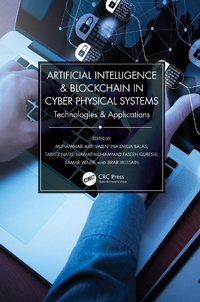
Artificial Intelligence & Blockchain in Cyber Physical Systems
Technologies & Applications
1st Edition
Published on 1. December 2023
258 pages
978-1-000-98197-1 (ISBN)
Description

This book explores the intersection of blockchain technology, artificial intelligence (AI) and cyber physical systems (CPS). It discusses how these technologies can be integrated to create secure and efficient CPS solutions.
The book covers various topics, including the basics of blockchain and AI, their applications in CPS and the challenges of integrating these technologies. It also explores real-world examples of how blockchain and AI are used in CPS, such as smart cities, transportation systems and healthcare.
The authors delve into the technical aspects of how blockchain and AI can be used together to enhance CPS security, data privacy and interoperability. They also discuss the potential benefits and limitations of these technologies and provide insights into the future of CPS.
Overall, this book provides a comprehensive overview of the use of blockchain and AI in CPS, making it a valuable resource for researchers, professionals and students in the fields of computer science, engineering and cybersecurity.
The book covers various topics, including the basics of blockchain and AI, their applications in CPS and the challenges of integrating these technologies. It also explores real-world examples of how blockchain and AI are used in CPS, such as smart cities, transportation systems and healthcare.
The authors delve into the technical aspects of how blockchain and AI can be used together to enhance CPS security, data privacy and interoperability. They also discuss the potential benefits and limitations of these technologies and provide insights into the future of CPS.
Overall, this book provides a comprehensive overview of the use of blockchain and AI in CPS, making it a valuable resource for researchers, professionals and students in the fields of computer science, engineering and cybersecurity.
More details
Edition
1. Auflage
Language
English
Place of publication
London
United Kingdom
Publishing group
Taylor & Francis Ltd
Target group
College/higher education
Professional and scholarly
Product notice
Reflowable
Illustrations
16 Tables, black and white; 141 Line drawings, black and white; 29 Halftones, black and white; 170 Illustrations, black and white
ISBN-13
978-1-000-98197-1 (9781000981971)
Copyright in bibliographic data and cover images is held by Nielsen Book Services Limited or by the publishers or by their respective licensors: all rights reserved.
Schweitzer Classification
Other editions
Additional editions
Muhammad Arif | Valentina Emilia Balas | Tabrez Nafis
Artificial Intelligence & Blockchain in Cyber Physical Systems
Technologies & Applications
Book
05/2025
1st Edition
CRC Press
€76.60
Shipment within 10-20 days
Muhammad Arif | Valentina Emilia Balas | Tabrez Nafis
Artificial Intelligence & Blockchain in Cyber Physical Systems
Technologies & Applications
Book
12/2023
1st Edition
CRC Press
€177.20
Shipment within 10-20 days
Persons
Muhammad Arif, PhD, is an Associate Professor at Superior University, Lahore, Pakistan. His research interests include artificial intelligence, big data, cloud computing and cyberspace security, data mining, image processing, medical image processing, privacy, security and e-learning. Currently, he is working on the privacy and security of vehicular networks.
Valentina Emilia Balas, PhD, is currently a Full Professor in the Department of Automatics and Applied Software, Faculty of Engineering, Aurel Vlaicu University, Arad, Romania. She earned a PhD in applied electronics and telecommunications at the Polytechnic University of Timisoara. Dr. Balas is the author of more than 350 research papers in refereed journals and international conferences. Her research interests include intelligent systems, fuzzy control, soft computing, smart sensors, information fusion, modeling and simulation.
Tabrez Nafis, PhD, is an Assistant Professor in the Department of Computer Science Engineering, Jamia Hamdard (Deemed to be University), New Delhi, India. He has a rich experience of more than 12 years in the field of computer science and engineering. Dr. Nafis is an Associate Editor of the International Journal of End-User Computing and Development (IJEUCD), published by IGI Global, USA. His research interests include big data, machine learning, health informatics and the Internet of Things (IoT).
Nawab Muhammad Faseeh Qureshi, PhD, is an Assistant Professor at Sungkyunkwan University, Seoul, South Korea. His research interests include big data analytics, context-aware data processing of the Internet of Things (IoT) and cloud computing.
Samar Wazir, PhD, is an Assistant Professor in the Department of Computer Science and Engineering (Deemed to be University), New Delhi, India, and serves as a university National Cadet Corps (NCC) officer. His area of interest is association rule mining. He has published many papers on a wide range of topics in frequent itemset mining, probability, fuzzy theory and OWA.
Ibrar Hussain, PhD, is a Professor and Dean of the Faculty of Information Technology and Head of the Department of Software Engineering at the University of Lahore, where he has been since 2015. His research interests include artificial intelligence, human-computer interaction, machine learning, ubiquitous computing and accessibility. He has authored several papers published in SCI-indexed journals and premier international conferences. He is a Senior Member of IEEE and a Member of EAI and ICAD.
Valentina Emilia Balas, PhD, is currently a Full Professor in the Department of Automatics and Applied Software, Faculty of Engineering, Aurel Vlaicu University, Arad, Romania. She earned a PhD in applied electronics and telecommunications at the Polytechnic University of Timisoara. Dr. Balas is the author of more than 350 research papers in refereed journals and international conferences. Her research interests include intelligent systems, fuzzy control, soft computing, smart sensors, information fusion, modeling and simulation.
Tabrez Nafis, PhD, is an Assistant Professor in the Department of Computer Science Engineering, Jamia Hamdard (Deemed to be University), New Delhi, India. He has a rich experience of more than 12 years in the field of computer science and engineering. Dr. Nafis is an Associate Editor of the International Journal of End-User Computing and Development (IJEUCD), published by IGI Global, USA. His research interests include big data, machine learning, health informatics and the Internet of Things (IoT).
Nawab Muhammad Faseeh Qureshi, PhD, is an Assistant Professor at Sungkyunkwan University, Seoul, South Korea. His research interests include big data analytics, context-aware data processing of the Internet of Things (IoT) and cloud computing.
Samar Wazir, PhD, is an Assistant Professor in the Department of Computer Science and Engineering (Deemed to be University), New Delhi, India, and serves as a university National Cadet Corps (NCC) officer. His area of interest is association rule mining. He has published many papers on a wide range of topics in frequent itemset mining, probability, fuzzy theory and OWA.
Ibrar Hussain, PhD, is a Professor and Dean of the Faculty of Information Technology and Head of the Department of Software Engineering at the University of Lahore, where he has been since 2015. His research interests include artificial intelligence, human-computer interaction, machine learning, ubiquitous computing and accessibility. He has authored several papers published in SCI-indexed journals and premier international conferences. He is a Senior Member of IEEE and a Member of EAI and ICAD.
Content
1. Facial Recognition Using Principal Component Analysis. 2. A Systematic Exploration of Blockchain-Based Healthcare Systems. 3. Smart Parking for Smart Drivers Using QR Codes. 4. Impact of Gamification in Children's Health Awareness. 5. Road Lane Detection System. 6. Stock Price Prediction Using Artificial Intelligence Based on LSTM-Deep Learning Model. 7. Blockchain in Healthcare. 8. A Study on the Role of Electroencephalogram in Cyber Physical System and Security. 9. Sentimental Analysis of Social Context Using Integration of PSO-Cuckoo Optimization and SVM Classifier. 10. Cyber Security: Analysis for Detection and Removal of Zero-Day Attacks (ZDA). 11. Addressing Gestures for One-Handed Mobile Interaction Techniques. 12. Trust Management in Smart Cities Using Blockchain Technology.
