

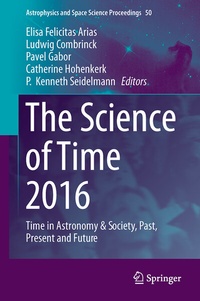
The Science of Time 2016
Time in Astronomy & Society, Past, Present and Future
Published on 5. October 2017
X, 394 pages
978-3-319-59909-0 (ISBN)
Description

The uses of time in astronomy - from pointing telescopes, coordinating and processing observations, predicting ephemerides, cultures, religious practices, history, businesses, determining Earth orientation, analyzing time-series data and in many other ways - represent a broad sample of how time is used throughout human society and in space. Time and its reciprocal, frequency, is the most accurately measurable quantity and often an important path to the frontiers of science. But the future of timekeeping is changing with the development of optical frequency standards and the resulting challenges of distributing time at ever higher precision, with the possibility of timescales based on pulsars, and with the inclusion of higher-order relativistic effects. The definition of the second will likely be changed before the end of this decade, and its realization will increase in accuracy; the definition of the day is no longer obvious. The variability of the Earth's rotation presents challengesof understanding and prediction.
In this symposium speakers took a closer look at time in astronomy, other sciences, cultures, and business as a defining element of modern civilization. The symposium aimed to set the stage for future timekeeping standards, infrastructure, and engineering best practices for astronomers and the broader society. At the same time the program was cognizant of the rich history from Harrison's chronometer to today's atomic clocks and pulsar observations. The theoreticians and engineers of time were brought together with the educators and historians of science, enriching the understanding of time among both experts and the public.
More details
Series
Edition
1st ed. 2017
Language
English
Place of publication
Cham
Switzerland
Publishing group
Springer International Publishing
Target group
Professional and scholarly
Product notice
Reflowable
Illustrations
X, 394 p. 169 illus., 136 illus. in color.
File size
14,61 MB
ISBN-13
978-3-319-59909-0 (9783319599090)
DOI
10.1007/978-3-319-59909-0
Schweitzer Classification
Other editions
Additional editions
Elisa Felicitas Arias | Ludwig Combrinck | Pavel Gabor
The Science of Time 2016
Time in Astronomy & Society, Past, Present and Future
Book
10/2017
Springer
€267.49
Shipment within 10-15 days
Persons
Felicitas Arias, Ph.D., is Director of the Time Department, International Bureau for Weights and Measures in Sèvres near Paris.Responsible for the maintenance of Universal Coordinated Time.
Ludwig Combrinck, Ph.D., is Acting Managing Director of the Hartebeesthoek Radio Astronomy Observatory (HartRAO), National Research Foundation, South Africa. His main interests are space geodesy and general relativity.
Pavel Gabor, Ph.D., is Vice Director of the Vatican Observatory responsible for its observational facilities in Arizona. He is involved in the robotic upgrades of three telescopes and other astronomical instrumentation projects. As a Jesuit priest and an official of the Holy See, he also studies timekeeping, its history and symbolism.
Catherine Hohenkerk, HM Nautical Almanac Office (HMNAO), UK Hydrographic Office, a long standing member of HMNAO, fellow of the Royal Institute of Navigation, Chair of the long standing IAU Division Aworking group Standards of Fundamental Astronomy (SOFA) and President of IAU Division A Commission for Fundamental Standards.
P.Kenneth Seidelmann, Research Professor of Astronomy at the Universityof Virginia; former director of astrometry directorate at the U.S. Naval Observatory, Co-editor of the Explanatory Supplement to the Astronomical Almanac, Co-author of books on astrometry, time, and celestial mechanics and astrodynamics, and author of many scientific papers.
Ludwig Combrinck, Ph.D., is Acting Managing Director of the Hartebeesthoek Radio Astronomy Observatory (HartRAO), National Research Foundation, South Africa. His main interests are space geodesy and general relativity.
Pavel Gabor, Ph.D., is Vice Director of the Vatican Observatory responsible for its observational facilities in Arizona. He is involved in the robotic upgrades of three telescopes and other astronomical instrumentation projects. As a Jesuit priest and an official of the Holy See, he also studies timekeeping, its history and symbolism.
Catherine Hohenkerk, HM Nautical Almanac Office (HMNAO), UK Hydrographic Office, a long standing member of HMNAO, fellow of the Royal Institute of Navigation, Chair of the long standing IAU Division Aworking group Standards of Fundamental Astronomy (SOFA) and President of IAU Division A Commission for Fundamental Standards.
P.Kenneth Seidelmann, Research Professor of Astronomy at the Universityof Virginia; former director of astrometry directorate at the U.S. Naval Observatory, Co-editor of the Explanatory Supplement to the Astronomical Almanac, Co-author of books on astrometry, time, and celestial mechanics and astrodynamics, and author of many scientific papers.
Content
The scientific and technical uses of time and time series data.- The civil and scientific understanding of time - education andoutreach.- The history of time and timepieces, clocks and calendars.- Social, cultural, and religious uses of timing informationHigh-precision time from sundials and the pendulum to atomic clocksand pulsars.- Impact of precise time and frequency measurement in astronomy & basic science.- Earth rotation and time Time and solar-system ephemerides.- The physics of time.
