

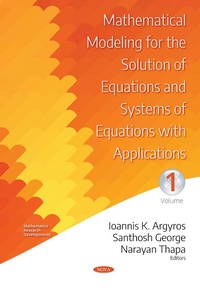
Mathematical Modeling for the Solution of Equations and Systems of Equations with Applications. Volume I
Published on 1. June 2018
334 pages
978-1-5361-3362-2 (ISBN)
Description

This book is dedicated to the approximation of solutions of nonlinear equations using iterative methods. The study about convergence matter of iterative methods is usually based on two categories: semi-local and local convergence analysis. The semi-local convergence category is, based on the information around an initial point, to provide criteria ensuring the convergence of the method; while the local one is, based on the information around a solution, to find estimates of the radii of the convergence balls. The book is divided into two volumes. The chapters in each volume are self-contained so they can be read independently. Each chapter contains semi-local and local convergence results for single, multi-step and multi-point old and new contemporary iterative methods involving Banach, Hilbert or Euclidean valued operators. These methods are used to generate a sequence defined on the aforementioned spaces that converges with a solution of a nonlinear equation, an inverse problem or an ill-posed problem. It is worth mentioning that most problems in computational and related disciplines can be brought in the form of an equation using mathematical modelling. The solutions of equations can be found in analytical form only in special cases. Hence, it is very important to study the convergence of iterative methods. The book is a valuable tool for researchers, practitioners, graduate students, and can also be used as a textbook for seminars in all computational and related disciplines.
More details
Other editions
Additional editions
Ioannis K. Argyros | Santhosh George | Narayan Thapa
Mathematical Modeling for the Solution of Equations and Systems of Equations with Applications -- Volume I
Book
05/2018
Nova Science Publishers Inc
€363.07
Shipment within 15-20 days
Content
- Intro
- MATHEMATICAL MODELINGFOR THE SOLUTION OF EQUATIONSAND SYSTEMS OF EQUATIONSWITH APPLICATIONSVOLUME 1
- MATHEMATICAL MODELINGFOR THE SOLUTION OF EQUATIONSAND SYSTEMS OF EQUATIONSWITH APPLICATIONSVOLUME 1
- Contents
- Preface
- Chapter 1Newton-Secant Methods
- 1.1. Introduction
- 1.2. Convergence of the Newton-SecantMethod
- 1.3. Numerical Examples
- References
- Chapter 2Newton-Gauss Method
- 2.1. Introduction
- 2.2. Local Convergence
- 2.3. Numerical Examples and Applications
- References
- Chapter 3Newton Traub Method
- 3.1. Introduction
- 3.2. Local Convergence
- 3.3. Numerical Example and Applications
- References
- Chapter 4The MMN-HSS Method
- 4.1. Introduction
- 4.2. Semilocal Convergence
- 4.3. Numerical Examples
- References
- Chapter 5The Kantorovich Theorem and FiniteElement Methods
- 5.1. Introduction
- 5.2. Convergence Analysis
- 5.3. Conclusion and Applications
- References
- Chapter 6Newton's Method for SolvingOptimal Shape Design Problems
- 6.1. Introduction
- 6.2. The Mesh Independence Principle
- References
- Chapter 7M¨uller's Method
- 7.1. Introduction
- 7.2. Improved Convergence Ball Analysis ofMethod (7.1.2)
- 7.3. Numerical Examples
- References
- Chapter 8M¨uller's Method forNon-Differentiable Functions
- 8.1. Introduction
- 8.2. Local Convergence Ball Analysis
- 8.3. Numerical Examples
- References
- Chapter 9The Shadowing Lemma forOperators with Chaotic Behaviour
- 9.1. Introduction
- 9.2. The Shadowing Lemma
- References
- Chapter 10Secant-Like Methods
- 10.1. Introduction
- 10.2. Improved Local Convergence Analysis of Method (10.1.5)
- 10.3. Numerical Examples
- References
- Chapter 11Modified Secant Method
- 11.1. Introduction
- 11.2. Improved Convergence Ball Analysis ofMethod (11.1.4)
- 11.3. Numerical Examples
- References
- Chapter 12Newton's Method for GeneralizedEquations
- 12.1. Introduction
- 12.2. Preliminaries
- 12.3. Local Analysis of Newton'sMethod
- 12.3.1. Basic Results
- 12.3.2. Proof of Theorem 12.3.1
- 12.4. Special Cases and Numerical Examples
- 12.4.1. Under Lipschitz-Type Condition
- References
- Chapter 13Variants of Jarratt's Method
- 13.1. Introduction
- 13.2. Local Convergence Analysis
- 13.3. Numerical Examples
- References
- Chapter 14Super-Halley Methods
- 14.1. Introduction
- 14.2. Local Convergence Analysis
- 14.3. Numerical Examples
- References
- Chapter 15Semidefinite Programs
- 15.1. Introduction
- 15.2. Semilocal Convergence Analysis
- References
- Chapter 16Moore's Theorem
- 16.1. Introduction
- 16.2. Convergence Analysis for Newton's Method
- References
- Chapter 17Miranda Results for IntermediateValue Theorem
- 17.1. Introduction
- 17.2. Convergence Analysis for Newton's Method (17.1.2)
- References
- Chapter 18Directional Newton Methods
- 18.1. Introduction
- 18.2. Semilocal Convergence Analysis
- References
- Chapter 19Newton's Method for a Class ofNonsmooth Operators
- 19.1. Introduction
- 19.2. Convergence Analysis
- References
- Chapter 20Newton-HSS Methods
- 20.1. Introduction
- 20.2. Local Convergence of Newton-HSS Method
- 20.3. Local Convergence of Modified Newton-HSS Method
- 20.4. Numerical Testing
- References
- Chapter 21Cauchy-Type Methods
- 21.1. Introduction
- 21.2. Local Convergence
- 21.3. Numerical Examples
- References
- Chapter 22Second Derivative Free Cauchy-TypeMethods
- 22.1. Introduction
- 22.2. Local Convergence
- 22.3. Numerical Examples
- References
- Chapter 23Mesh Independence Principle ofNewton's Method
- 23.1. Introduction
- 23.2. The Mesh Independence Principle
- 23.3. Numerical Examples
- References
- Chapter 24High Convergence Order Method
- 24.1. Introduction
- 24.2. Local Convergence: One Dimensional Case
- 24.3. Numerical Example and Applications
- 24.4. Conclusion
- References
- Chapter 25Two Step Method with Memory
- 25.1. Introduction
- 25.2. Local Convergence: One Dimensional Case
- 25.3. Numerical Example and Applications
- 25.4. Conclusion
- References
- Chapter 26Broyden's Method
- 26.1. Introduction
- 26.2. Semilocal Convergence Analysis of Broyden'sMethod
- References
- Chapter 27Existence and Uniqueness ofWeakSolution
- 27.1. Introduction
- 27.2. Weak Formulation of Hyperbolic PDE
- 27.3. Existence and Uniqueness of Weak Solutions
- References
- Chapter 28Existence of Optimal Parameters
- 28.1. Introduction
- 28.2. Continuity of SolutionMap
- References
- Chapter 29Weak G^ateau Derivative of theSolution Map of Initial BoundaryValue Problem
- 29.1. Introduction
- 29.2. Optimal Parameters
- References
- Chapter 30Spectral Method for OptimalParameters
- 30.1. Computational Algorithm
- 30.2. Numerical Results
- References
- Chapter 31Variational Inequality Problems
- 31.1. Preliminaries
- 31.2. Algorithm
- 31.3. Main Results
- References
- Chapter 32Newton's Method on GeneralizedBanach Spaces
- 32.1. Introduction
- 32.2. Generalized Banach Spaces
- 32.3. Convergence Analysis
- Semilocal Convergence Case
- Suppose:
- Local Convergence Case
- 32.4. Numerical Example and Applications
- References
- Author Contact Information
- Index
- Blank Page
