

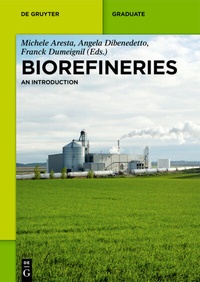
Biorefineries
An Introduction
1st Edition
Published on 31. August 2015
XX, 348 pages
978-3-11-033158-5 (ISBN)
Description

Biorefineries compiles the basic science and technologies used to convert terrestrial and aquatic biomass into essential molecular compounds and polymeric materials. The book provides in depth insights into this fairly recent concept of industrial chemistry that aims to achieve optimal economic profits while minimizing the environmental impact. Chapters written by renowned experts cover, amongst others, the application of catalysis, downstream processing, biomass sourced olefins, lignin biorefinery techniques and biogas.The authors thoroughly examine and explain the value chain for biomass conversion into platform molecules and their transformation into final products. A comprehensive thematic overview on the topic giving beginners access to fundamental concepts is presented. Supplemented by numerous full color figures and tables, the contents impart knowledge about the involved techniques. Advanced students and experts in the field will find the summary of state-of-the-art research and current literature of valuable interest. Explores the enormous potential of biomass conversion as a future source for fuels and chemicals Focuses on both general scientific background and current innovations in the field of biorefinery Targets students and researchers in Chemistry, Chemical Engineering, Biotechnology, and Materials Science About the Editors Prof. Michele Aresta, Chair of the Scientific Committee of CIRCC in Italy and holds the IMM Chair at the Department of Chemical and Biomolecular Engineering at NUS, Singapore. He is author of over 200 papers and Author or Editor of nine books. Prof. Angela Dibenedetto, Associate Professor at the Department of Chemistry of the University of Bari (Italy) focused on carbon dioxide utilization by applying biorefinery concepts; and Director of the Interuniversity Consortium on Chemical Reactivity and Catalysis-CIRCC. Prof. Franck Dumeignil, Deputy Director of the CNRS joint Unit of Catalysis and Chemistry of Solid (UCCS) of Lille University (France); project coordinator of several projects on chemistry, including the EuroBioRef Project for designing next generation biorefineries.
More details
Series
Language
English
Place of publication
Berlin/Boston
Germany
Target group
Professional and scholarly
US School Grade: College Graduate Student
Illustrations
50 s/w Zeichnungen, 100 s/w Abbildungen, 50 farbige Zeichnungen, 100 s/w Tabellen
100 b/w ill., 100 b/w tbl., 50 b/w and 50 col. ld
File size
13,99 MB
ISBN-13
978-3-11-033158-5 (9783110331585)
DOI
http://www.degruyter.com/isbn/9783110331585
Schweitzer Classification
Other editions
Additional editions
E-Book
08/2015
1st Edition
De Gruyter
€69.95
Available for download
Book
08/2015
1st Edition
De Gruyter
€69.95
Shipment within 7-9 days
Persons
Michele Aresta and Angela Dibendetto, University of Bari, Italy; Franck Dumeignil, University of Lille - Nord de France, Villeneuve d'Ascq, France.
Content
- Intro
- Preface
- Contributing authors
- Abbreviations
- Introduction to Biorefinery
- 1 Catalysis, growth, and society
- 2 Terrestrial biomass production
- 2.1 Introduction
- 2.1.1 Land availability
- 2.1.2 The crops
- 2.1.2.1 The oil crops
- 2.1.2.2 The lignocellulosic crops
- 2.2 Land suitability
- 2.2.1 Oil crops
- 2.2.1.1 Data sets
- 2.2.1.2 Determination of selection criteria
- 2.2.2 Lignocellulosic crops
- 2.3 Crop setting up
- 2.3.1 Oil crops
- 2.3.1.1 Soil preparation
- 2.3.1.2 Sowing
- 2.3.1.3 Irrigation
- 2.3.1.4 Fertilization
- 2.3.1.5 Weeding
- 2.3.1.6 Crop rotations
- 2.3.2 Lignocellulosic crops
- 2.3.2.1 Soil type requirement
- 2.3.2.2 Soil preparation
- 2.3.2.3 Planting
- 2.3.2.4 Irrigation
- 2.3.2.5 Fertilization
- 2.3.2.6 Weeding
- 2.4 Yields
- 2.4.1 Oil crops
- 2.4.1.1 Experimental design
- 2.4.1.2 Results
- 2.4.2 Lignocellulosics
- 2.4.2.1 Giant reed
- 2.5 Crop harvesting
- 2.5.1 Oil crops
- 2.5.1.1 Castor
- 2.5.1.2 Crambe
- 2.5.1.3 Safflower
- 2.5.2 Giant reed
- 2.6 Fuel characterization
- Bibliography
- 3 Production and uses of aquatic biomass
- 3.1 Introduction
- 3.2 Classification of aquatic biomass
- 3.2.1 Macroalgae
- 3.2.2 Microalgae
- 3.2.3 Plants
- 3.3 Cultivation of aquatic biomass
- 3.3.1 Macroalgae
- 3.3.2 Microalgae
- 3.4 Harvesting of aquatic biomass
- 3.4.1 Macroalgae
- 3.4.2 Microalgae
- 3.5 Composition of aquatic biomass
- 3.5.1 Bio-oil content of aquatic biomass
- 3.5.2 The quality of bio-oil
- 3.6 Technologies for algal oil and chemicals extraction
- 3.6.1 Fractionation of algal biomass
- 3.6.2 Extraction using chemico-physical methods
- 3.6.3 Conventional solvent extraction
- 3.6.4 Supercritical fluid extraction (SFE)
- 3.6.5 Biological extraction
- 3.7 Conclusions
- Bibliography
- 4 Introduction to bioconversion and downstream processing: principles and process examples
- 4.1 Introduction
- 4.2 Principles of bioconversion process
- 4.3 Examples of bioconversion processes
- 4.3.1 Microbial production of 1,3-propanediol from glycerol
- 4.3.2 Bioproduction of n-butanol
- 4.4 Downstream processing
- 4.4.1 General scheme of downstream processing of fermentation broth
- 4.4.2 Downstream processing methods for 1,3-PDO and n-butanol
- 4.4.2.1 Evaporation and distillation
- 4.4.2.2 Gas stripping
- 4.4.2.3 Extraction methods
- 4.4.2.4 Pervaporation/Membrane separation
- 4.4.2.5 Adsorption and Chromatography
- 4.5 Concluding remarks
- Bibliography
- 5 Microbial strain selection and development for the production of second-generation bioethanol
- 5.1 Introduction
- 5.2 Enzymatic hydrolysis
- 5.2.1 Identification and development of biocatalysts for cellulose and hemicellulose hydrolysis
- 5.3 Fermentation inhibitors in lignocellulosic hydrolyzate
- 5.3.1 Weak acids
- 5.3.2 Furan derivatives: furfural and HMF
- 5.3.3 Phenolic compounds
- 5.3.4 Other inhibitors
- 5.3.5 Detoxification
- 5.3.5.1 Physical and chemical detoxification methods
- 5.3.5.2 Biological detoxification methods
- 5.3.6 Development of biocatalysts with enhanced resistance to fermentation inhibitors
- 5.4 Fermentation
- 5.4.1 Separate hydrolysis and fermentation (SHF)
- 5.4.2 Simultaneous saccharification and fermentation (SSF)
- 5.4.3 Simultaneous saccharification and co-fermentation (SSCF)
- 5.4.4 Consolidated bioprocessing (CBP)
- 5.4.5 High-gravity fermentation
- 5.5 Microbial biocatalysts
- 5.5.1 Escherichia coli
- 5.5.2 Zymomonas mobilis
- 5.5.3 Other bacteria
- 5.5.4 Saccharomyces cerevisiae
- 5.5.4.1 Expression of the fungal xylose utilization pathway
- 5.5.4.2 Expression of the bacterial xylose utilization pathway
- 5.5.4.3 Expression of the arabinose utilization pathway
- 5.5.5 Other yeasts
- 5.6 Strain development for CBP
- Bibliography
- 6 Biomass-derived molecules conversion to chemicals using heterogeneous and homogeneous catalysis
- 6.1 Introduction
- 6.2 Lignocellulosic biomass
- 6.2.1 Natural polymers processing
- 6.2.1.1 Glucidic polymers
- 6.2.1.2 Lignin
- 6.2.2 C1-C6 molecules
- 6.2.2.1 C1 starting materials: biogas and syngas
- 6.2.2.2 C2 molecule - ethanol
- 6.2.2.3 C3 molecules - glycerol and lactic acid
- 6.2.2.4 C4 molecules - succinic acid, 1,4-butanediol, ?-butyrolactone, butanol, iso-butanol, and olefins
- 6.2.2.5 C5 molecules - xylose, furfural, levulinic acid, and isoprene
- 6.2.2.6 C6 molecules - 5-hydroxymethylfurfural, 2,5-furandicarboxylic acid, and sorbitol
- 6.3 Oleaginous biomass
- 6.3.1 Separation and primary products
- 6.3.1.1 Triglycerides
- 6.3.1.2 Fatty acids and esters
- 6.4 Conclusion
- Bibliography
- 7 Bio-sourced polyolefins
- 7.1 Introduction: why renewable polymers?
- 7.2 Bioderived conventional polyolefins: the drop-in synthesis of olefins
- 7.3 New polyolefins from bioderived monomers
- 7.4 Outlook and perspective
- Bibliography
- 8 Conversion of lignocellulosic biomass-derived intermediates to hydrocarbon fuels
- 8.1 Introduction
- 8.2 Upgrading of bio-oil from biomass pyrolysis
- 8.2.1 Upgrading of bio-oil to hydrocarbons by hydrodeoxygenation
- 8.2.2 Upgrading of bio-oil via C-C coupling reactions
- 8.2.3 Upgrading of bio-oil to hydrocarbons by fluid catalytic cracking (FCC)
- 8.3 Sugars to hydrocarbon fuels
- 8.4 Upgrading of butanol to fuels
- 8.5 Challenges - outlook
- Bibliography
- 9 Use of bio-sourced syngas
- 9.1 Introduction
- 9.2 Uses of syngas
- 9.2.1 Syngas as a fuel
- 9.2.2 Syngas as a chemical feedstock
- 9.2.2.1 Hydrogen production and uses
- 9.2.2.2 Ammonia production and uses
- 9.2.2.3 Urea production and use
- 9.2.2.4 Methanol production and uses
- 9.2.2.5 Oxo chemicals production and uses
- 9.2.3 Transportation fuels from syngas: the Fischer-Tropsch process
- 9.2.3.1 Fischer-Tropsch to fuels: biomass-to-liquids processes
- 9.2.3.2 Fischer-Tropsch to olefins
- 9.2.3.3 Feeding Fischer-Tropsch reactions with CO2
- 9.3 Syngas fermentation
- 9.4 Perspectives
- Bibliography
- 10 Oil chemistry: chemicals, polymers, and fuels
- 10.1 Introduction
- 10.2 Industrial applications of oil chemistry
- 10.3 EuroBioRef case studies
- 10.3.1 General description of the value chains
- 10.3.2 Oil production
- 10.3.3 Competition analysis
- 10.3.4 Technology analysis
- 10.3.4.1 IPscore analysis
- 10.3.4.2 Risk and SWOT analysis
- 10.3.4.3 Life cycle assessment (LCA)
- 10.3.4.4 Technology Readiness Level (TRL) assessment - actual demonstration status
- 10.3.5 Costs analysis
- 10.3.5.1 Capital expenditure (CAPEX) evaluation
- 10.3.5.2 Production costs evaluation
- 10.3.5.3 Job creation
- 10.3.5.4 Business model
- 10.3.5.5 Co-location in existing assets
- 10.4 Conclusions
- Bibliography
- 11 Lignin biorefinery: structure, pretreatment and use
- 11.1 Introduction
- 11.2 Origin and characteristics of lignin
- 11.2.1 Lignin occurrence and location
- 11.2.2 Lignin structure
- 11.3 Potential sources of biorefinery lignin
- 11.3.1 Lignin pretreatment
- 11.3.2 Kraft lignin process
- 11.3.3 The sulfite pulping process
- 11.3.4 Organosolv lignin
- 11.3.5 Pyrolysis process
- 11.3.6 Steam explosion lignin
- 11.3.7 Other processes
- 11.4 The use of lignin in current and future biorefinery schemes
- 11.4.1 Power - green fuels - syngas
- 11.4.2 Macromolecules
- 11.4.3 Aromatics and chemicals
- 11.4.4 Applications in nanomaterials
- 11.4.4.1 Capsules
- 11.4.4.2 Nanoparticles
- 11.4.4.3 Microporous and nanoporous materials
- 11.5 Conclusions and perspectives
- Bibliography
- 12 Utilization of existing assets
- 12.1 Introduction
- 12.1.1 Why utilizing existing plants to implement bio-based technology?
- 12.1.2 Kinds of integration scenarios
- 12.2 Case study 1: maleic anhydride production in a phthalic anhydride plant
- 12.2.1 General
- 12.2.2 Technological aspects of the retrofit
- 12.2.3 Economic evaluation
- 12.2.4 Demonstration status
- 12.2.5 Strengths, weaknesses, opportunities, and threats analysis
- 12.2.6 Value creation
- 12.2.7 Concluding remarks
- 12.3 Case study 2: 1,1-dibutoxyethane production added to an n-butanol plant in Europe
- 12.3.1 General
- 12.3.2 Technological aspects
- 12.3.3 Demonstration status
- 12.3.4 Strengths, weaknesses, opportunities, and threats analysis
- 12.3.5 Value creation
- 12.3.6 Concluding remarks
- 12.4 Perspective view
- Bibliography
- 13 Biogas from wet biomass: basic science and applications
- 13.1 Introduction
- 13.1.1 The "aerobic" and "anaerobic" processes for wet WB
- 13.2 Structure of raw materials used for biogas production
- 13.2.1 Cellulose
- 13.2.2 Hemicellulose
- 13.2.3 Lignin
- 13.2.4 Pectin
- 13.2.5 Starch
- 13.2.6 Lipids
- 13.2.7 Proteins
- 13.3 The phases of biogas production
- 13.3.1 Anaerobic digestion: a nature-based biotechnology
- 13.3.2 Hydrolytic bacteria and acidogenesis
- 13.3.2.1 Transitional bacteria
- 13.3.2.2 Acetogenesis
- 13.3.2.3 Bacterial flora composition
- 13.4 Role of hydrogenases
- 13.4.1 [FeFe]H2-ase
- 13.4.2 [FeS]H2-ase
- 13.4.3 [NiFe]H2-ase and [Fe-Ni-Se]-ase
- 13.4.4 Molybdenum-iron-containing N2-ase
- 13.5 Methanogenic bacteria
- 13.5.1 Methanogenesis
- 13.5.2 The laboratory equipment for biogas production and system investigation
- 13.6 Industrial reactors
- 13.6.1 Types of reactors and configuration of biogas plants
- 13.6.1.1 Solid content
- 13.6.1.2 Temperature
- 13.6.1.3 Liquid and solid retention time
- 13.6.1.4 Continuity of the process
- 13.6.2 Biogas from wastewaters
- Bibliography
- Index
