

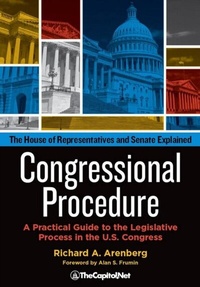
Congressional Procedure: A Practical Guide to the Legislative Process in the U.S. Congress
Description

"A clear explanation of the workings of the United States government that should be required reading for politically engaged Americans." -- KIRKUS
Congressional Procedure explains the legislative and congressional budget processes along with all aspects of Congress.
This comprehensive guide to Congress is ideal for anyone who wants to know how Congress really works, including federal executives, attorneys, lobbyists, media and public affairs staff, government affairs, policy and budget analysts, congressional office staff and students.
- Clear explanation of the legislative process, budget process, and House and Senate business
- Legislative process flowchart
- Explanation of the electoral college and votes by states
- Relationship between budget resolutions and appropriation and authorization bills
- Amendment tree and amendment procedures
- How members are assigned to committees
- Glossary of legislative terms
Each chapter concludes with Review Questions.
Chapter 1 examines the relationship between the U.S. Constitution and the House and Senate. It discusses Constitutional provisions that directly affect Congress. The makeup, roles and leadership of the House and Senate are compared and contrasted. Congressional committees and their place and power in the House and Senate are explored.
Chapter 2 begins with a discussion of why members submit legislation, explains the forms of legislation, and lays out the steps involved in drafting legislation. Bills, joint resolutions, concurrent resolutions and simple House and Senate resolutions and their purposes are separately described. Ends with a flowchart of the legislative process.
In Chapter 3, the work of Congressional committees is examined in greater detail: types of committees and their structures; subcommittees; power of the chairs of committees; hearings, markups and amendment procedure in committee; and the reporting of legislation to the House and Senate floor.
Chapters 4 and 5 follow the course of legislation through the respective chambers and some of the more arcane elements of House and Senate floor action.
Chapter 4 addresses some of the unique characteristics of the House including the central and crucial role played by the Rules Committee and the special rules it reports. Scheduling, consideration, amending, and passage of legislation through the House is described in detail.
Chapter 5 discusses the handling of legislation on the Senate floor, including unique Senate characteristics like the filibuster, the nuclear option, holds, and the filling of the amendment tree.
Chapter 6 explains the various procedures for resolving differences in legislation between the Senate and the House.
The budget process is addressed in Chapter 7, including appropriations and authorization procedures, the 1974 Budget and Impoundment Control Act and the key role it has played since its adoption, the use of the optional budget reconciliation process, and the somewhat complex but crucial Byrd Rule.
Chapter 8 concludes the detail and analysis of Congressional procedure with a number of processes that are not strictly legislative, including a number of Constitutional responsibilities given to Congress such as oversight and investigation and advice and consent, counting of Electoral College ballots, and impeachment.
The conclusion, Chapter 9, describes the way in which many of the procedures explained in this book are increasingly being used, and some would say abused, in both the House and the Senate.
Glossary Index
Also see related CRS Reports and links on TCNCPAM.com
For detailed Table of Contents, see CongressionalProcedure.com
More details
Content
About the Author
Acknowledgments
Foreword by Alan S. Frumin
Preface
Chapter 1. Congress and the Constitution
Chapter 2. Introduction of Legislation
Chapter 3. Committees
Chapter 4. House Floor
Chapter 5. Senate Floor
Chapter 6. Resolving Differences Between the House and Senate
Chapter 7. The Congressional Budget and Other Special Cases
Chapter 8. Additional Congressional Responsibilities and Procedures
Chapter 9. Conclusion
Glossary Index
Also see related CRS Reports and links on TCNCPAM.com
For detailed Table of Contents, see CongressionalProcedure.com
