

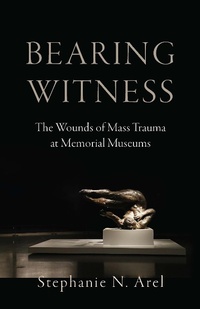
Bearing Witness
Description

Museum memorialization has long been about politics, design implications, and visitor experience--rarely focused upon the people mired in commemorating the dead. Profound challenges confront those who memorialize mass trauma at memorial museums. Listening to the voices of those called to do this work enables insight into the critical role they play in preserving and disseminating history's most painful narratives, expanding views of recovery from mass trauma, and revealing the value in the profession.
As an Andrew W. Mellon Fellow at the National September 11 Memorial Museum, Dr. Stephanie Arel recognized costs--psychological, spiritual, and physical--aligned with responding to mass trauma and participating in communal recovery. The impact of bearing witness at memorial museums emerged in the lives of workers. To explore the phenomenon, she visited Auschwitz, interviewing those who remember the Holocaust's horrors while resisting its infiltration in their personal lives. The immensity of honoring the dead for others inspired additional sojourns in Bosnia-Herzegovina, Cambodia, Israel, South Africa, and the United States. She discovered dimensions of pride and care evident in those who honor memory: the capacity of workers to address reverberating political tensions, while tending to visitor needs; the passion workers have for giving voice to the voiceless who died during traumatic events, while offering care and support to the survivors; and the reality that reassembling the fragments of mass trauma is not for the weary, but instead emerges as a calling and a vocation.
Bearing Witness places value on what workers do, opening space for workers' testimonies to be heard for the first time and creating a global community of and for these workers, who have otherwise never been given a platform to speak about their experiences. The interviews reveal the entanglement of politics with commemoration, the sacredness of remembering, and the multidimensional aspects of care, transforming the reader's understanding of humanity forever.
More details
Other editions
Additional editions
Person
Content
- Cover Page
- Title Page
- Copyright Page
- Dedication
- Contents
- Preface
- Acknowledgments
- Introduction
- 1. Public Suffering
- 2. Fragments
- 3. The Aftermath of Trauma
- 4. Negotiating Publics
- 5. The Vocation of Memory
- Notes
- Bibliography
- Index
