

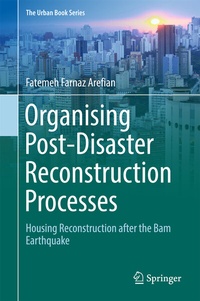
Organising Post-Disaster Reconstruction Processes
Description

Through a synthesis of a broader inter-disciplinary literature in the field of disaster studies, organisation theory and management, and an in-depth case study this book provides an analytical framework for organising post-disaster reconstruction programmes which aim to reduce future disaster risks and achieve other objectives. It explores the role of organisational design and management on approaching and achieving the objectives of the reconstruction programme in Iran after the 2003 Bam earthquake.
The housing reconstruction programme in Bam was a complex case, offering various learning opportunities to understand organising reconstruction processes especially in urban areas. The case study research explores how the urban housing reconstruction programme system was formed purposefully towards the delivery of the stated objectives and created an innovative housing process throughout the urban area. It identifies consistencies and inconsistencies among the influential organisational attributes of the programme delivery system formation. The system evolved through corrective adjustments (either formally or informally) during its implementation to reflect unfolding consequences of inconsistencies in initial formation and emerging contextual issues in the field.
More details
Other editions
Additional editions
Person
Content
Part I Introduction.- Chapter 1. Introduction.- Chapter 2. Methodology.-Part II Literature Review.- Chapter 3. Post Disaster Reconstruction, Recovery and Development.- Chapter 4. Organising Reconstruction.- Part III Case Study.- Chapter 5. Earthquake Prone Iran.- Chapter 6. The Bam Urban Area: the Past and Earthquake.- Chapter 7. Organising the housing reconstruction programme in Bam.- Chapter 8. Implementation and the Dynamic Evolution of the Bam Housing Reconstruction Programme Delivery System.- Part IV Analyses.- Chapter 9. Organisational Configuration of the Socio-technical System: Consistencies and Inconsistencies.- Chapter 10. Analysis of the Strategic Nature of the Bam Housing Reconstruction Programme.- Chapter 11. Analysis of the Social Nature of Reconstruction in Bam .- Chapter 12. Analysis of the Multi-organisational Nature of the Bam housing Reconstruction Programme.- Part V Conclusion .- Chapter 13. Concluding Discussions.- References.
