

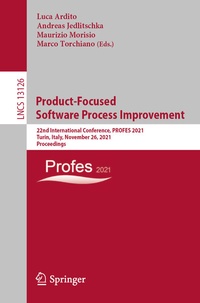
Product-Focused Software Process Improvement
Description

This book constitutes the refereed proceedings of the 22nd International Conference on Product-Focused Software Process Improvement, PROFES 2021, held in Turin, Italy, in November 2021. Due to COVID-19 pandemic the conference was held as a hybrid event.
The 20 revised papers, including 14 full papers, 3 short papers and 3 industry papers, presented were carefully reviewed and selected from 48 submissions. The papers cover a broad range of topics related to professional software development and process improvement driven by product and service quality needs. They are organized in the following topical sections: agile and migration, requirements, human factors, and software quality.
More details
Other editions
Additional editions
Content
Agile and Migration.- Migration from Ionic to Android: Implications.- The migration journey towards microservices.- Migrating from a Centralized Data Warehouse to a Decentralized Data Platform Architecture.- How Do Agile Teams Manage Impediments?.- Keeping the momentum: Driving continuous improvement after the large-scale agile transformation.- Requirements.- How Do Practitioners Interpret Conditionals in Requirements?.- Situation- and Domain-specific Composition and Enactment of Business Model Development Methods.- Using a data-driven context model to support the elicitation of context-aware functionalities - a controlled experiment.- A Transformation Model for Excelling in Product Roadmapping in Dynamic and Uncertain Market Environments.- Introducing Traceability in GitHub for Medical Software Development.- Human Factors.- An Empirical Study on Personality Traits and Team Climate in a Smart-Working Development Context.- Searching for bellwether developers forcross-personalized defect prediction.- Using Machine Learning to Recognise Novice and Expert Developers.- Is knowledge the key? An experiment on debiasing architectural decision-making - a pilot study.-Communicating Cybersecurity Vulnerability Information: A Producer-Acquirer Case Study.- Software quality.- Analyzing SAFe Practices with respect to Quality Requirements: Findings from a Qualitative Study.- Capitalizing on Developer-Tester Communication - A Case Study.- Toward a Technical Debt Relationship with the Pivoting of Growth Phase Startups.- Towards a Common Testing Terminology for Software Engineering and Artificial Intelligence Experts.- Towards RegOps: A DevOps Pipeline for Medical Device Software.-
