

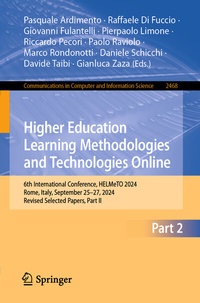
Higher Education Learning Methodologies and Technologies Online
Description

The two-volume set CCIS 2467 and 2468 constitutes the refereed post-conference proceedings of the 6th International Conference on Higher Education Learning Methodologies and Technologies Online, HELMeTO 2024, held in Rome, Italy, during September 25-27, 2024.
The 46 revised full papers presented in these proceedings were carefully reviewed and selected from 101 submissions. The papers are organized in the following topical sections:
Part I: Artificial Intelligence in Education - Emerging Technologies and Digital Transformation in Education.
Part II: Inclusion, Well-being, and Student Support - Educational Policy, Ethics, and Teacher Professional Development.
More details
Other editions
Additional editions
Content
.- Inclusion, Well-being, and Student Support.
.- Artificial Intelligence in Special Education: Enhancing IEP Design with CONALI & ChatGPT.
.- AI-personalized Mindfulness sessions to promote the emotional well-being in higher education.
.- University students with Special Educational Needs: An assessment of satisfaction and perceptions of e-learning and services provided.
.- Play at first sight: A literature review on the integration of Eye-tracking into special needs education.
.- Innovative Approaches in Teacher Education: Active Breaks and Technology Integration.
.- Development and initial validation of a future teacher anxiety questionnaire: a pilot study.
.- Stress in the university population: a literature review of the positive role of physical activity to improve the well being of students.
.- Pre-service Teachers and Public Speaking Anxiety. Insights and possible interventions through AI and IoT.
.- Enhancing social presence through art: a study on the intersection of emotions and class engagement.
.- Enhancing educational inclusion through advanced Assistive Technologies: impact of AR, VR and AI integration in supporting students with motor and communication impairments.
.- Educational Policy, Ethics, and Teacher Professional Development.
.- The Role of Universities in Teachers' Professional Development: a Model Proposal.
.- AI Act: a quanti-qualitative analysis.
.- Business Schools practices: a websites' content analysis.
.- Faculty Development for the integration of a comprehensive perspective on AI in Higher Education: LookAIHed, a case study.
.- Brain dominance and neuromyths: widespread beliefs among Italian teachers.
.- Sensor-Based to Interaction-Based AI Models in Education: The JOINclusion Case Study.
.- Digital Innovation and Internationalisation through eTwinning: Reimagining Initial Teacher Education.
.- Developing Assessment Competences in Teacher Education: Insights from Moodle-Based Task.
.- Transversal Competences with AI: Training Implications and Faculty Development Perspectives.
.- The influence of online education and secondary school teachers' views on digital competencies.
