

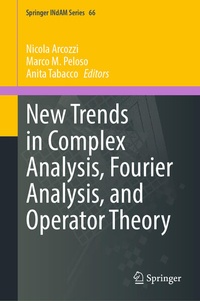
New Trends in Complex Analysis, Fourier Analysis, and Operator Theory
Description

This book compiles contributions primarily from young scholars who participated in the Workshop on Complex Analysis, Fourier Analysis, and Operator Theory 2, held in Rome in September 2022. This workshop was funded by the Istituto Nazionale di Alta Matematica (INdAM) and took place at the institute's Rome headquarters. The research topics addressed during the workshop encompass areas such as complex analysis, Fourier analysis, and operator theory, with significant connections to complex geometry, the spectral theory of canonical systems, applications to frame theory, and thus, signal theory.
More details
Other editions
Additional editions
Persons
Nicola Arcozzi obtained his Ph.D. from Washington University in St. Louis in 1995. He has been member of the Department of Mathematics at the Università degli Studi di Bologna since 1998, where he became a full professor in 2015. He visited several prestigious institutions, among many others the Mittag-Leffler Institute, MSRI, and the St. Petersburg Department of Steklov Mathematical Institute. He has been involved in the organisation of several events in Complex and Harmonic Analysis, and the training of many young researchers. His research interests are in complex analysis, holomorphic function spaces, harmonic analysis and related areas.
Marco Maria Peloso obtained his Ph.D. from Washington University in St. Louis in 1990. He has been a professor of Mathematical Analysis at the Università degli Studi di Milano since 2007 and was previously at the Politecnico di Torino. He has held visiting positions at Michigan State University, the University of Missouri-Columbia, Washington University in St. Louis, and the University of Arkansas-Fayetteville. His research interests are in harmonic analysis, complex analysis in one and several variables, and related areas.
Anita Tabacco obtained her Ph.D. from Washington University in St. Louis in 1986 under the guidance of Richard Rochberg and Guido Weiss. She has been a professor of Mathematical Analysis at the Department of Mathematical Sciences at the Politecnico di Torino, Italy, since 1992. Her research interests include real and complex analysis, functional analysis, and harmonic analysis. She is also involved in the field of engineering education and university management.
Content
Some Current Directions in Complex Analysis.- Cyclicity and Iterated Logarithms in the Drury-Arveson Space.- A Survey on Invariant Spaces of Holomorphic Functions on Symmetric Domains.- A Note on a Stochastic Approach to Caffarelli-Silvestre Theorem.- Metaplectic Wigner Distributions.- Heat Kernel and Riesz Laplacian on Homogeneous Trees.- H1 and BMO Spaces for Exponentially Decreasing Measures on Homogeneous Trees.- The Central Limit Theorem for inner functions II.
