

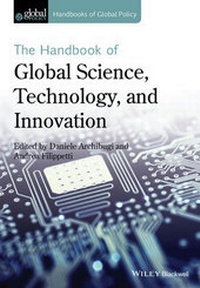
The Handbook of Global Science, Technology, and Innovation
Description

More details
Other editions
Additional editions
Persons
Content
Notes on Contributors viii
Editors' Introduction: Science, Technology, and Innovation Go Global 1
Daniele Archibugi and Andrea Filippetti
Part I Global Trends 13
1 The Convergence Paradox: The Global Evolution of National Innovation Systems 15
Fulvio Castellacci and Jose Miguel Natera
2 World Top University Rankings: From Distribution to Implications on National Knowledge Creation and Competitiveness 46
Thanh Quang Le and Kam Ki Tang
3 The International Race of Top Supercomputers and Its Implications 69
Kam Ki Tang and Thanh Quang Le
4 Soft Innovation and Changes in Product Aesthetics: An Omitted Dimension in Economic Analyses of Innovation Activities 88
Paul Stoneman
5 Is the World of Science Moving to the East? What Bibliometrics Says 109
Ping Zhou and Jiang li
Part II The Globalization of Technology and Innovation 125
6 Innovation, Internationalization, and the Transnational Corporation 127
Grazia Ietto]Gillies
7 International R&D Alliances by Firms: Origins and Development 144
Rajneesh Narula and Andrea Martínez]Noya
8 The Globalization of Knowledge]Intensive Services 171
Ian Miles and Marcela Miozzo
9 Capital and Technology Flows: Changing Technology Acquisition Strategies in Developing Countries 191
Suma Athreye and Sandeep Kapur
10 Clusters and Global Innovation: The Role of Connectedness and Connectivity 212
Mark Lorenzen and Ram Mudambi
11 New Product Development in Emerging Economies: Innovation in Reverse from China 228
Simone Corsi, Alberto Di Minin, and Andrea Piccaluga
12 Crowdfunding: Toward the Democratization of Innovation Financing 245
Alessandro Cordova, Johanna Dolci, and Gianfranco Gianfrate
Part III Spaces and Flows of Knowledge 267
13 Harnessing the Geography of Innovation: Toward Evidence]Based Economic Development Policy 269
Maryann P. Feldman and Jongmin Choi
14 Multinational Enterprises Innovation Networks and the Role of Cities 290
Simona Iammarino and Philip McCann
15 The Rise of the Global Creative Class 313
Richard Florida and Charlotta Mellander
16 Global Science Collaboration 343
Stefan Hennemann and Ingo Liefner
17 International Mobility of Scientists 364
Kieron Flanagan
18 The Role of Global Connectedness in the Development of Indigenous Science in Middle]Income Countries 382
Helena Barnard, Robin Cowan, Marta Fernandez de Arroyabe Arranz, and Moritz Müller
19 Global Trends in Brain Drain and Likely Scenario in the Coming Years 407
Alessio Terzi
Part IV Global Institutions and Intellectual Property Rights 419
20 The Globalization of Intellectual Property Rights 421
Andrea Filippetti and Daniele Archibugi
21 Patents, Monopoly Power, and the Pricing of Pharmaceuticals in Low]Income Nations 443
F.M. Scherer
22 Global Governance and Intangible Cultural Heritage in the Information Society: At the Crossroads of IPRs and Innovation 458
Paolo Davide Farah and Riccardo Tremolada
Part V The Global Governance of Science and Technology 477
23 Knowledge as Global Public Good 479
Daniele Archibugi and Andrea Filippetti
24 From Governmental Open Data Toward Governmental Open Innovation (GOI): A Global Perspective 504
Sabine Brunswicker and Jeremiah Johnson
25 Serendipity and Chance in Scientific Discovery: Policy Implications for Global Society 525
Donald Gillies
26 Global Climate Change and the Direction of Technological Change 540
Andrew Tylecote
27 Global Risks: Cause and Consequence of the New Interactions Between Science, Technology, and Society 558
Jean]Yves Heurtebise
28 Globalization, Regionalization, and Technological Change 575
Frederick Guy
Index 597
Notes on Contributors
Daniele Archibugi is a Research Director at the Italian National Research Council (CNR-IRPPS) in Rome, and Professor of Innovation, Governance and Public Policy at the University of London, Birkbeck College. He works on the economics and policy of science, technology, and innovation and on the political theory of international relations. He has worked at the Universities of Sussex, Cambridge, London School of Economics, Harvard, and Rome LUISS. In 2006 he was appointed honorary professor at Sussex University. He has chaired the European Commission's Expert Group on "A Wide Opening of the European Research Area to the World." Besides several edited books and articles in academic journals, he has authored The Technological Specialization of Advanced Countries (with Mario Pianta, Kluwer, 1992) and Innovation and Economic Crisis: Lessons and Prospects from the Economic Downturn (with Andrea Filippetti, Routledge, 2011).
Suma Athreye is Professor of International Strategy at Brunel Business School, Brunel University. Her research interests include technology development of emerging market firms and their use of international markets to gain competiveness. Her recent work has focused on the internationalization of Indian and Chinese firms, especially those in the software and pharmaceutical sectors.
Helena Barnard, since obtaining her PhD in Management from Rutgers University, has been working at GIBS, University of Pretoria, in South Africa where she is Director of Research. Her research interests are in how knowledge (and with it technology, organizational practices, and innovation) moves from more to less developed countries. She focuses both on organizational mechanisms (notably emerging multinationals) and individual mechanisms, especially the diaspora and scientific collaborations.
Sabine Brunswicker is researcher with a particular interest in open innovation and innovation ecosystems. She is an Associate Professor of Innovation and Director of the Research Center for Open Digital Innovation at Purdue University, Indiana. She is also a Visiting Professor at ESADE Business School at Ramon Llull University, Barcelona, and is a strategic advisor for open innovation at the Fraunhofer Institute for Industrial Engineering, Stuttgart. Her general research interests lie in understanding collaborative models of innovation and value creation in today's global and digital economy.
Fulvio Castellacci is Director of the TIK Centre, University of Oslo, and Research Professor at the Norwegian Institute of International Affairs (NUPI). He holds a PhD in Innovation Studies (University of Oslo, 2004) and a PhD in Economics (University of Rome La Sapienza, 2005). His main research interests are in the fields of the economics of innovation, and particularly on the relationship between innovation and economic performance.
Jongmin Choi is a doctoral student in the Department of Public Policy at the University of North Carolina, Chapel Hill. His main research interests include innovation, entrepreneurship, and economic development policy suited for regional characteristics. In particular, he focuses on industry cluster as an economic development strategy. He plans to shed light on regional characteristics that spark the initial takeoff of an industry in a region.
Alessandro Cordova is a PhD candidate in Business Administration at Bocconi University, Milan. He graduated cum laude in Economics at Bocconi University, and he obtained an MSc in Economics from the London School of Economics. In 2013, he has been awarded a research grant and worked with the Dean of the Bocconi PhD School on projects related to the economy of innovation, entrepreneurship, and public administration. Currently, his main research interests lie in new business ventures and Big Data. Alongside, he is founding a start-up in the health sector.
Simone Corsi is Programme Manager of the Lancaster China Catalyst Programme (Lancaster University) and Honorary Researcher at the Institute for Entrepreneurship and Enterprise Development (IEED) at the Lancaster University Management School. His research and work deal with R&D internationalization and collaboration in China. He holds a PhD in Management from Scuola Superiore Sant'Anna in Pisa (Italy) and he is Research Associate at the Research Center for Global R&D Management (GLORAD) at Tongji University in Shanghai (China) where he has been visiting doctoral student (2011).
Robin Cowan is Professor of Management at the University of Strasbourg, Professor of the Economics of Technical Change at Maastricht University, and Professorial Fellow at UNU-MERIT. His research focuses on the economics of networks, knowledge, and innovation.
Alberto Di Minin is an Associate Professor at the Institute of Management of Scuola Superiore Sant'Anna in Pisa (Italy), and Research Fellow at the Berkeley Roundtable on the International Economy (BRIE). He has a PhD from University of California, Berkeley. His research deals with the appropriability of innovation, open innovation, business models, intellectual property, and R&D management. His research has appeared in Research Policy, California Management Review, R&D Management, and Journal of International Business Studies.
Johanna Dolci is a financial consultant at CMC Capital in London, where she executes M&A transactions, principal investing, and valuation assignments. She completed her Master of Science in Finance at Bocconi University, Milan. Johanna started research on crowdfunding during her studies at Bocconi University.
Paolo Davide Farah is University Professor at West Virginia University, Department of Public Administration within the Eberly College of Arts and Sciences and Law School; Research Scientist and Principal Investigator at gLAWcal - Global Law Initiatives for Sustainable Development (United Kingdom); Principal Investigator and Research Team Coordinator for European Commission-funded projects at the University Institute of European Studies (IUSE) in Turin (Italy). He has been Visiting Scholar (2011-2012) at Harvard Law School, East Asian Legal Studies (EALS) and Marie Curie Fellow (2013-2014) at Peking University, Center for European Studies in Beijing (China).
Maryann P. Feldman is the Heninger Distinguished Professor in the Department of Public Policy at the University of North Carolina, Chapel Hill. Her research and teaching interests focus on the areas of innovation, the commercialization of academic research and the factors that promote technological change and economic growth.
Marta Fernandez de Arroyabe Arranz is a PhD student at the Center for Research in Economics and Management (CREA) at the University of Luxembourg and at UNU-MERIT. Her research interests include the areas of innovation roadmap, innovation planning, networks, and alliances.
Andrea Filippetti is Marie Curie Fellow at the London School of Economics and Political Science, Department of Geography and Environment, and Researcher at the National Research Council of Italy (CNR) Institute for Regional Studies. He is interested in innovation and technological change, the globalization of science and technology, and intellectual property rights. He has been Visiting Fellow at Birkbeck College, University of London, Fulbright-Schuman Post Doc at Harvard University, Center for European Studies, Visiting Fellow at the University of Queensland, Faculty of Economics, Center for Productivity Analysis, Australia, Marie Curie Visiting Fellow at the School of Government, Beijing Normal University, Beijing (China) in 2013, and Visiting Fellow at the Department of Political Science of Columbia University, New York. He has co-authored (with Daniele Archibugi) Innovation and Economic Crisis: Lessons and Prospects from the Economic Downturn (Routledge, 2011).
Kieron Flanagan is Senior Lecturer in Science and Technology Policy at the Manchester Institute of Innovation Research of the University of Manchester. He works on rationales for policy intervention and the construction of science policy problems; on policy dynamics in science, technology and innovation; on the international dimensions of science policy; on the place of science and technology in government; and on science and innovation policies for local and regional economic development. He has published in a range of innovation, science policy, and economic geography journals, is an active commentator on science policy issues, and is a founding contributor to the science policy blog of The Guardian.
Richard Florida is Director of the Martin Prosperity Institute at the University of Toronto's Rotman School of Management and Global Research Professor at New York University. He is the author of several global best-sellers, including the award-winning The Rise of the Creative Class (Basic Books, 2002). He previously taught at Carnegie Mellon and George Mason Universities, and has been a visiting professor at Harvard and MIT. He earned his Bachelor's degree from Rutgers University and his PhD from Columbia University
Gianfranco Gianfrate is an "Empedocle Maffia Fellow" of the Sustainability Science Program at the Harvard Kennedy School, an Assistant Professor of Finance at Bocconi University, and a Research Affiliate of Tufts University. He did both his undergraduate and postgraduate work (PhD in Business Administration) at Bocconi University. In 2014 he was awarded the...
