

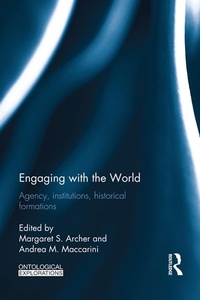
Engaging with the World
Agency, Institutions, Historical Formations
Published on 2. April 2013
240 pages
978-1-135-07701-3 (ISBN)
Description

This title reflects the general theme of the 2010 IACR annual conference that was held in Padova, Italy, the aim of which was to provide a fresh view on some cultural and structural changes involving Western societies after the world economic crisis of 2008, from the point of view of Critical Realism.
Global society is often regarded as disrupting identities and blurring boundaries, one which entails giving up ideas of structure and fixity. Globalization supposedly introduces a "liquid" era of fluidity where everything is possible, and anything goes. Nevertheless, its current dynamics are developing into a harder reality: wars, economic crisis, the haunting risk of pandemics, the ever worsening food supply crisis, and the environmental challenge. These social facts call for a dramatic shift in the optimistic cosmopolitan mood and the thought that we can build and rebuild ourselves and our world as we please, at least for the most developed countries. The challenges we face produce new forms of social life and individual experience. They also require us to develop new frameworks to analyze emergent contexts, institutional complexes and morphogenetic fields, and new ways to understand human agency and the meaning of emancipation.
The book broadly falls into three parts:
The first, "Social Ontology and a New Historical Formation", deals with mainly social ontological issues, insofar as they are connected to social scientific and public issues in the emerging society of the XXI century.
The second, "Being human and the adventure of agency", is concerned with the way human beings adapts to the "new world" of "our times", and comes up with innovative models of agency and socialization.
The third, "The constitutionalization of the new world", explores critical realist perspectives, as compared to system-theoretical ones, on the issue of global order and justice.
In all of this, the challenge is to engage with this "new world" in a meaningful way, a task for which a realist mind set is badly needed. Critical realism provides a strong theoretical framework that can meet the challenge, and the book explores its contribution to making sense of, and coming to terms with, this historical formation.
Global society is often regarded as disrupting identities and blurring boundaries, one which entails giving up ideas of structure and fixity. Globalization supposedly introduces a "liquid" era of fluidity where everything is possible, and anything goes. Nevertheless, its current dynamics are developing into a harder reality: wars, economic crisis, the haunting risk of pandemics, the ever worsening food supply crisis, and the environmental challenge. These social facts call for a dramatic shift in the optimistic cosmopolitan mood and the thought that we can build and rebuild ourselves and our world as we please, at least for the most developed countries. The challenges we face produce new forms of social life and individual experience. They also require us to develop new frameworks to analyze emergent contexts, institutional complexes and morphogenetic fields, and new ways to understand human agency and the meaning of emancipation.
The book broadly falls into three parts:
The first, "Social Ontology and a New Historical Formation", deals with mainly social ontological issues, insofar as they are connected to social scientific and public issues in the emerging society of the XXI century.
The second, "Being human and the adventure of agency", is concerned with the way human beings adapts to the "new world" of "our times", and comes up with innovative models of agency and socialization.
The third, "The constitutionalization of the new world", explores critical realist perspectives, as compared to system-theoretical ones, on the issue of global order and justice.
In all of this, the challenge is to engage with this "new world" in a meaningful way, a task for which a realist mind set is badly needed. Critical realism provides a strong theoretical framework that can meet the challenge, and the book explores its contribution to making sense of, and coming to terms with, this historical formation.
More details
Series
Language
English
Place of publication
London
United Kingdom
Publishing group
Taylor & Francis Ltd
Target group
College/higher education
Product notice
Reflowable
Illustrations
6 Tables, black and white; 8 Line drawings, black and white; 8 Illustrations, black and white
File size
2,71 MB
ISBN-13
978-1-135-07701-3 (9781135077013)
Copyright in bibliographic data and cover images is held by Nielsen Book Services Limited or by the publishers or by their respective licensors: all rights reserved.
Schweitzer Classification
Other editions
Additional editions
Margaret S. Archer | Andrea Maccarini
Engaging with the World
Agency, Institutions, Historical Formations
Book
05/2014
1st Edition
Routledge
€89.32
Shipment within 10-20 days
Margaret S. Archer | Andrea Maccarini
Engaging with the World
Agency, Institutions, Historical Formations
Book
01/2013
1st Edition
Routledge
€222.84
Shipment within 15-20 days
Persons
Margaret S. Archer is Professor at the Centre for Social Ontology, Ecole Polytechnique Federale de Lausanne. She has written and edited several books for Routledge, including Conversations About Reflexivity.
Andrea Maccarrini is Associate professor of Sociology at the University of Padova
Andrea Maccarrini is Associate professor of Sociology at the University of Padova
Content
1. Introduction: Engaging with the World: Critical Social Science in the Wake of the 'Big Crisis' of 'Our Times' by Andrea M. Maccarini PART I 2. Prolegomenon; The consequences of the revindication of philosophical ontology for philosophy and social theory by Roy Bhaskar 3. A Morphogenetic-Relational Account of Social Emergence. Processes and Forms by Andrea M. Maccarini 4. Reflexive Social Subjectivities by Riccardo Prandini PART II 5. Realist Engagements in Critical Hermeneutics by Frederic Vandenberghe 6. Re-conceptualizing Socialization as Reflexive Engagement by Margaret S. Archer 7. Engagement as a Social Relation: A Leap into Trans-modernity by Pierpaolo Donati PART III 8. The Human Being Invested in Social Forms: Four Extensions of the Notion of Engagement by Laurent Thevenot 9. The New World Order: What Role for Critical Realism? by Douglas V. Porpora 10. Complex governance and Europe's model of subsidiarity by Helmut Willke
