

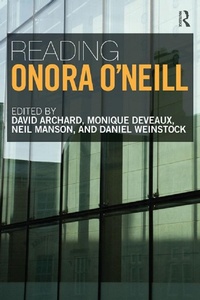
Reading Onora O'Neill
1st Edition
Published on 24. July 2013
264 pages
978-1-135-01761-3 (ISBN)
Description

Onora O'Neill is one of the foremost moral philosophers writing today. Her work on ethics and bioethics, political philosophy and the philosophy of Kant is extremely influential. Her landmark Reith Lectures on trust did much to establish the subject not only on the philosophical and political agenda but in the world of media, business and law more widely.
Reading Onora O'Neill is the first book to examine and critically appraise the work of this important thinker. It includes specially commissioned chapters by leading international philosophers in ethics, Kantian philosophy and political philosophy. The following aspects of O'Neill's work are examined:
global justice
Kant
the ethics of the family
bioethics
consent
trust.
Featuring a substantial reply to her critics at the end of the book, Reading Onora O'Neill is essential reading for students and scholars of ethics and political philosophy.
Reading Onora O'Neill is the first book to examine and critically appraise the work of this important thinker. It includes specially commissioned chapters by leading international philosophers in ethics, Kantian philosophy and political philosophy. The following aspects of O'Neill's work are examined:
global justice
Kant
the ethics of the family
bioethics
consent
trust.
Featuring a substantial reply to her critics at the end of the book, Reading Onora O'Neill is essential reading for students and scholars of ethics and political philosophy.
Reviews / Votes
"... this volume provides a wide-ranging and high quality overview of O'Neill's contributions to moral philosophy. The essays are also of considerable philosophical interest in their own right. I commend the volume to anyone with interest in O'Neill's work, or in broader issues of Kantianism, constructivism, autonomy, consent, and trust." - Anna Stilz, Notre Dame Philosophical Reviews"Lucid and timely, these essays honour the arguments of this exceptional moral philosopher, not by meekly accepting them, but by challenging them, and taking them in new directions. The breadth of their topics reflects the range of O'Neill's reflective engagement: what autonomy, consent and independence mean for fallible agents, and why these matter; whether moral norms are in some sense constructed; whether we have a right to have children; what hope means for Kant's account of ethics and religion. Especially timely are responses to O'Neill's work on trust and communication, looking at testimony in contexts rife with prejudice. In their own way, these essays offer answers to Kant's famous trio of questions: What can I know? What must I do? What may I hope? The answers they propose are sometimes more realistic than Kant's own, since, following O'Neill's lead, they do better justice to our vulnerabilities and limitations, as knowers and agents living in social circumstances that are far from ideal-and in so doing, they offer eloquent proof of O'Neill's continuing power to inspire and engage." - Rae Langton, Massachusetts Institute of Technology, USA
More details
Language
English
Place of publication
London
United Kingdom
Publishing group
Taylor & Francis Ltd
Target group
College/higher education
Product notice
Reflowable
File size
1,32 MB
ISBN-13
978-1-135-01761-3 (9781135017613)
Copyright in bibliographic data and cover images is held by Nielsen Book Services Limited or by the publishers or by their respective licensors: all rights reserved.
Schweitzer Classification
Other editions
Additional editions
David Archard | Monique Deveaux | Neil Manson
Reading Onora O'Neill
Book
06/2013
1st Edition
Routledge
€206.50
Shipment within 15-20 days
David Archard | Monique Deveaux | Neil Manson
Reading Onora O'Neill
Book
06/2013
1st Edition
Routledge
€74.50
Shipment within 15-20 days
Persons
Onora O'Neill, Baroness O'Neill of Bengarve, is Professor of Philosophy Emeritus at the University of Cambridge, UK. She is a former President of the British Academy, and former chair of the Nuffield Foundation, and now chairs the Equality and Human Rights Commission. In 2002 she delivered the BBC Reith Lectures, A Question of Trust. Her publications include Towards Justice and Virtue, Bounds of Justice, and Autonomy and Trust in Bioethics.
David Archard is Professor of Philosophy in the School of Politics, International Studies and Philosophy at Queen's University, Belfast, UK.
Monique Deveaux is Professor of Philosophy and Canada Research Chair of Ethics and Global Social Change at the University of Guelph, Canada.
Neil Manson is Senior Lecturer in Philosophy in the Department of Politics, Philosophy and Religion at Lancaster University, UK.
Daniel Weinstock is Professor in the Faculty of Law and member of the Research Group on Constitutional Studies at McGill University, Canada.
David Archard is Professor of Philosophy in the School of Politics, International Studies and Philosophy at Queen's University, Belfast, UK.
Monique Deveaux is Professor of Philosophy and Canada Research Chair of Ethics and Global Social Change at the University of Guelph, Canada.
Neil Manson is Senior Lecturer in Philosophy in the Department of Politics, Philosophy and Religion at Lancaster University, UK.
Daniel Weinstock is Professor in the Faculty of Law and member of the Research Group on Constitutional Studies at McGill University, Canada.
Content
Introduction David Archard, Monique Deveaux, Neil Manson, and Daniel Weinstock Part 1: Kant on Action and Reason 1. Moral Worth and Moral Rightness, Maxims and Actions Marcia Baron 2. Constructivist Practical Reasoning and Objectivity Melissa Barry 3. Varieties of Constructivism Thomas Hill Jr. 4. Hope as Prudence: Practical Faith in Kant's Political Thinking Katrin Flikschuh Part 2: Agency , Consent and Autonomy 5. Informed Consent and Referential Opacity Neil Manson 6. Respect for Autonomy in Medical Ethics Suzanne Uniacke 7. Independence, Dependence, and the Liberal Subject Marilyn Friedman Part 3: Some Practical Questions 8. Agents of Global Justice Simon Caney 9. Procreative Rights and Procreative Duties David Archard Part 4:Trustworthiness and Trust 10. What is Trust? Annette Baier 11. Distrusting the Trustworthy Karen Jones 12. Trust in Institutions Daniel Weinstock Responses Onora O'Neill. Index
