

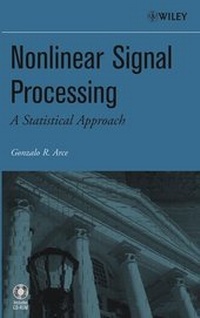
Nonlinear Signal Processing
Description

Reviews / Votes
"This book will be a valuable textbook for students and researchersinterested in learning nonlinear signal processing techniquesdesigned to be robust against heavy-tailed error distributions."(Journal of the American Statistician, December 2008) "This comprehensive book...will be a good reference for boththe trained statisticians and engineers." (Technometrics,February 2006)More details
Other editions
Additional editions
Person
Content
Acknowledgments.
Acronyms.
1. Introduction.
1.1 Non-Gaussian Random Processes.
1.1.1 Generalized Gaussian Distributions and Weighted Medians.
1.1.2 Stable Distributions and Weighted Myriads.
1.2 Statistical Foundations.
1.3 The Filtering Problem.
1.3.1 Moment Theory.
PART I: STATISTICAL FOUNDATIONS.
2. Non-Gaussian Models.
2.1 Generalized Gaussian Distributions.
2.2 Stable Distributions.
2.2.1 Definitions.
2.2.2 Symmetric Stable Distributions.
2.2.3 Generalized Central Limit Theorem.
2.2.4 Simulation of Stable Sequences.
2.3 Lower Order Moments.
2.3.1 Fractional Lower Order Moments.
2.3.2 Zero Order Statistics.
2.3.3 Parameter Estimation of Stable Distributions.
Problems.
3. Order Statistics.
3.1 Distributions of Order Statistics.
3.2 Moments of Order Statistics.
3.2.1 Order Statistics From Uniform Distributions.
3.2.2 Recurrence Relations.
3.3 Order Statistics Containing Outliers.
3.4 Joint Statistics of Ordered and Non-Ordered Samples.
Problems.
4. Statistical Foundations of Filtering.
4.1 Properties of Estimators.
4.2 Maximum Likelihood Estimation.
4.3 Robust Estimation.
Problems.
PART II: SIGNAL PROCESSING WITH ORDER STATISTICS.
5. Median and Weighted Median Smoothers.
5.1 Running Median Smoothers.
5.1.1 Statistical Properties.
5.1.2 Root Signals (Fixed Points).
5.2 Weighted Median Smoothers.
5.2.1 The Center Weighted Median Smoother.
5.2.2 Permutation Weighted Median Smoothers.
5.3 Threshold Decomposition Representation.
5.3.1 Stack Smoothers.
5.4 Weighted Medians in Least Absolute Deviation (LAD) Regression.
5.4.1 Foundation and Cost Functions.
5.4.2 LAD Regression with Weighted Medians.
5.4.3 Simulation.
Problems.
6. Weighted Median Filters.
6.1 Weighted Median Filters With Real-Valued Weights.
6.1.1 Permutation Weighted Median Filters.
6.2 Spectral Design of Weighted Median Filters.
6.2.1 Median Smoothers and Sample Selection Probabilities.
6.2.2 SSPs for Weighted Median Smoothers.
6.2.3 Synthesis of WM Smoothers.
6.2.4 General Iterative Solution.
6.2.5 Spectral Design of Weighted Median Filters Admitting Real-Valued Weights.
6.3 The Optimal Weighted Median Filtering Problem.
6.3.1 Threshold Decomposition for Real-Valued Signals.
6.3.2 The Least Mean Absolute (LMA) Algorithm.
6.4 Recursive Weighted Median Filters.
6.4.1 Threshold Decomposition Representation of Recursive WM Filters.
6.4.2 Optimal Recursive Weighted Median Filtering.
6.5 Mirrored Threshold Decomposition and Stack Filters.
6.5.1 Stack Filters.
6.5.2 Stack Filter Representation of Recursive WM Filters.
6.6 Complex Valued Weighted Median Filter.
6.6.1 Phase Coupled Complex WM Filters.
6.6.2 Marginal Phase Coupled Complex WM Filter.
6.6.3 Complex Threshold Decomposition.
6.6.4 Optimal Marginal Phase Coupled Complex WM.
6.6.5 Spectral Design of Complex Valued Weighted Medians.
6.7 Weighted Median Filters for Multichannel Signals.
6.7.1 Marginal WM Filter.
6.7.2 Vector WM Filter.
6.7.3 Weighted Multichannel Median Filtering Structures.
6.7.4 Filter Optimization.
Problems.
7. Linear Combination or Order Statistics.
7.1 L-Estimates of Location.
7.2 L-Smoothers.
7.3 Ll-Filters.
7.3.1 Design and Optimization of Ll Filters.
7.4 Ljl Permutation Filters.
7.5 Hybrid Median/Linear FIR Filters.
7.5.1 Median and FIR Affinity Trimming.
7.6 Linear Combination of Weighted Medians.
7.6.1 LCWM Filters.
7.6.2 Design of LCWM Filters.
7.6.3 Symmetric LCWM Filters.
Problems.
PART III: SIGNAL PROCESSING WITH THE STABLE MODEL.
8. Myriad Smoothers.
8.1 FLOM Smoothers.
8.2 Running Myriad Smoothers.
8.3 Optimality of the Sample Myriad.
8.4 Weighted Myriad Smoothers.
8.5 Fast Weighted Myriad Computation.
8.6 Weighted Myriad Smoother Design.
8.6.1 Center Weighted Myriads for Image Denoising.
8.6.2 Myriadization.
Problems.
9. Weighted Myriad Filters.
9.1 Weighted Myriad Filters with Real-Valued Weights.
9.2 Fast Real-Valued Weighted Myriad Computation.
9.3 Weighted Myriad Filter Design.
9.3.1 Myriadization.
9.3.2 Optimization.
Problems.
References.
Appendix A: Software Guide.
Index.
