

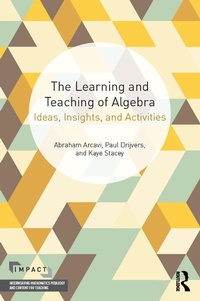
The Learning and Teaching of Algebra
Ideas, Insights and Activities
Published on 23. June 2016
158 pages
978-1-134-82070-2 (ISBN)
Description

IMPACT (Interweaving Mathematics Pedagogy and Content for Teaching) is an exciting new series of texts for teacher education which aims to advance the learning and teaching of mathematics by integrating mathematics content with the broader research and theoretical base of mathematics education.
The Learning and Teaching of Algebra provides a pedagogical framework for the teaching and learning of algebra grounded in theory and research.
Areas covered include:
* Algebra: Setting the Scene
* Some Lessons From History
* Seeing Algebra Through the Eyes of a Learner
* Emphases in Algebra Teaching
* Algebra Education in the Digital Era
This guide will be essential reading for trainee and qualified teachers of mathematics, graduate students, curriculum developers, researchers and all those who are interested in the "problematique" of teaching and learning algebra. It allows you to get involved in the wealth of knowledge that teachers can draw upon to assist learners, helping you gain the insights that mastering algebra provides.
The Learning and Teaching of Algebra provides a pedagogical framework for the teaching and learning of algebra grounded in theory and research.
Areas covered include:
* Algebra: Setting the Scene
* Some Lessons From History
* Seeing Algebra Through the Eyes of a Learner
* Emphases in Algebra Teaching
* Algebra Education in the Digital Era
This guide will be essential reading for trainee and qualified teachers of mathematics, graduate students, curriculum developers, researchers and all those who are interested in the "problematique" of teaching and learning algebra. It allows you to get involved in the wealth of knowledge that teachers can draw upon to assist learners, helping you gain the insights that mastering algebra provides.
Reviews / Votes
"The book makes a valuable contribution to the existing literature in terms of the teaching and learning of algebra. At the same time it is different, in various ways: one of the differences is that it has been co-authored by three authors, rather than edited, which provides the reader with a more coherent reading."- Birgit Pepin, Nieuw Archief voor Wiskunde (Dutch Journal of the Royal Mathematics Society)More details
Series
Language
English
Place of publication
London
United Kingdom
Publishing group
Taylor & Francis Ltd
Target group
College/higher education
Illustrations
12 s/w Tabellen, 27 s/w Photographien bzw. Rasterbilder, 19 s/w Zeichnungen
12 Tables, black and white; 19 Line drawings, black and white; 27 Halftones, black and white
File size
7,94 MB
ISBN-13
978-1-134-82070-2 (9781134820702)
Copyright in bibliographic data and cover images is held by Nielsen Book Services Limited or by the publishers or by their respective licensors: all rights reserved.
Schweitzer Classification
Other editions
Additional editions
Abraham Arcavi | Paul Drijvers | Kaye Stacey
The Learning and Teaching of Algebra
Ideas, Insights and Activities
Book
07/2016
1st Edition
Routledge
€195.70
Shipment within 15-20 days
Abraham Arcavi | Paul Drijvers | Kaye Stacey
The Learning and Teaching of Algebra
Ideas, Insights and Activities
Book
07/2016
1st Edition
Routledge
€64.70
Shipment within 15-20 days
Persons
Abraham Arcavi holds the Lester B. Pearson Professorial Chair at the Weizmann Institute of Science, Israel. He has written about the teaching and learning of algebra for researchers and teachers, led large curriculum development projects, and has been involved in teacher professional development for more than 30 years.
Paul Drijvers is Professor of Mathematics Education at the Freudenthal Institute, Utrecht University, The Netherlands. His research interests include the role of ICT in mathematics education, the teaching and learning of algebra, and teachers' professional development.
Kaye Stacey is Professor Emeritus at the University of Melbourne, Australia, having held the Foundation Chair of Mathematics Education there for 20 years. She has made major contributions to understanding students' early learning of formal algebra and discovering how information technology can enhance the teaching of algebra and functions throughout secondary school.
Paul Drijvers is Professor of Mathematics Education at the Freudenthal Institute, Utrecht University, The Netherlands. His research interests include the role of ICT in mathematics education, the teaching and learning of algebra, and teachers' professional development.
Kaye Stacey is Professor Emeritus at the University of Melbourne, Australia, having held the Foundation Chair of Mathematics Education there for 20 years. She has made major contributions to understanding students' early learning of formal algebra and discovering how information technology can enhance the teaching of algebra and functions throughout secondary school.
Content
Preface
1. Algebra - Setting the scene
1.1 Introduction
1.2 Algebra - Aims, actions and entities
1.2.1 Aims
1.2.2 Actions
1.2.3 Entities
1.3 Why Algebra?
1.4 Chapter Summary
1.5 Thinking further
1.6 References
2. Some lessons from history
2.1 Introduction
2.2 Linear equations in ancient Egypt
2.3 Quadratic equations in ancient Babylonia
2.4 A geometric view of algebra from Arabic mathematics
2.5 Beyond solving equations: The emergence of algebra in Europe
2.5.1 Some algebraic rules and their explanation
2.5.2 Negative numbers
2.6 Chapter summary
2.7 Thinking further
2.8 References
3. Seeing algebra through the eyes of a learner
3.1 Introduction - putting on teachers' bifocal spectacles
3.2 What do algebraic letters represent?
3.2.1 Fruit salad algebra - misleading teaching with long term consequences
3.3 The process-object duality
3.4 The meaning of the equals sign
3.5 Algebra for recording and revealing mathematical structure
3.6 Transitions from arithmetic to algebra
3.6.1 Contrasting arithmetic and algebraic problem solving
3.6.2 Fundamental ideas of equation solving
3.6.3 Algebra and creativity
3.7 The procedures of equation solving
3.7.1 Process-object distinction in solving simultaneous equations
3.8 Functions as processes and objects
3.9 Chapter Summary
3.10 Thinking Further
3.11 References
Chapter 4: Emphases in algebra teaching
4.1 Introduction
4.2 Teaching algebra in context
4.3 Productive practice
4.4 The reconciliation of routine and insight
4.5 Exploiting student mistakes
4.6 Proofs in algebra teaching
4.7 Chapter summary
4.8 Thinking further
4.9 References
5. Algebra education in the digital era
5.1 Introduction
5.2 Digital tools for algebra
5.2.1 Algebraic functionality of digital tools
5.2.2 Pedagogical roles of digital tools for algebra
5.3 Core algebra entities with digital means
5.3.1 Variable
5.3.2 Equation and equivalence
5.3.3 Function
5.4 Teaching and learning algebra with digital means
5.5 Chapter summary
5.6 Thinking further
5.7 References
Epilogue
1. Algebra - Setting the scene
1.1 Introduction
1.2 Algebra - Aims, actions and entities
1.2.1 Aims
1.2.2 Actions
1.2.3 Entities
1.3 Why Algebra?
1.4 Chapter Summary
1.5 Thinking further
1.6 References
2. Some lessons from history
2.1 Introduction
2.2 Linear equations in ancient Egypt
2.3 Quadratic equations in ancient Babylonia
2.4 A geometric view of algebra from Arabic mathematics
2.5 Beyond solving equations: The emergence of algebra in Europe
2.5.1 Some algebraic rules and their explanation
2.5.2 Negative numbers
2.6 Chapter summary
2.7 Thinking further
2.8 References
3. Seeing algebra through the eyes of a learner
3.1 Introduction - putting on teachers' bifocal spectacles
3.2 What do algebraic letters represent?
3.2.1 Fruit salad algebra - misleading teaching with long term consequences
3.3 The process-object duality
3.4 The meaning of the equals sign
3.5 Algebra for recording and revealing mathematical structure
3.6 Transitions from arithmetic to algebra
3.6.1 Contrasting arithmetic and algebraic problem solving
3.6.2 Fundamental ideas of equation solving
3.6.3 Algebra and creativity
3.7 The procedures of equation solving
3.7.1 Process-object distinction in solving simultaneous equations
3.8 Functions as processes and objects
3.9 Chapter Summary
3.10 Thinking Further
3.11 References
Chapter 4: Emphases in algebra teaching
4.1 Introduction
4.2 Teaching algebra in context
4.3 Productive practice
4.4 The reconciliation of routine and insight
4.5 Exploiting student mistakes
4.6 Proofs in algebra teaching
4.7 Chapter summary
4.8 Thinking further
4.9 References
5. Algebra education in the digital era
5.1 Introduction
5.2 Digital tools for algebra
5.2.1 Algebraic functionality of digital tools
5.2.2 Pedagogical roles of digital tools for algebra
5.3 Core algebra entities with digital means
5.3.1 Variable
5.3.2 Equation and equivalence
5.3.3 Function
5.4 Teaching and learning algebra with digital means
5.5 Chapter summary
5.6 Thinking further
5.7 References
Epilogue
