

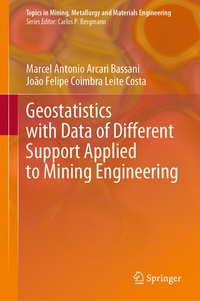
Geostatistics with Data of Different Support Applied to Mining Engineering
Description

This book explains the integration of data of different support in Geostatistics. There is a common misconception in the mining industry that the data used for estimation/simulation should have the same size or support. However, Geostatistics provides the tools to integrate several types of information that may have different support. This book aims to explain these geostatistical tools and provides several examples of applications. The book is directed for a broad audience, including engineers, geologists, and students in the area of Geostatistics.
More details
Other editions
Additional editions
Persons
Marcel Bassani is currently an adjunct professor in the area of Geostatistics in the Federal University of Rio Grande do Sul. He is a mining engineer with a Masters and Doctorate Degree in the area of Geostatistics. He has worked extensively in the use of data of different support in Geostatisitcs, multivariate geostatistical simulation, and unstructured grids during his studies. His research is focused on solving real problems from the industry related to Geostatistics and building better numerical geostatistical models.
Joao Felipe Costa is a professor at Mining Engineer Department at Federal University of Rio Grande do Sul, Brazil, where he joined in 1986. Before joining the university, he served as a mining engineer at a major coal operation in south Brazil for seven years. During this time, he was involved in mining unit operations optimization involving computer applications in the early 80s. He received a B.Sc. and M.Sc. in mining engineering fromthe same university where he serves up today in 1983 and 1992, respectively. He also was awarded a Ph.D. degree in Geostatistics from the University of Queensland in 1997. He has coordinated the mineral exploration and mine planning research laboratory (LPM) at his university for the last 26 years.
Content
Chapter 1 - Introduction.- Chapter 2 - Kriging with data of different support.- Chapter 3 - Simulation with data of different support.- Chapter 4 - Change of support in the variogram.- Chapter 5 - Case study of kriging with data of different support.- Chapter 6 - Case study of direct sequential simulation with data of different support.- Chapter 8 - Case study of sequential indicator simulation with data of different support.- Chapter 9 - Conclusions.
