

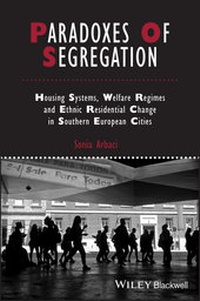
Paradoxes of Segregation
Description

* Focuses on eight Southern European cities, develops new metaphors and furthers the theorisation/conceptualisation of segregation in Europe
* Re-centres the segregation debate on the causes of marginalisation and inequality, and the role of the state in these processes
* A pioneering analysis of which and how systemic mechanisms, contextual conditions, processes and changes drive patterns of ethnic segregation and forms of socio-ethnic differentiation
* Develops an innovative inter-disciplinary approach which explores ethnic patterns in relation to European welfare regimes, housing systems, immigration waves, and labour systems
More details
Other editions
Additional editions


Person
Sonia Arbaci is Associate Professor at the Bartlett School of Planning, University College London, UK. Her research draws on European comparative studies and focuses on ethnic residential segregation and the role of welfare/housing systems and urban policies in the production of urban inequality. She has published extensively in journals including International Journal of Urban and Regional Research, Housing Studies, International Journal of Housing Policy, Journal of Ethnic and Migration Studies, and European Urban and Regional Studies.
Content
List of Figures viii
Series Editors' Preface xiii
Preface xiv
1 Introduction 1
Paradoxes of Segregation? 2
Recentring the Debate on the Production of Urban Inequality 5
The Value of the (European) Periphery 12
Structure of the Book 13
Notes 18
2 Theorising Segregation from Europe 21
Reconceptualising Segregation: Societal Transformations and the Transatlantic Debate 24
Southern Europe ... a View from the Periphery 47
Framework for the Book 54
Notes 60
3 Welfare Regimes and National Housing Systems in Europe 63
Welfare Clusters and Segregation 65
Linking Welfare Regimes and Housing Systems: Principles of Stratification and Mechanisms of Differentiation 70
How Mechanisms of Differentiation Inform the Social and Spatial Dimensions of Segregation: Land Supply, Tenure and Provision 81
Conclusion 90
Notes 92
4 International Migration Turnaround 95
Models, Frameworks and Theories in Migration Studies: Towards a Social Transformation Perspective 97
The (Southern) European Migration Turnaround 100
Mapping Flows and Waves: A Divergence Perspective on Southern Europe 109
Conclusion 123
Notes 124
5 Societal and Urban Contexts in (Southern) Europe 127
Patterns of Segregation: A Southern European Model? 131
Mechanisms of Differentiation: Urban Segregation in the Wider Societal Context 136
Mechanisms of Ethnic Residential Marginalisation: From Systemic Arrangements to Local Urban Political Agendas 141
Conclusion 147
Notes 149
6 A Mosaic of Ethnic Segregation Patterns: Southern European Cities in the 1990s 151
Mapping Ethnic Segregation 152
Socio-Spatial Distribution of the Native Population: A Contextual Legacy 172
Contrasting Ethnic and Social Residential Patterns 186
Conclusion 193
Note 194
7 Mechanisms of Differentiation: The Role of Local Housing Systems up to the 1990s 195
Housing Tenure Perspectives to Understand Inequalities 196
Mechanisms of Socio-Tenurial and Socio-Spatial Differentiation 200
Conclusion 221
Notes 224
8 Changing Urban Societies: New Mechanisms of Differentiation from the 1990s 225
Changing Housing Systems: Path-Dependency and Systemic Shifts 227
Growing Homeowning Cities: New Mechanisms of Differentiation, Residential Marginalisation and Diffuse Segregation 243
Conclusion 258
Notes 260
9 The Urban Diaspora: The Paradox of (De)Segregation 262
Widening Ethnic Residential Marginalisation and Socio-Tenurial Differentiation 263
Diffusing Ethnic Segregation: An Indicator of Exclusion 278
Conclusion 298
10 Towards a Systemic Understanding of (Ethnic) Residential Segregation 300
Redistribution, Distinctiveness ... and Housing Systems 301
Looking Ahead: Emerging Processes and Challenges 309
It's the State, Stupid 312
References 315
Index 354
