

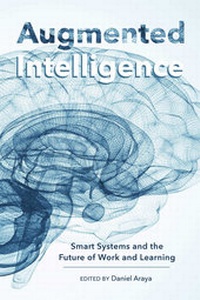
Augmented Intelligence
Description

Where the Agricultural Revolution harnessed domesticated animals for pastoral farming, and the Industrial Revolution leveraged machines for factory production, so today the Computational Revolution is advancing computers to augment human intelligence. Indeed, many now argue that the promise of exascale computing and the slow migration towards a computational society may represent a new threshold in human history. This "transcension" of earlier stages of tool-mediated work and learning foreshadows a momentous change in the kinds of cities we might build, the kinds of medicine we might practice, and the kinds of education we might provide. What is perhaps most surprising about the current Computational Revolution, however, is its expanding reach. The question that many now ask is "what is the trajectory of this human-machine symbiosis?" It would appear that we are on the cusp of a sea change in our capacities to augment human intelligence. But what is the future of work and learning? Will augmented intelligence help us in transforming a waning industrial society? These are the kinds of questions that we explore in Augmented Intelligence: Smart Systems and the Future of Work and Learning.
More details
Other editions
Additional editions
Person
Daniel Araya is a researcher and advisor to government with a special interest in technological innovation, public policy, and education. He is a Sharing Cities Policy Fellow and a regular contributor to various media outlets including Futurism, The Brookings Institution, Singularity Hub, and Medium. He has written or edited eight books overlapping public policy and technological innovation and is an alumnus of Singularity University in Silicon Valley. He is also a film producer and holds a doctorate from the University of Illinois at Urbana-Champaign.
Content
List of Figures - List of Tables - Ann Pendleton-Jullian/John Seely Brown: Foreword - Daniel Araya: Introduction - Colin G. Harrison: Augmented Intelligence and Society - Jim Spohrer/M. Abul Kalam Siddike: The Future of Digital Cognitive Systems: Tool, Assistant, Collaborator, Coach, Mediator - Daniel Araya/Kevin Stolarick: Augmented Intelligence: Work and Class in the Age of Machine Intelligence - Rodrigo Nieto-Gómez: This Is Your Brain on Code: Embodied Intelligence Augmentation and the Evolution of Conict - Yana B. Feygin/Kelly Morris/Roman V. Yampolskiy: Intelligence Augmentation: Uploading Brain into Computer: Who First? - Jovan D. Rebolledo-Mendez: The Intersection of the Human Senses and Exponential Technologies: Exploring Relevant Trends and the Future of the Senses - Stan Ruecker/Susan Liepert: Augmented Intelligence Continues to Be Embodied Intelligence - Alix Rübsaam: Augmenting the Posthuman: The Return of Humanist Discourse in Posthumanist Environments - Rita Kop: What Augmented Intelligence? Power and Control in the Era of Open Networked Learning - Robert David Steele: Augmented Intelligence with Human-Machine Integrity: Future-Oriented Hybrid Governance Integrating Holistic Analytics, True Cost Economics, and Open Source Everything Engineering (OSEE) - James D. Miller: For Pleasure or Productivity: Divergent Paths in Intelligence Augmentation - Darlene Damm: Building Human Character in a World of Augmented Intelligence - About the Contributors - Index.
