

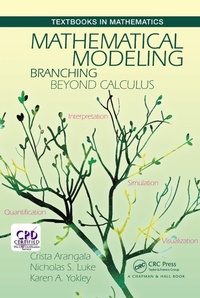
Mathematical Modeling
Branching Beyond Calculus
1st Edition
Published on 31. January 2018
316 pages
978-1-4987-7103-0 (ISBN)
Description

Mathematical Modeling: Branching Beyond Calculus reveals the versatility of mathematical modeling. The authors present the subject in an attractive manner and flexibley manner. Students will discover that the topic not only focuses on math, but biology, engineering, and both social and physical sciences.
The book is written in a way to meet the needs of any modeling course. Each chapter includes examples, exercises, and projects offering opportunities for more in-depth investigations into the world of mathematical models. The authors encourage students to approach the models from various angles while creating a more complete understanding. The assortment of disciplines covered within the book and its flexible structure produce an intriguing and promising foundation for any mathematical modeling course or for self-study.
Key Features:
Chapter projects guide more thorough investigations of the models
The text aims to expand a student's communication skills and perspectives
WThe widespread applications are incorporated, even includinge biology and social sciences
Its structure allows it to serve as either primary or supplemental text
Uses Mathematica and MATLAB are used to develop models and computations
The book is written in a way to meet the needs of any modeling course. Each chapter includes examples, exercises, and projects offering opportunities for more in-depth investigations into the world of mathematical models. The authors encourage students to approach the models from various angles while creating a more complete understanding. The assortment of disciplines covered within the book and its flexible structure produce an intriguing and promising foundation for any mathematical modeling course or for self-study.
Key Features:
Chapter projects guide more thorough investigations of the models
The text aims to expand a student's communication skills and perspectives
WThe widespread applications are incorporated, even includinge biology and social sciences
Its structure allows it to serve as either primary or supplemental text
Uses Mathematica and MATLAB are used to develop models and computations
Reviews / Votes
Undergraduate textbooks on calculus, differential equations, and linear algebra usually contain a few exercises per chapter that use their subject to model a phenomenon from outside mathematics-typically from physics, biology, chemistry, engineering, or economics. In a typical class, these applications do not amount to more than ten percent of class time. In this book, the authors collect modeling examples from those three areas and make them the central focus of their book. For most of the book, no new theory is covered; instead, the authors provide brief refreshers on some of the necessary theoretical concepts from calculus, differential equations, and linear algebra. The intended audience is second- or third-year students who have already taken those classes. A few exercises accompany each section, with solutions included at the end of the book. The fifth and last chapter does contain material that will be new to most mid-career undergraduates, such as Monte-Carlo simulations and the Prisoners' Dilemma. This book seems ideally suited to an undergraduate class on modeling-a class that few institutions likely offer-and may serve some as a means of independent study.--M. Bona, University of Florida
More details
Series
Language
English
Place of publication
Philadelphia, PA
United States
Publishing group
Taylor & Francis Inc
Target group
College/higher education
Product notice
Reflowable
Illustrations
149 s/w Abbildungen, 46 s/w Tabellen
46 Tables, black and white; 149 Illustrations, black and white
File size
7,12 MB
ISBN-13
978-1-4987-7103-0 (9781498771030)
Copyright in bibliographic data and cover images is held by Nielsen Book Services Limited or by the publishers or by their respective licensors: all rights reserved.
Schweitzer Classification
Other editions
Additional editions
Book
01/2023
1st Edition
Chapman & Hall/CRC
€81.97
Shipment within 10-20 days
Book
02/2018
1st Edition
Chapman & Hall/CRC
€156.20
Shipment within 15-20 days
Persons
Dr. Crista Arangala is a professor at Elon University with a Ph.D. in mathematics from the University of Cincinnati. She teaches and researches areas from mathematical modeling to learning service education. Together with her Elon students, she runs a traveling science museum in Kerala, India. She also authored the book Exploring Linear Algebra: Labs and Projects Using Mathematica. In 2014 she was named a Fulbright Scholar.
Dr. Nicholas S. Luke is an associate professor at North Carolina Agricultural and Technical State University with a Ph.D. in computational applied mathematics from North Carolina State University. He has won multiple teaching awards for his approach to courses from college algebra to differential equations. Currently, he focuses his research on mathematical modeling of biological systems.
Dr. Karen A. Yokley is an associate professor at Elon University with a Ph.D. in computational applied mathematics from North Carolina State University. She teaches various undergraduate mathematics courses, and her research interests include modeling biological systems with ordinary differential equations. She co-authored the book, Exploring Calculus: Labs and Projects Using Mathematica, with Dr. Arangala.
Dr. Nicholas S. Luke is an associate professor at North Carolina Agricultural and Technical State University with a Ph.D. in computational applied mathematics from North Carolina State University. He has won multiple teaching awards for his approach to courses from college algebra to differential equations. Currently, he focuses his research on mathematical modeling of biological systems.
Dr. Karen A. Yokley is an associate professor at Elon University with a Ph.D. in computational applied mathematics from North Carolina State University. She teaches various undergraduate mathematics courses, and her research interests include modeling biological systems with ordinary differential equations. She co-authored the book, Exploring Calculus: Labs and Projects Using Mathematica, with Dr. Arangala.
Content
Chapter 1: Modeling with Calculus; Exploring Extrema; Modeling with The Fundamental Theorem of Calculus; Probability Distributions; Introduction to Stochastic Processes Applications of Sequences and Series; Fibonacci and Lucas Sequences; Taylor Approximations Fourier Series and Signal Processing. Chapter 2: Modeling with Linear Algebra; Modeling with Graphs; Stochastic Models - Markov Chains; Leslie Matrices and other Matrix Models; Linear Programming; Game Theory. Chapter 3: Modeling with Programming; Simulations; Automata Models; Branching Theory. Chapter 4: Modeling with Ordinary Differential Equations; Introduction of Modeling with Differential Equations and Difference Equations; Basic Growth Models; Finding and Analyzing Equilibrium; Multiple Population Models, Coupled Systems; Epidemic Models; Models in a Variety of Fields.
