

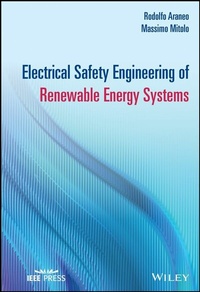
Electrical Safety Engineering of Renewable Energy Systems
Description

A reference to designing and developing electrical systems connected to renewable energies
Electrical Safety Engineering of Renewable Energy Systems is an authoritative text that offers an in-depth exploration to the safety challenges of renewable systems. The authors--noted experts on the topic--cover a wide-range of renewable systems including photovoltaic, wind, and cogeneration and propose a safety-by-design approach. The book clearly illustrates safe behavior in complex real-world renewable energy systems using practical approaches.
The book contains a review of the foundational electrical engineering topics and highlights how safety engineering links to the renewable energies. Designed as an accessible resource, the text discusses the most relevant and current topics supported by rigorous analytical, theoretical and numerical analyses. The authors also provide guidelines for readers interested in practical applications. This important book:
* Reviews of the major electrical engineering topics
* Shows how safety engineering links to the renewable energies
* Discusses the most relevant current topics in the field
* Provides solid theoretical and numerical explanations
Written for students and professional electrical engineers, Electrical Safety Engineering of Renewable Energy Systems explores the safety challenges of renewable systems and proposes a safety-by-design approach, which is currently missing in current literature.
More details
Other editions
Additional editions
Persons
RODOLFO ARANEO, PhD, is an Associate Professor at the Department of Electrical Engineering at the University of Rome "La Sapienza".
MASSIMO MITOLO, PhD, is a Professor of Physics and Electrical Engineering at the School of Integrated Design, Engineering and Automation of the Irvine Valley College, Irvine California.
Content
Preface ix
Acknowledgments xi
1 Fundamental Concepts of Electrical Safety Engineering 1
1.1 Introduction 1
1.2 Electric Shock 2
1.2.1 Ventricular Fibrillation 3
1.2.2 The Heart-current Factor 5
1.3 The Electrical Impedance of the Human Body 6
1.3.1 The Internal Resistance of the Human Body 7
1.4 Thermal Shock 10
1.5 Heated Surfaces of Electrical Equipment and Contact Burn Injuries 12
1.6 Ground-Potential and Ground-Resistance 14
1.6.1 Area of Influence of a Ground-electrode 18
1.7 Hemispherical Electrodes in Parallel 18
1.8 Hemispherical Electrodes in Series 19
1.9 Person's Body Resistance-to-ground and Touch Voltages 20
1.10 Identification of Extraneous-Conductive-Parts 24
1.11 Measuring Touch Voltages 26
2 Safety-by-Design Approach in AC/DC Systems 31
2.1 Introduction 31
2.2 Class I PV Equipment 33
2.3 Class II PV Equipment 35
2.4 Ground Faults and Ground Fault Protection 35
2.5 Functionally Grounded PV Systems 37
2.6 Non-Ground-Referenced PV Systems 40
2.7 Ground-Referenced PV Systems 42
2.8 Fire Hazard in Ground-Referenced PV Systems 44
2.9 Faults at Loads Downstream the PV Inverter in Ground-Referenced PV Systems 47
2.10 Non-Electrically Separated PV System 48
2.11 PV Systems Wiring Methods and Safety 50
2.12 d.c. Currents and Safety 52
2.13 Electrical Safety of PV Systems 55
2.14 Rapid-Shutdown of PV Arrays on Buildings 57
2.15 Hazard and Risk 58
3 Grounding and Bonding 63
3.1 Introduction 63
3.2 Basic Concepts of Grounding Systems: The Ground Rod 67
3.3 The Maxwell Method 77
3.4 Multiple Rods: Mutual Resistance 83
3.5 Ground Rings and Ground Grid 87
3.6 Complex Arrangements: Rings and Ground Grids Combined with Rods and Horizontal Electrodes 100
4 Lightning Protection Systems 107
4.1 Review of Natural Lightning Physics, Modeling and Protection 108
4.2 Lightning Protection of PV Systems 121
4.2.1 Ground-Mounted PV Systems 124
4.2.2 Rooftop Mounted PV Systems 126
4.2.3 Protection against Overvoltage 128
4.2.4 Surge Protective Devices (SPDs) 130
4.3 Lighting Protection of Wind Turbines 136
4.3.1 Lightning Protection System (LPS) 139
4.3.2 Step and Touch Voltages 143
4.3.3 Lightning Exposure Assessment 144
4.3.4 Assessment of the Average Annual Number of Dangerous Events NL Due to Flashes Directly to and near Service Cables 147
4.3.5 Lightning Protection Zones 149
4.4 High-Frequency Grounding Systems 151
4.4.1 Arrangement of Ground Electrodes 155
4.4.2 Effective Length of a Ground Electrode 157
4.4.3 Frequency-dependent Soil and Ionization 158
5 Renewable Energy System Protection and Coordination 169
5.1 Introduction 169
5.2 Power Collection Systems 170
5.3 Cable Connections 182
5.4 Offshore Wind Farm 188
5.5 Distributed Energy Resources: Battery Energy Storage Systems and Electric Vehicles 192
6 Soil Resistivity Measurements and Ground Resistance 205
6.1 Soil Resistivity Measurements 205
6.2 Wenner Method 208
6.3 Schlumberger Method 214
6.4 Multi-layer Soils 214
6.4.1 Ground Grid in Multi-layer Soil 217
6.4.2 Ground Rod in Multi-layer Soil 219
6.5 Fall-of-Potential Method for Ground Resistance Measurement 220
6.6 Slope Method for Grounding Resistance Measurement 223
6.7 Star-delta Method for Grounding Resistance Measurement 224
6.8 Four Potential Method for Grounding Resistance Measurement 225
6.9 Potentiometer Method for Grounding Resistance Measurement 226
Appendix 1: Performance of Grounding Systems in Transient Conditions 231
1 Grounding System Analysis 232
2 Mathematical Model 233
3 Computation of Impedances 235
4 Green's Function 237
4.1 Static Formulation 237
4.1.1 One-Layer Ground 242
4.1.2 Two-Layer Ground 243
4.2 Dynamic Formulation 245
4.2.1 Equivalent Transmission Line Approach 249
5 Numerical Integration Aspects 252
5.1 Singular Term 252
5.2 Sommerfeld Integrals 254
Appendix 2: Cable Failures in Renewable Energy Systems 265
1 Cable Failures in Renewable Energy Systems: Introduction 266
2 Possible Solutions 267
2.1 Optimal Solutions 268
2.2 Termite Attacks Prevention 269
3 Non-destructive Methods for Cable Testing and Fault-locating 269
3.1 Insulation Resistance (IR) Test 271
3.1.1 IR Measurement of the Cable Insulation (XLPE) 271
3.1.2 IR Measurement of the Polyethylene (PE) Cable Jacket 272
3.2 High-Potential Test 272
3.3 LCR Test 273
3.3.1 Insulation Resistance (IR) 273
3.3.2 Dielectric Absorption Ratio (DAR) 273
3.3.3 Polarization Index (PI) 274
3.3.4 Quality Factor (Q) 274
3.3.5 Dissipation Factor (DF) 274
3.3.6 Time Domain Reflectometry (TDR) Test 275
3.3.7 Arc Reflection (ARC) Test 276
3.3.8 Bridge Methods 276
3.4 Cable Fault Analysis 279
3.4.1 Prelocation 279
3.4.2 Pinpointing 280
4 Sheath and Jacket Repairs 280
5 Termite Baiting Stations and Monitoring 281
6 Termite-proof Cables 283
Index 285
1
Fundamental Concepts of Electrical Safety Engineering
CONTENTS
1.2.1 Ventricular Fibrillation
1.2.2 The Heart-current Factor
1.3 The Electrical Impedance of the Human Body
1.3.1 The Internal Resistance of the Human Body
1.5 Heated Surfaces of Electrical Equipment and Contact Burn Injuries
1.6 Ground-Potential and Ground-Resistance
1.6.1 Area of Influence of a Ground-electrode
1.7 Hemispherical Electrodes in Parallel
1.8 Hemispherical Electrodes in Series
1.9 Person's Body Resistance-to-ground and Touch Voltages
1.10 Identification of Extraneous-Conductive-Parts
I shall be telling this with a sigh
Somewhere ages and ages hence:
Two roads diverged in a wood, and I-
I took the one less traveled by,
And that has made all the difference.
Robert Frost
1.1 Introduction
The renewable energy sector has been rapidly growing in the past decade [1-3], and so has been the number of accidents involving workers in "green" projects. Statistics in the United States reveal that injuries and death are caused by lack of safety training and safety procedures [4]. The Electric hazard, but also Falls, Struck by and Caught in between hazards, are always present during all photovoltaic, solar thermal, and wind tower construction projects, regardless of the magnitude of the job.
The culture of the safety-by-design [5, 6] seems to be the appropriate response to the increased risk offered by renewable energy systems (RES). RES may challenge the safety of workers because they are generally always live, and the system voltage may exceed 500 V d.c.1
In addition to safety training and procedures, electrical safety may be conveyed through engineering measures that reduce the risk of electric shock below a threshold that is conventionally deemed acceptable by applicable standards. In fault-free conditions, the basic protection ensures that persons cannot come into contact with parts normally live (i.e., proper insulation of electrical components). In the case of failure of the basic insulation of components, the fault protection ensures defense against electric shock by automatic interruption of the fault current. In some scenarios, the fault protection may be obtained with alternative methods to the fault current interruption.
In general, the safety-by-design of RES [7] is achieved if hazardous energized parts are never accessible, and that equipment/appliances, also referred to as exposed-conductive-parts (ECPs), are never hazardous either under normal operations or in the event of single-faults. In essence, touch voltages and contact durations must be within the magnitudes deemed safe by applicable technical standards and codes.
1.2 Electric Shock
External electrical stimuli applied to the human body can prevent operational skeletal and cardiac muscles from properly operating, as well as destroy bodily tissues by thermal shock.[8]
External a.c. currents with frequency ranging from 50 to 100 Hz of magnitude around 10 mA for adult males and 15 mA for adult females, can override the internal electrical signals from the brain controlling the body muscles, render the person unable to "let go" of an energized part and cause painful muscle contractions.
For d.c. currents, thresholds of let-go cannot be positively defined. The circulation of d.c. current through the body only causes a sensation of warmth, and the person is subjected to painful muscle contractions only during making and breaking of the d.c. current.
Stevens' Law [9, 10] describes the perceived strength of a physical stimulus as a function of its intensity, expressed in its physical units. According to Stevens' Law, the perception of electric shock is superlinear with the stimulus, as varies as the 3.5 power of the a.c. voltage applied. The coefficient 3.5 relates the magnitude of the applied voltage to the perceived magnitude of the shock as current through the fingers; thus, a small increase in the applied voltage is perceived as a larger increase in the electric shock.
A 30 mA-current, if interrupted within 300 ms, can cause involuntary muscular contractions but usually no harmful electrical physiological effects. Longer disconnection time, up to 5 s, can cause muscular contractions, difficulty in breathing, reversible disturbances of heart function, but usually no organic damage.
Higher body currents inhibit internal muscle control, prejudicing the function of the muscles involved in the breathing process, thus causing asphyxia.
1.2.1 Ventricular Fibrillation
The ventricular fibrillation (V-fib) [11] is the loss of the normal heart rhythm. The V-fib causes the ventricles to quiver, or fibrillate, instead of contracting normally, preventing the heart from pumping blood and causing cardiac arrest. The ventricular fibrillation is the main cause of death in electric shock accidents.
The cardiac muscle, whose fibers have high contractile strength, specializes in pumping blood throughout the person's body. The contractions of the heart are stimulated by the sinoatrial node (SA), situated in the right atrium, which generates electrical impulses. The impulses propagate through the conductive tissues named Bundle of His, and Purkinje fibers, and reach the atrioventricular node (AV), situated in the center of the heart (Figure 1.1).
Figure 1.1 Electric conduction of the heart.
The Bundle of His, which departs from the AV, conducts the stimuli to the ventricles, which, after filling with blood, contract and push the blood through the arteries during the systole. After the contraction, the heart relaxes and fills up with blood again, awaiting further stimuli to contract again.
The net charge of the heart is zero; however, positive and negative charges are dynamically separated during each cardiac cycle and form an electric dipole vector that rotates and varies in magnitude with time. Thus, electric potential differences at different places along the person's body also change with time during each cardiac cycle, and this can be observed in an electrocardiogram (i.e., EKG or ECG) (Figure 1.2). Usually, scalar EKG measurements are performed: vector EKGs, which may more deeply describe the heart dipole rotation, are rarely performed. Typical potential differences showed in the EKG range between 30 and 500 µV.
Figure 1.2 A normal electrocardiogram (EKG).
During the P wave, the right and left atria contract; during the Q-R-S complex, the right and left ventricles contract (systole). The last event of the cycle, the S-T-U interval, is the repolarization of the ventricles: they return to the resting state; their walls relax and await the next signal. This complex procedure continues as the atria refill with blood and more electrical signals are sent by the SA; the heart-period duration is around 400 ms.
The superposition of external currents of larger magnitude to the normal bodily currents will override the control signals from the brain to the skeletal and cardiac muscles, which can no longer operate as intended, exposing persons to the risk of death.
The last half of the T wave is referred to as the relative refractory period, or the vulnerable period, which is known as the crucial time interval during which external electrical stimuli (i.e., electric shock) may induce the ventricular fibrillation.
For shock durations shorter than the cardiac cycle, the ventricular fibrillation may not occur, based on the lower probability that the external stimulus occurs during the vulnerable period of the heart.
For d.c. currents, experiments on animals and data derived from electrical accidents demonstrate that the threshold of V-fib for a downward current is about twice as high as for an upward current; therefore, downward currents are less hazardous than upward currents.
For shock durations longer than the cardiac cycle (e.g., 0.5-1 s), the threshold of fibrillation for d.c. is several times higher than for a.c. However, for shock durations shorter than 200 ms, the threshold of d.c. fibrillation is approximately the same as for a.c. (measured in r.m.s. values).
1.2.2 The Heart-current Factor
The probability that the V-fib is induced is dependent upon the pathway of the body current. To compare the danger of different current paths through the body, standard IEC 60479-12 defines the heart-current factor F [12] (Eq. 1.1).
(1.1)Iref is the body current that determines V-fib for the path left hand to feet, and Ih is the fibrillation current for different body paths, as shown in Table 1.1.
Table 1.1 Heart-current factor F for different current...
