

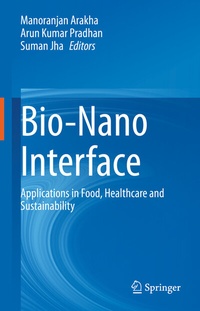
Bio-Nano Interface
Description

This book discusses the unique interactions of nanoparticles with various biomolecules under different environmental conditions. It describes the consequences of these interactions on other biological aspects like flora and fauna of the niche, cell proliferation, etc. The book provides information about the novel and eco-friendly nanoparticle synthesis methods, such as continuous synthesis of nanoparticles using microbial cells. Additionally, the book discusses nanoparticles' potential impact in different areas of biological sciences like food, medicine, agriculture, and the environment. Due to their advanced physicochemical properties, nanoparticles have revolutionized biomedical and pharmaceutical sciences. Inside the biological milieu, nanoparticles interact with different moieties to adopt stable shape, size, and surface functionalities and form nano-biomolecular complexes. The interaction pattern at the interface form complexes determines the fate of interacting biomolecules and nanoparticles inside the biological system. Understanding the interaction pattern at the nano-bio interface is crucial for the safe use of nanoparticles in natural sciences. This book rightly addresses all questions about the interaction and the ensuing structure and function of these nano-biomolecular complexes.
This book caters to students and researchers in the area of biotechnology, microbiology, and pharmaceutical sciences.
More details
Other editions
Additional editions
Persons
Dr. Manoranjan Arakha is an assistant professor at the Centre for Biotechnology, Siksha' O' Anusandhan (Deemed to be University), Bhubaneswar, Odisha, India. He received his doctorate in Life Science from the National Institute of Technology Rourkela, India, in 2017. Subsequently, He pursued post-doctoral research on Bio-Nano interface at University College Dublin, Ireland. His research interests include green synthesis of different metal nanoparticles and moderate their Physico-chemical parameters for antimicrobial and cytotoxic properties. For antimicrobial, he is mainly interested in nanoformulation effective against biofilm-forming and antimicrobial peptide-resistant bacteria.
Dr. Arun Kumar Pradhan is an assistant professor in Centre for Biotechnology, School of Pharmaceutical Sciences, Siksha' O' Anusandhan (Deemed to be University), Bhubaneswar, Odisha, India. He received his Ph.D. degree in 2016 from the Department of Environment & Sustainability, CSIR-Institute of Minerals and Materials Technology, Bhubaneswar, India. His area of interest is microbial biosurfactants and their various biotechnological applications like the effect of biosurfactant on cancer cells, study of biofilm inhibitory capacity of biosurfactants, nanoparticle approach (liposome) of heavy metal detection, etc. Currently, he is working on the green synthesis of various nanoparticles and clinical applications of biosurfactants to cure different disorders.
Dr. Suman Jha is an associate professor in the Department of Life Science, National Institute of Technology Rourkela, Odisha, India. He received his Ph.D. from the Department of Physical Chemistry-I, Technical University of Dortmund, Germany, in 2009. He completed his post-doctoral research in protein biophysics from the Department of Molecular and Cell Biology, University of Connecticut, USA (2010-2011). Currently, Dr. Jha investigates different nanoformulations for biological applications like in TIIDM, Parkinson's, and cancer. His research interests involve studying nanoparticle-biomolecular interfacial interactions, protein-metal ions & protein-protein interactions.
