

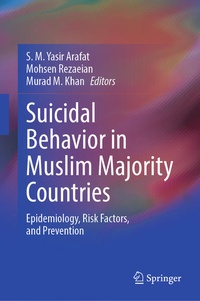
Suicidal Behavior in Muslim Majority Countries
Description

The book is about suicidal behavior in Muslim majority countries.
Islam is the second-largest religion in the world. There are also sizable Muslim populations in non-Islamic countries. Suicide is strongly prohibited in Islam and based on this tenet, suicide and self-harm remain criminalized acts in many Islamic countries.
When compared to the global estimates for suicide rates and to non-Islamic countries, Muslim majority countries have lower rates, indicating that Islamic faith and practice may be protective against suicidal behaviors. However, several factors such as criminal status, stigma toward suicide, extreme dearth of research, low-quality data, and under-reporting make it difficult to draw any firm conclusions.
Hence, this book aims to do a deeper study of suicidal behaviors in Muslim majority countries, covering epidemiology, risk factors, and the challenges of suicide prevention in Muslim majority countries.
Reviews / Votes
"This book is essential reading for suicide researchers, mental health practitioners, policymakers, advocates, and those working on suicide prevention within Muslim communities and countries. The book offers valuable information that is context-specific and insightful providing practitioners, scholars, and advocates a path to progress in suicide research and practice." (Shahnaz Savani, Crisis -The Journal of Crisis Intervention and Suicide Prevention, Vol. 45 (6), 2024)
More details
Other editions
Additional editions
Persons
Dr. S M Yasir Arafat is currently working as an assistant professor of Psychiatry at Enam Medical College and Hospital, Dhaka, Bangladesh. He completed M.D. in Psychiatry from Bangabandhu Sheikh Mujib Medical University, Dhaka, and MBBS from the Dhaka Medical College, Dhaka, Bangladesh. He also did an MPH in Health Economics and MBA in Marketing. Dr. Arafat has (co)authored more than 300 peer-reviewed articles and book chapters, and (co)edited several books with Springer. He was included in the global 2% researcher list in 2021, 2022, and 2023. He is acting as an editorial member in more than ten leading journals in mental health published by Frontiers, Wiley, Hindawi, Springer, and Taylor and Francis. His research focused on suicidal behavior, psychometrics, panic buying, and psycho-sexual disorders.
Professor Mohsen Rezaeian is a professor of Epidemiology at Rafsanjan University of Medical Sciences in Iran. He is one of the founders of the Iranian Scientific Society for Suicide Prevention (ISSSP) and editor-in-chief of the newly developed Journal of Suicide Prevention (JSP). He is a co-chair of the International Association for Suicide Prevention (IASP) Special Interest Group (SIG) on the Development of Effective National Suicide Prevention Strategy and Practice. Over the past two decades, he has published numerous articles and a couple of book chapters in the area of suicide prevention. He has also developed some new ideas in the areas of suicide studies and suicide prevention.
Professor Murad Moosa Khan, MRCPsych, Ph.D. is Professor Emeritus, Dept. of Psychiatry and Brian & Mind Institute, Aga Khan University. He is also an associate faculty at the Centre for Bioethics and Culture (CBEC), Karachi. Prof. Khan is the past president of the International Association for Suicide Prevention (IASP) 2017-2020 and continues to serve on the Board of IASP, where he contributes to the organization's global suicide prevention strategy. He also serves in several other mental health non-governmental organizations and bioethics forums in Pakistan. Prof. Khan's research interests include focusing on epidemiology and socio-cultural and religious factors in suicide and self-harm in South Asia and developing economies, mental health of women and the elderly, narrative medicine, and organizational ethics. His extensive research work, findings, and contributions on social and ethical issues have been published in several medical journals and the lay press, where is a frequent contributor.
