

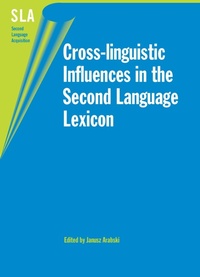
Cross-linguistic Influences in the Second Language Lexicon
Published on 28. February 2006
288 pages
978-1-78892-024-7 (ISBN)
Description

This volume contains a selection of papers analyzing language transfer, a phenomenon which results from language contact in bilingual and multilingual language acquisition and learning contexts. The main focus of the volume is on the lexical aspects of language transfer.
Reviews / Votes
This is an impressive collection of serious thought and critical analysis ranging from broad issues and their implications to more specific problems. The papers are firmly grounded in significant previous research and they present good summaries of much recent work as well. I found the topics to be intriguing, the research to be rigorous and valuable to the field, and the findings and analyses outlined in the papers as a whole to represent a perspective that is relevant and useful. This is a significant contribution to the field of second language acquisition studies. -- Julie Bruch, Mesa State College * Linguist List 17.2001 *More details
Series
Language
English
Place of publication
Clevedon
United Kingdom
Target group
Professional and scholarly
ISBN-13
978-1-78892-024-7 (9781788920247)
Copyright in bibliographic data and cover images is held by Nielsen Book Services Limited or by the publishers or by their respective licensors: all rights reserved.
Schweitzer Classification
Other editions
Additional editions
Janusz Arabski
Cross-linguistic Influences in the Second Language Lexicon
Book
02/2006
Multilingual Matters
€128.00
Shipment within 10-20 days
Janusz Arabski
Cross-linguistic Influences in the Second Language Lexicon
E-Book
02/2006
1st Edition
Multilingual Matters
€14.49
Available for download
Person
Janusz Arabski is a professor of English and Chairman of the English Language Institute at the University of Silesia in Katowice, Poland. He has published a number of books and articles in the areas of applied linguistics, foreign language learning, psycholinguistics, contrastive studies and lexicography.
Content
Introduction
Part 1: Language Contact and Language Transfer Revisited
1. On the Ambiguity of the Notion of 'Transfer' - Hans W. Dechert (Kassel Universitaet)
2. Language Transfer in Language Learning and Language Contact - Janusz Arabski
3. Could a Contrastive Analysis Ever be Complete? - Terence Odlin (Ohio State University)
4. The Importance of Different Types of Similarity in Transfer Studies - Hakan Ringbom (Abo Akademi)
5. Language Contact vs Foreign and Second Language Acquisition - Elzbieta Manczk-Wohlfeld (Uniwersytet Jagiellonski)
Part 2: Language Contact Observed
6. Genre: Language Contact and Culture Transfer - Andrzej Lyda (Uniwersytet Slaski)
7. Cross-linguistic Influence and the Collocational Competence of Polish Learners of English - Justyna Lesniewska (Uniwersytet Jagiellonski)
8. International Terms and Profile Transfer: On Discussion - Krystyna Warchal (Uniwersytet Slaski)
9. Influence of English on Polish Drug-related Slang - Magdalena Bartlomiejczyk (Uniwersytet Slask)
Part 3: Lexical Transfer in Language Processing
10. Why Money Can't Buy You Anything in German: A Functional-Typological Approach to the Mapping of Semantic Roles to Syntactic Functions in SLA - Marcus Callies (Phillips- Universitaet Marburg)
11. Lexical Transfer: Interlexical or Intralexical? - David Singleton (The University of Dublin)
12. The Interaction of Languages in the Lexical Search of Multilingual Language Users - Danuta Gabrys-Barker (Uniwersytet Slaski)
13. Assessing L1 and L2 Lexical Knowledge in Early L2 Learning - Anna Nizegorodcew (Uniwersytet Jagiellonski)
14. Code-mixing in Early L2 Lexical Acquisition - Joanna Rokita (Akademia Pedagogiczna w Krakowie)
Part 4: Lexical Transfer in Fixed Expressions
15. Metaphorical Transferability - Rudiger Zimmermann (Phillips- Universitaet Marburg)
16. On the Use of Translation in Studies of Language Contact - Jolanta Latkowska (Uniwersytet Slaski)
17. On Building Castles on the Sand, or Exploring the Issue of Transfer in the Interpretation and Production of L2 Fixed Expressions - Anna Cieslicka (Uniwersytet im. Adama Mickiewicza)
18. 'Don't Lose your Head' or How Polish Learners of English Cope with Idiomatic Expressions - Liliana Piasecka (Uniwersytet Opolski)
19. Phrasal Verb Idioms and the Normative Concept of the Interlanguage Hypothesis - Przemyslaw Olejniczak
Part 1: Language Contact and Language Transfer Revisited
1. On the Ambiguity of the Notion of 'Transfer' - Hans W. Dechert (Kassel Universitaet)
2. Language Transfer in Language Learning and Language Contact - Janusz Arabski
3. Could a Contrastive Analysis Ever be Complete? - Terence Odlin (Ohio State University)
4. The Importance of Different Types of Similarity in Transfer Studies - Hakan Ringbom (Abo Akademi)
5. Language Contact vs Foreign and Second Language Acquisition - Elzbieta Manczk-Wohlfeld (Uniwersytet Jagiellonski)
Part 2: Language Contact Observed
6. Genre: Language Contact and Culture Transfer - Andrzej Lyda (Uniwersytet Slaski)
7. Cross-linguistic Influence and the Collocational Competence of Polish Learners of English - Justyna Lesniewska (Uniwersytet Jagiellonski)
8. International Terms and Profile Transfer: On Discussion - Krystyna Warchal (Uniwersytet Slaski)
9. Influence of English on Polish Drug-related Slang - Magdalena Bartlomiejczyk (Uniwersytet Slask)
Part 3: Lexical Transfer in Language Processing
10. Why Money Can't Buy You Anything in German: A Functional-Typological Approach to the Mapping of Semantic Roles to Syntactic Functions in SLA - Marcus Callies (Phillips- Universitaet Marburg)
11. Lexical Transfer: Interlexical or Intralexical? - David Singleton (The University of Dublin)
12. The Interaction of Languages in the Lexical Search of Multilingual Language Users - Danuta Gabrys-Barker (Uniwersytet Slaski)
13. Assessing L1 and L2 Lexical Knowledge in Early L2 Learning - Anna Nizegorodcew (Uniwersytet Jagiellonski)
14. Code-mixing in Early L2 Lexical Acquisition - Joanna Rokita (Akademia Pedagogiczna w Krakowie)
Part 4: Lexical Transfer in Fixed Expressions
15. Metaphorical Transferability - Rudiger Zimmermann (Phillips- Universitaet Marburg)
16. On the Use of Translation in Studies of Language Contact - Jolanta Latkowska (Uniwersytet Slaski)
17. On Building Castles on the Sand, or Exploring the Issue of Transfer in the Interpretation and Production of L2 Fixed Expressions - Anna Cieslicka (Uniwersytet im. Adama Mickiewicza)
18. 'Don't Lose your Head' or How Polish Learners of English Cope with Idiomatic Expressions - Liliana Piasecka (Uniwersytet Opolski)
19. Phrasal Verb Idioms and the Normative Concept of the Interlanguage Hypothesis - Przemyslaw Olejniczak
