

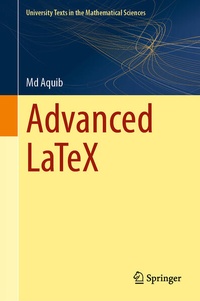
Advanced LaTeX
Description

This book presents an in-depth guide designed for students, researchers and professionals seeking to harness the power of LaTeX, which is a high-quality typesetting tool widely used in academia, engineering and scientific communities for producing well-structured, complex documents. It is crafted to demystify LaTeX, equipping readers with the skills to create professional-quality documents from simple articles to complex reports, theses and books. The book covers both basic and advanced aspects of LaTeX and addresses common challenges faced by LaTeX users, such as structuring long documents, creating mathematical equations, managing bibliographies and incorporating graphics. By providing a clear progression from fundamental to advanced topics, it aims to make LaTeX accessible and practical for students, researchers and professionals across disciplines.
More details
Other editions
Additional editions
Person
Mohammad Aquib is Assistant Professor in the Department of Mathematics and Statistics at the College of Science of Imam Mohammad Ibn Saud Islamic University, Riyadh, Saudi Arabia. An active mathematician, he earlier taught a wide range of undergraduate and graduate courses, including differential geometry, fluid dynamics, LaTeX and coding theory at several prominent institutions like Jamia Millia Islamia (JMI) and the University of Delhi, in New Delhi, India. With a Ph.D. in mathematics from JMI, his research contributions are extensive, with numerous publications in high-impact journals covering topics like slant submanifolds, Ricci curvature and geometric inequalities.
His collaborative work spans international borders, engaging with experts from France, China, Romania, South Korea and Saudi Arabia, contributing to advancements in both theoretical and applied mathematics. In addition to his research and teaching, he has presented invited talks at global conferences and is an active reviewer for prestigious journals. Proficient in programming languages and mathematical software, he brings a robust technical skill set to his work, alongside a passion for continuous learning and knowledge-sharing within the mathematical community.
Content
Chapter 1 Managing Large Projects.- Chapter 2 Advanced Figures and Graphics.- Chapter 3 Advance Presentations and Posters.- Chapter 4 Advanced LaTeX Topics.- Chapter 5 Multilingual and Global Typesetting.- Chapter 6 Troubleshooting and Best Practices.- Chapter 7 Advanced LaTeX Packages and Domain-Specific Applications.
