

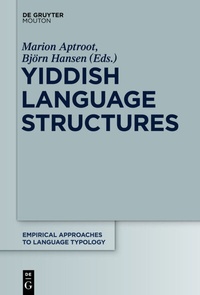
Yiddish Language Structures
1st Edition
Published on 13. December 2013
VI, 299 pages
978-3-11-033952-9 (ISBN)
Description

Yiddish Language Structures presents ten new studies on structural aspects of Yiddish in the light of modern linguistic theories which are of interest to linguists and philologists. The contributions are examples of data-based research. They address several levels of the language system including morphology, syntax and lexicology, and put special emphasis on mechanisms of internal and contact-induced language change spanning different epochs and societal and textual strata.
More details
Other editions
Additional editions
Marion Aptroot | Björn Hansen
Yiddish Language Structures
Book
12/2013
1st Edition
De Gruyter Mouton
€189.95
Shipment within 7-9 days
Persons
Marion Aptroot, Heinrich-Heine-Universität, Duesseldorf, Germany; Björn Hansen, University of Regensburg, Germany.
Content
1 - Introduction [Seite 7]
2 - A. Haredi Yiddish today [Seite 13]
2.1 - 1. Noun plurals in Israeli Hasidic Yiddish: a psycholinguistic perspective [Seite 15]
2.2 - 2. Language change in a bilingual community: the preposition far in Israeli Haredi Yiddish [Seite 45]
2.3 - 3. The foundations of written Yiddish among Haredi Satmar Jews [Seite 69]
3 - B. Yiddish in the past [Seite 111]
3.1 - 4. The (original) unity of Western and Eastern Yiddish: an assessment based on morpho-syntactic phenomena [Seite 113]
3.2 - 5. Changes in the position of the finite verb in older Yiddish [Seite 131]
3.3 - C. Yiddish from a typological perspective [Seite 149]
3.4 - 6. Yiddish modals, with special reference to their polyfunctionality and constructional properties [Seite 151]
3.5 - 7. On negation, indefinites, and negative indefinites in Yiddish [Seite 191]
3.6 - 8. On superordinate az-clauses in Yiddish narrative [Seite 237]
3.7 - 9. Aspects of Yiddish adjective formation: nasal suffixes - creativity across a dual heritage [Seite 259]
4 - D. A new tool for the study of Yiddish [Seite 273]
4.1 - 10. Yiddish passive constructions: a case study based on the new Corpus of Modern Yiddish [Seite 275]
5 - Index [Seite 303]
2 - A. Haredi Yiddish today [Seite 13]
2.1 - 1. Noun plurals in Israeli Hasidic Yiddish: a psycholinguistic perspective [Seite 15]
2.2 - 2. Language change in a bilingual community: the preposition far in Israeli Haredi Yiddish [Seite 45]
2.3 - 3. The foundations of written Yiddish among Haredi Satmar Jews [Seite 69]
3 - B. Yiddish in the past [Seite 111]
3.1 - 4. The (original) unity of Western and Eastern Yiddish: an assessment based on morpho-syntactic phenomena [Seite 113]
3.2 - 5. Changes in the position of the finite verb in older Yiddish [Seite 131]
3.3 - C. Yiddish from a typological perspective [Seite 149]
3.4 - 6. Yiddish modals, with special reference to their polyfunctionality and constructional properties [Seite 151]
3.5 - 7. On negation, indefinites, and negative indefinites in Yiddish [Seite 191]
3.6 - 8. On superordinate az-clauses in Yiddish narrative [Seite 237]
3.7 - 9. Aspects of Yiddish adjective formation: nasal suffixes - creativity across a dual heritage [Seite 259]
4 - D. A new tool for the study of Yiddish [Seite 273]
4.1 - 10. Yiddish passive constructions: a case study based on the new Corpus of Modern Yiddish [Seite 275]
5 - Index [Seite 303]
