

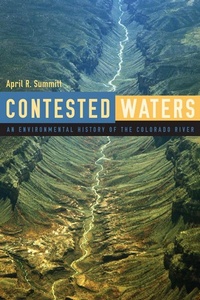
Contested Waters
Description

The Colorado River is a vital resource to urban and agricultural communities across the Southwest, providing water to 30 million people. Contested Waters tells the river''s story-a story of conquest, control, division, and depletion.
Beginning in prehistory and continuing into the present day, Contested Waters focuses on three important and often overlooked aspects of the river''s use: the role of western water law in its over-allocation, the complexity of power relationships surrounding the river, and the concept of sustainable use and how it has been either ignored or applied in recent times. It is organized in two parts, the first addresses the chronological history of the river and long-term issues, while the second examines in more detail four specific topics: metropolitan perceptions, American Indian water rights, US-Mexico relations over the river, and water marketing issues. Creating a complete picture of the evolution of this crucial yet over-utilized resource, this comprehensive summary will fascinate anyone interested in the Colorado River or the environmental history of the Southwest.
More details
Other editions
Additional editions
Content
- Cover Page
- Title Page
- Copyright Page
- Dedication
- Contents
- Preface
- NOTES
- Acknowledgments
- Part I. A River through Time
- 1. Conquering the Wild Colorado
- As the River Flows
- Early Exploration
- Taming the River
- NOTES
- 2. Farming the Desert
- Agriculture and Its Impact on Water
- The 160-Acre Limit
- Arizona v. California and CAP
- Upper Basin Projects
- NOTES
- 3. Saving the River
- Altered River Environment
- Saving the Grand Canyon
- CAP: The Last Big Diversion Project
- Environment versus Development
- NOTES
- 4. Sharing the Shortage
- Defeat of Presidential Reform
- Slow Change
- River Use at the Turn of the Twenty-First Century
- NOTES
- Part 2. Currents of Today
- 5. The Metropolis and the Desert
- San Diego (est. 1769)
- Los Angeles (est. 1781)
- Tucson (est. 1775)
- Denver (est. 1858)
- Phoenix (est. 1881)
- Tijuana (est. 1889)
- Mexicali (est. 1903)
- Las Vegas (est. 1905)
- Urban Water Users and the Colorado River
- NOTES
- 6. Owning the River
- The Dry Reservation
- Only "Paper Water"
- Quantification and "Wet Water"
- Indian Water Marketing
- NOTES
- 7. Crossing the Border
- Reluctant Sharing
- Competing Nationalism
- Cooperation and Its Challenges
- Transborder Issues and Cooperation
- NOTES
- 8. The Water Market
- How the Market Functions
- Development of a US Water Market
- Benefits and Costs
- Current Challenges and Possible Solutions
- Basin-Wide Planning and the Future
- NOTES
- Conclusion
- Present and Future Challenges
- Basin States and Individual Solutions
- Basin-Wide Planning and Negotiation
- A Cycle Complete
- NOTES
- Bibliography
- ARCHIVAL COLLECTIONS
- SELECTED GOVERNMENT DOCUMENTS
- NEWSPAPERS
- OTHER PRIMARY SOURCES
- BOOKS, ARTICLES, AND DISSERTATIONS
- Index
