

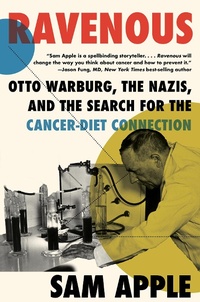
Ravenous
Description

The extraordinary story of the Nazi-era scientific genius who discovered how cancer cells eat—and what it means for how we should.
The Nobel laureate Otto Warburg—a cousin of the famous finance Warburgs—was widely regarded in his day as one of the most important biochemists of the twentieth century, a man whose research was integral to humanity's understanding of cancer. He was also among the most despised figures in Nazi Germany. As a Jewish homosexual living openly with his male partner, Warburg represented all that the Third Reich abhorred. Yet Hitler and his top advisors dreaded cancer, and protected Warburg in the hope that he could cure it.
In Ravenous, Sam Apple reclaims Otto Warburg as a forgotten, morally compromised genius who pursued cancer single-mindedly even as Europe disintegrated around him. While the vast majority of Jewish scientists fled Germany in the anxious years leading up to World War II, Warburg remained in Berlin, working under the watchful eye of the dictatorship. With the Nazis goose-stepping their way across Europe, systematically rounding up and murdering millions of Jews, Warburg awoke each morning in an elegant, antiques-filled home and rode horses with his partner, Jacob Heiss, before delving into his research at the Kaiser Wilhelm Society.
Hitler and other Nazi leaders, Apple shows, were deeply troubled by skyrocketing cancer rates across the Western world, viewing cancer as an existential threat akin to Judaism or homosexuality. Ironically, they viewed Warburg as Germany's best chance of survival. Setting Warburg's work against an absorbing history of cancer science, Apple follows him as he arrives at his central belief that cancer is a problem of metabolism. Though Warburg's metabolic approach to cancer was considered groundbreaking, his work was soon eclipsed in the early postwar era, after the discovery of the structure of DNA set off a search for the genetic origins of cancer.
Remarkably, Warburg's theory has undergone a resurgence in our own time, as scientists have begun to investigate the dangers of sugar and the link between obesity and cancer, finding that the way we eat can influence how cancer cells take up nutrients and grow. Rooting his revelations in extensive archival research as well as dozens of interviews with today's leading cancer authorities, Apple demonstrates how Warburg's midcentury work may well hold the secret to why cancer became so common in the modern world and how we can reverse the trend. A tale of scientific discovery, personal peril, and the race to end a disastrous disease, Ravenous would be the stuff of the most inventive fiction were it not, in fact, true.
More details
Other editions
Additional editions
Person
Content
- Intro
- Title
- Contents
- Introduction
- Part I A "Disease of Civilization" (Late Nineteenth Century-1918)
- 1 "A Chemical Laboratory of the Most Amazing Kind"
- 2 "The Great Unsolved Problem"
- 3 Magic Bullets
- 4 Glucose, Cancer, and the Crown Prince
- 5 "Slaves of the Light"
- Part II "The Meaning of Life Disappears" (1919-1945)
- 6 The Warburg Effect
- 7 The Emperor of Dahlem te text&8 "The Eternal Jew"
- 9 "The Herb Garden" of Dachau
- 10 The Age of Koch
- 11 "I Refused to Intervene"
- Part III The Seed and the Soil (Postwar)
- 12 Coming to America
- 13 Two Engines
- 14 "Strange New Creatures of Our Own Making"
- 15 The Prime Cause of Cancer
- 16 Cancer and Diet
- Part IV Pure, White, and Deadly (The Twenty- First Century)
- 17 Lost and Found
- 18 The Metabolism Revival
- 19 Diabetes and Cancer
- 20 The Insulin Hypothesis
- 21 Sugar
- 22 The Evil Twin
- Postscript
- Acknowledgments
- Notes
- Suggestions for Further Reading
- Illustration Credits
- Index
- Praise for Ravenous
- Copyright
