

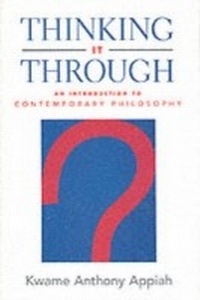
Thinking It Through
An Introduction to Contemporary Philosophy
1st Edition
Published on 13. February 2003
431 pages
978-0-19-803635-7 (ISBN)
Description

This book aims to help readers make sense of the big issues in philosophy: Mind, Knowledge, Language, Science, Morality, Politics, Law and Metaphysics. The book allows readers with no previous exposure to professional philosophy to gain an understanding of the approaches and the positions current in the field and to prepare them to read further.
More details
Other editions
Additional editions
Book
03/2003
Oxford University Press Inc
€24.75
Article exhausted; check different version
Content
- Intro
- Contents
- Preface
- Introduction: A Few Preliminaries
- CHAPTER 1: MIND
- 1.1 Introduction
- 1.2 Descartes: The beginnings of modern philosophy of mind
- 1.3 The private-language argument
- 1.4 Computers as models of the mind
- 1.5 Why should there be a functionalist theory?
- 1.6 Functionalism: A first problem
- 1.7 A simple-minded functionalist theory of pain
- 1.8 Ramsey's solution to the first problem
- 1.9 Functionalism: A second problem
- 1.10 M again
- 1.11 Consciousness
- 1.12 The puzzle of the physical
- 1.13 Conclusion
- CHAPTER 2: KNOWLEDGE
- 2.1 Introduction
- 2.2 Plato: Knowledge as justified true belief
- 2.3 Descartes' way: Justification requires certainty
- 2.4 Locke's way: Justification can be less than certain
- 2.5 The foundations of knowledge
- 2.6 Ways around skepticism I: Verificationism
- 2.7 Ways around skepticism II: Causal theories of knowledge
- 2.8 Causal theories contrasted with traditional accounts of justification
- 2.9 Epistemology naturalized
- 2.10 Conclusion
- CHAPTER 3 : LANGUAGE
- 3.1 Introduction
- 3.2 The linguistic turn
- 3.3 The beetle in the box
- 3.4 Frege's "sense" and "reference
- 3.5 Predicates and open sentences
- 3.6 Problems of intensionality
- 3.7 Truth conditions and possible worlds
- 3.8 Analytic-synthetic and necessary-contingent
- 3.9 Natural language and logical form
- 3.10 Using logic: Truth preservation, probability, and the lottery paradox
- 3.11 Logical truth and logical properties
- 3.12 Conventions of language
- 3.13 The paradox of analysis
- 3.14 Conclusion
- CHAPTER 4 : SCIENCE
- 4.1 Introduction
- 4.2 Description and prescription
- 4.3 An example: Gregor Mendel's genetic theory
- 4.4 Theory and observation
- 4.5 The received view of theories
- 4.6 The deductive-nomological model of explanation
- 4.7 Theory reduction and instrumentalism
- 4.8 Theory-ladenness
- 4.9 Justifying theories I: The problem of induction
- 4.10 Goodman's new riddle of induction
- 4.11 Justifying theories II: Popper and falsification
- 4.12 Justifying theories III: Inference to the best explanation
- 4.13 Laws and causation
- 4.14 Conclusion
- CHAPTER 5 : MORALITY
- 5.1 Introduction
- 5.2 Facts and values
- 5.3 Realism and emotivism
- 5.4 Intuitionism
- 5.5 Emotivism again
- 5.6 Kant's universalizability principle
- 5.7 Dealing with relativism
- 5.8 Prescriptivism and supervenience
- 5.9 Problems of utilitarianism I: Defining "utility."
- 5.10 Problems of utilitarianism II: Consequentialism versus absolutism
- 5.11 Rights
- 5.12 Self and others
- 5.13 Conclusion
- CHAPTER 6 : POLITICS
- 6.1 Introduction
- 6.2 Hobbes: Escaping the state of nature
- 6.3 Problems for Hobbes
- 6.4 Game theory I: Two-person zero-sum games
- 6.5 Game theory II: The prisoners' dilemma
- 6.6 The limits of prudence
- 6.7 Rawls's theory of justice
- 6.8 The difference principle and inequality surpluses
- 6.9 Criticizing Rawls I: The structure of his argument
- 6.10 Criticizing Rawls II: Why maximin?
- 6.11 Criticizing Rawls III: The status of the two principles
- 6.12 Reflective equilibrium
- 6.13 Are the two principles right?
- 6.14 Nozick: Beginning with rights
- 6.15 The entitlement theory
- 6.16 Ethics and politics
- 6.17 Conclusion
- CHAPTER 7 : LAW
- 7.1 Introduction
- 7.2 Defining "law" I: Positivism and natural law
- 7.3 Defining "law" II: Legal systems and the variety of laws
- 7.4 Hart: The elements of a legal system
- 7.5 Punishment: The problem
- 7.6 Justifying punishment: Deterrence
- 7.7 Retributivism: Kant's objections
- 7.8 Combining deterrence and retribution
- 7.9 Deterrence theory again
- 7.10 Why do definitions matter?
- 7.11 Conclusion
- CHAPTER 8 : METAPHYSICS
- 8.1 Introduction
- 8.2 An example: The existence of numbers
- 8.3 "God" as a proper name
- 8.4 The necessary being
- 8.5 Hume: No a priori proofs of matters of fact
- 8.6 Kant: "Existence" is not a predicate
- 8.7 A posteriori arguments
- 8.8 The argument from design
- 8.9 The harmony of nature
- 8.10 The necessity of a creative intelligence
- 8.11 Hume's argument from design: The argument from experience
- 8.12 The problem of evil and inference to the best explanation
- 8.13 Conclusion
- CHAPTER 9 : PHILOSOPHY
- 9.1 Introduction
- 9.2 Traditional thought
- 9.3 Arguing with the Azande
- 9.4 The significance of literacy
- 9.5 Cognitive relativism
- 9.6 The argument against strong relativism
- 9.7 The argument for weak relativism
- 9.8 Philosophy and religion
- 9.9 Philosophy and science
- 9.10 An example: Free will and determinism
- 9.11 Compatibilism and moral responsibility
- 9.12 The special character of philosophy
- 9.13 Conclusion
- Notes
- Index
- A
- B
- C
- D
- E
- F
- G
- H
- I
- J
- K
- L
- M
- N
- O
- P
- Q
- R
- S
- T
- U
- V
- W
- Z
