

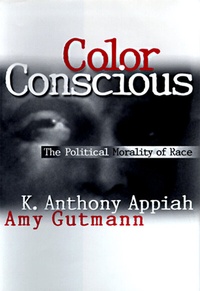
Color Conscious
The Political Morality of Race
1st Edition
Published on 16. June 2015
200 pages
978-1-4008-2209-6 (ISBN)
Description

In America today, the problem of achieving racial justice--whether through "color-blind" policies or through affirmative action--provokes more noisy name-calling than fruitful deliberation. In Color Conscious, K. Anthony Appiah and Amy Gutmann, two eminent moral and political philosophers, seek to clear the ground for a discussion of the place of race in politics and in our moral lives. Provocative and insightful, their essays tackle different aspects of the question of racial justice; together they provide a compelling response to our nation's most vexing problem.
Appiah begins by establishing the problematic nature of the idea of race. He draws on the scholarly consensus that "race" has no legitimate biological basis, exploring the history of its invention as a social category and showing how the concept has been used to explain differences among groups of people by mistakenly attributing various "essences" to them. Appiah argues that, while people of color may still need to gather together, in the face of racism, under the banner of race, they need also to balance carefully the calls of race against the many other dimensions of individual identity; and he suggests, finally, what this might mean for our political life.
Gutmann examines alternative political responses to racial injustice. She argues that American politics cannot be fair to all citizens by being color blind because American society is not color blind. Fairness, not color blindness, is a fundamental principle of justice. Whether policies should be color-conscious, class conscious, or both in particular situations, depends on an open-minded assessment of their fairness. Exploring timely issues of university admissions, corporate hiring, and political representation, Gutmann develops a moral perspective that supports a commitment to constitutional democracy.
Appiah and Gutmann write candidly and carefully, presenting many-faceted interpretations of a host of controversial issues. Rather than supplying simple answers to complex questions, they offer to citizens of every color principled starting points for the ongoing national discussions about race.
Appiah begins by establishing the problematic nature of the idea of race. He draws on the scholarly consensus that "race" has no legitimate biological basis, exploring the history of its invention as a social category and showing how the concept has been used to explain differences among groups of people by mistakenly attributing various "essences" to them. Appiah argues that, while people of color may still need to gather together, in the face of racism, under the banner of race, they need also to balance carefully the calls of race against the many other dimensions of individual identity; and he suggests, finally, what this might mean for our political life.
Gutmann examines alternative political responses to racial injustice. She argues that American politics cannot be fair to all citizens by being color blind because American society is not color blind. Fairness, not color blindness, is a fundamental principle of justice. Whether policies should be color-conscious, class conscious, or both in particular situations, depends on an open-minded assessment of their fairness. Exploring timely issues of university admissions, corporate hiring, and political representation, Gutmann develops a moral perspective that supports a commitment to constitutional democracy.
Appiah and Gutmann write candidly and carefully, presenting many-faceted interpretations of a host of controversial issues. Rather than supplying simple answers to complex questions, they offer to citizens of every color principled starting points for the ongoing national discussions about race.
More details
Other editions
Additional editions
Book
04/1998
Princeton University Press
€34.70
Shipment within 10-20 days
Book
10/1996
Princeton University Press
€37.14
Article exhausted; check different version

Book
01/1996
Princeton University Press
Unfortunately, price unknown
Article exhausted; check different version
Persons
K. Anthony Appiah is Professor of Afro-American Studies and Philosophy at Harvard University. His books include the award-winning In My Father's House. Amy Gutmann is Laurance S. Rockefeller University Professor of Politics at Princeton University. Her books include Democratic Education (Princeton). David B. Wilkins is Kirkland and Ellis Professor of Law and Director of the Program on the Legal Profession at Harvard Law School.
Content
Introduction: The Context of Race DAVID B. WILKINS 3
Race, Culture, Identity: Misunderstood Connections K. ANTHONY APPIAH 30
Part 1. Analysis. Against Races 30
Part 2. Synthesis: For Racial Identities 74
Responding to Racial Injustice AMY GUTMANN 106
Part 1. Why Question the Terms of Our Public Debate? 108
Part 2. Must Public Policy Be Color Blind? 118
Part 3. Should Public Policy Be Class Conscious Rather than Color Conscious? 138
Part 4. Why Not Aim for Proportional Representation by Race? 151
Part 5. What's Morally Relevant about Racial Identity? 163
Epilogue K. ANTHONY APPIAH 179
Index 185
Race, Culture, Identity: Misunderstood Connections K. ANTHONY APPIAH 30
Part 1. Analysis. Against Races 30
Part 2. Synthesis: For Racial Identities 74
Responding to Racial Injustice AMY GUTMANN 106
Part 1. Why Question the Terms of Our Public Debate? 108
Part 2. Must Public Policy Be Color Blind? 118
Part 3. Should Public Policy Be Class Conscious Rather than Color Conscious? 138
Part 4. Why Not Aim for Proportional Representation by Race? 151
Part 5. What's Morally Relevant about Racial Identity? 163
Epilogue K. ANTHONY APPIAH 179
Index 185
