

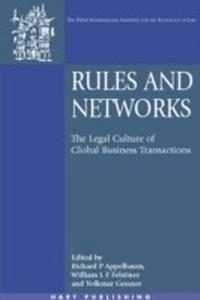
Rules and Networks
The Legal Culture of Global Business Transactions
1st Edition
Published on 21. December 2001
432 pages
978-1-84731-235-8 (ISBN)
Description

International business transactions are heavily influenced by culture,practice and rule. The pursuit of business relationships within nation-states can be subject to differences in the generation of norms and the processing of disputes, but these conflicts are magnified many times over in cross-border transactions where nation-state control and support is weak or absent. This book seeks different explanations of the ways in which business people and their legal advisers try to minimise the effect of these magnified difficulties. At the outset the editors suggest four sources through which the international business community might be considered to have supplemented nation-state conflict prevention and dispute resolution institutions-an international legal order; the development of a private normative order based on common business practices (denominated the lex mercatoria); through the efforts and work product of internationalised law firms, and by means of extensive, thick personal relationships often referred to by their Chinese term guanxi.
Since most explanations are dominated by North American and European legal scholarship and practice, a second concern of this book is to open up the discussion to competing explanatory frameworks. Specifically, it develops the notion that global legal convergence may not be the immediate, inevitable result of increased global economic interaction. Rather, less formal mechanisms for achieving normative understanding and predictability in business dealings may also flourish.
Since most explanations are dominated by North American and European legal scholarship and practice, a second concern of this book is to open up the discussion to competing explanatory frameworks. Specifically, it develops the notion that global legal convergence may not be the immediate, inevitable result of increased global economic interaction. Rather, less formal mechanisms for achieving normative understanding and predictability in business dealings may also flourish.
More details
Series
Edition
1. Auflage
Language
English
Place of publication
London
United Kingdom
Publishing group
Bloomsbury Publishing PLC
Target group
Professional and scholarly
ISBN-13
978-1-84731-235-8 (9781847312358)
Copyright in bibliographic data and cover images is held by Nielsen Book Services Limited or by the publishers or by their respective licensors: all rights reserved.
Schweitzer Classification
Other editions
Additional editions
Richard Appelbaum | William L.F. Felstiner | Volkmar Gessner
Rules and Networks
The Legal Culture of Global Business Transactions
Book
12/2001
Hart Publishing
€62.08
Article exhausted; check different version
Richard Appelbaum | William L.F. Felstiner | Volkmar Gessner
Rules and Networks
The Legal Culture of Global Business Transactions
Book
12/2001
Hart Publishing
€119.04
Article exhausted; check for reprint
Persons
Richard Appelbaum is Professor of Sociology and Global & International Studies,and Director of the Institute for Social, Behavioral, and Economic Research at the University of California, Santa Barbara.
William Felstiner is Distinguished Research Professor of Law at Cardiff University.
Volkmar Gessner is Professor of Sociology of Law and Comparative Law at the University of Bremen.
William Felstiner is Distinguished Research Professor of Law at Cardiff University.
Volkmar Gessner is Professor of Sociology of Law and Comparative Law at the University of Bremen.
Content
- Half title page
- Half title verso
- Title page
- Title verso
- Series Editor's Foreword
- Preface
- Contents
- List of Contributors
- Introduction: The Legal Culture of Global Business Transactions
- Part One. The New Global Environment of Business Transactions
- 1. Sovereignty and Law in a Denationalised World
- Statehood in the National Constellation
- Challenges of and Responses to Denationalisation
- The New Architecture of Statehood
- Law Beyond the Nation-State
- References
- 2. The Institutional Structuring of Business Transactions
- The Management of Uncertainty in Business Transactions
- Institutional Features Affecting Inter-Firm Relationships
- Institutional Features, Business Environments and the Management of Business Transactions
- The Management of International Business Transactions
- References
- Part Two. The Role of Legal Rules: State Law and Unified Law
- 3. Global Law in Our High Speed Economy
- Lon Fuller - Theorist of Globalisation?
- High-Speed Dispute Resolution in a High-Speed Economy
- Conclusions
- References
- 4. Traditional Private and Commercial Law Rules under the Pressure of Global Transactions: The Role for an International Order
- The Legal Approach
- Rise of Global Transactions
- Types of Global Transactions
- The Changing Role of the Nation-State
- Internationalisation and Uniformity
- The Strategies of Private Parties
- Conclusion
- References
- Part Three. The Role of Autonomous Rules: The New Lex Mercatoria and Self-Regulation
- 5. Lex Mercatoria (New Law Merchant): Globalisation and International Self-regulation
- The Lex Mercatoria Approach to Globalisation
- Analysis of the Lex Mercatoria Approach to Globalisation
- Legitimacy of the Lex Mercatoria Approach to Globalisation
- Assessment and Conclusion
- References
- 6. Lex Mercatoria - Critical Comments on a Tricky Topic
- The Lex Mercatoria as a New Conflict-of-Law Theory
- A Field of Study of Arbital Awards
- Validity and Enforceability of Such Awards is Not a Problem
- Consequences
- Conclusions
- References
- 7. Global Markets, New Games, New Rules: The Challenge of International Private Governance
- Introduction: The Limits of Metaphors in Public Policy
- The Emergence of Rules and Institutions Among Rational Actors
- Beyond Game Theory: The Social Foundations of Economic Action
- Private Governance and the Provision of Public Goods
- Public Information, Institutions and Social Embeddedness
- Conclusion
- References
- Part Four. The Role of the Legal Profession: Mega-Lawyers and In-house Counsel
- 8. Capital Markets: Those Who Can and Cannot Do the Purest Global Law Markets
- Part 1: Capital Markets Business
- Par 2: Multidisciplinary Partnerships
- Part 3: Bringing it Together
- References
- 9. The Role of Global Law Firms in Constructing or Obstructing a Transitional Regime of Labour Law
- The Role of Lawyers in Labour Law
- Labour Lawyers in the Global Economy: An Empirical Study
- The Effects of Globalisation on National Labour Law
- The Effects of Globalisation on Labour Lawyers
- Conclusion
- References
- 10. Oil Lawyers and the Globalisation of the Venezuelan Oil Industry
- The Oil Business in Venezuela
- Legal Services for the Oil Businesses
- The Career of Oil Lawyers
- Conflict Prevention and Apertura
- Conflict and Litigation
- Conclusions
- References
- Part Five. The Role of Business Networks: Relationism and Guanxi
- 11. Social Logic as Business Logic: Guanxi, Trustworthiness, and the Embeddedness of Chinese Business Practices
- A Three-Dimensional View of Guanxi
- The Intermediate Logic of Guanxi
- Guanxi and Business Transactions
- The Institutional Context of Interim Networks
- Conclusion: The Chinese Way of Doing Business in a Global Economy
- References
- 12. Coasean Foundations of a Unified Theory of Western and Chinese Contractual Practices and Economic Organisations
- Introduction
- Coase's Theory of the Firm (1937)
- Landa's Theory of Contract Law (1976)
- Landa's (1981) Theory of the Ethnically Homogenous Chinese Middleman Group (EHMG)/Ethnic Trading Groups
- Theory of EHMG: Links with the "Markets-Hierarchies", "Embeddedness/Social Networks" Research Programmes
- Implications of a Theory of EHMG for Formulating some (Testable) Hypotheses
- References
- 13. Understanding Chinese Legal and Business Norms: A Comment on Janet Tai Landa's Chapter
- Introduction
- Tai Landa's Theory of Contract Law and the Logic of the Ethnically Homogenous Middleman Group (EHMG)
- Evaluating and Re-Evaluating China's Commercial Tradition and Law
- Law (+ Social Norms) As "Rules of the Game
- Property, Politics and the Prerequisites of "Spontaneous" Norms
- Conclusion
- References
- 14. A Brief Note on Guanxi
- Promises and Problems
- The Limitations of a Rational-Instrumentalist Analysis of Trust-Based Transaction
- Guanxi and Chinese Business Behaviour
- Conclusion: What Guanxi is not about
- References
- 15. Responding to Comments by John K. M. Ohnesorge and Tai-lok Lui
- Response to Lui's Comments
- References
- 16. Settling Business Disputes with China
- Twenty Years of Legal Progress in China
- Negotiating Means of Dispute Resolution
- Actual Dispute Resolution
- Concluding Thoughts
- References
- Index
