

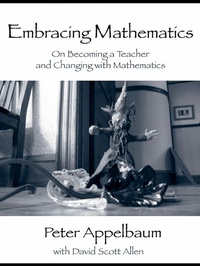
Embracing Mathematics
On Becoming a Teacher and Changing with Mathematics
Published on 30. June 2008
368 pages
978-1-135-89224-1 (ISBN)
Description

This alternative textbook for courses on teaching mathematics asks teachers and prospective teachers to reflect on their relationships with mathematics and how these relationships influence their teaching and the experiences of their students. Applicable to all levels of schooling, the book covers basic topics such as planning and assessment, classroom management, and organization of classroom experiences; it also introduces some novel approaches to teaching mathematics, such as psychoanalytic perspectives and post-modern conceptions of curriculum. Traditional methods-of-teaching issues are recast in a new discourse, provoking new ideas for making mathematics education meaningful to teachers as well as their students. Co-authored by a professor and coordinator of mathematics education programs, with illustrative contributions from practicing elementary, middle, and high school mathematics teachers, this book is a unique collaboration across all pre-college grades, making it ideal for teacher discussion groups at any level.
Embracing Mathematics:
integrates pedagogy and content exploration in ways that are unique in mathematics education
features textboxes with reflection questions and suggested explorations that can be easily utilized as homework for a course or as discussion opportunities for teacher reading groups
offers examples of teachers' action research projects that grew out of their interactions with the main chapters in the book
is not narrowly limited to mathematics education but incorporates curriculum studies - an invaluable asset that allows instructors to find more ways to engage students in self-reflexive acts of teaching
Embracing Mathematics is intended as a method text for undergraduate and master's-level mathematics education courses and more specialized graduate courses on mathematics education, and as a resource for teacher discussion groups.
Embracing Mathematics:
integrates pedagogy and content exploration in ways that are unique in mathematics education
features textboxes with reflection questions and suggested explorations that can be easily utilized as homework for a course or as discussion opportunities for teacher reading groups
offers examples of teachers' action research projects that grew out of their interactions with the main chapters in the book
is not narrowly limited to mathematics education but incorporates curriculum studies - an invaluable asset that allows instructors to find more ways to engage students in self-reflexive acts of teaching
Embracing Mathematics is intended as a method text for undergraduate and master's-level mathematics education courses and more specialized graduate courses on mathematics education, and as a resource for teacher discussion groups.
Reviews / Votes
"This book is likely to have a substantial impact on the landscape of pedagogical thinking. The pedagogy is a model for how to be engaged in life, in this sense presenting a personal vision that informs more than how to teach."David Kirshner, Louisiana State University
"Embracing Mathematics offers mathematics teachers other possibilities for teaching, in practical and very tangible ways. Simultaneously, [it] challenges the current field and provides possibilities for how these 'different' ways of considering teaching can work effectively in our current situations."
Sarah Smitherman Pratt, University of North Carolina at Greensboro "Embracing Mathematics...[offers] a theoretical and practical grounding for how teachers might enhance all students' access to powerful mathematical ideas-irrespective of socioeconomic background, home language, and out-of-school affiliations."--Margaret Anne Walshaw, Educational Studies in Mathematics (2010) 73:99-103
"This book is likely to have a substantial impact on the landscape of pedagogical thinking. The pedagogy is a model for how to be engaged in life, in this sense presenting a personal vision that informs more than how to teach."--David Kirshner, Louisiana State University
"Embracing Mathematics offers mathematics teachers other possibilities for teaching, in practical and very tangible ways. Simultaneously, [it] challenges the current field and provides possibilities for how these 'different' ways of considering teaching can work effectively in our current situations."--Sarah Smitherman Pratt, University of North Carolina at Greensboro
"Embracing Mathematics presents a wealth of educational ideas. It provides lenses for seeing classroom practice as open to fascinating changes. Emerging as a powerful collective achievement, it provides a dialogical opening of post-modern trends in critical mathematics education, seen as practice, as research, and as learning for everybody." Ole Skovsmose, Aalborg University, Denmark
"This is a book that helps the reader think about his/her practice. It guides teachers in a quest for teaching methods that will enable students to develop a critical mind, which should be the goal of all mathematics education. But it is also an extraordinarily practical book that along with stimulating ideas provides numerous applications, which are immediately useful in the mathematics classroom."--Corinne Hahn, Advancia-Negocia and European School of Management; President, International Commission for Study and Improvement of Mathematics Teaching
More details
Language
English
Place of publication
London
United Kingdom
Publishing group
Taylor & Francis Ltd
Target group
College/higher education
Illustrations
8 s/w Tabellen
8 Tables, black and white
File size
8,21 MB
ISBN-13
978-1-135-89224-1 (9781135892241)
Copyright in bibliographic data and cover images is held by Nielsen Book Services Limited or by the publishers or by their respective licensors: all rights reserved.
Schweitzer Classification
Other editions
Additional editions
Peter Appelbaum | with David Scott Allen
Embracing Mathematics
On Becoming a Teacher and Changing with Mathematics
Book
05/2008
1st Edition
Routledge
€267.41
Shipment within 15-20 days
Peter Appelbaum | with David Scott Allen
Embracing Mathematics
On Becoming a Teacher and Changing with Mathematics
Book
05/2008
1st Edition
Routledge
€96.74
Shipment within 15-20 days
Persons
Peter Appelbaum is Associate Professor, Arcadia University, Pennyslvania, where he teaches Mathematics Education, Curriculum Theory, and Cultural Studies, and is Coordinator of Mathematics Education Programs, and serves on the University Undergraduate Academic Programs Committee; University General Education Task Force; University Intercultural Committee. Secondary Education Committee; and Elementary Education Committee. His publications include Popular Culture, Educational Discourse, and Mathematics (SUNY Press, 1995); (Post) Modern Science (Education): Frustrations, propositions, and alternative paths, coedited with John Weaver and Marla Morri (Peter Lang, 2001), Multicultural and Diversity Education (ABC-CLIO, 2002), Children's Books for Grownup Teachers (LEA/Routledge, in press), and numerous chapters in edited volumes and journal articles.
David Scott Allen teaches 7th, 8th, and sometimes 9th grade math at Pennbrook Middle School in North Wales, Pennsylvania.
David Scott Allen teaches 7th, 8th, and sometimes 9th grade math at Pennbrook Middle School in North Wales, Pennsylvania.
Content
Preface: How can I (better) embrace mathematics? David Scott Allen
Prologue Peter AppelbaumResponse to Prologue: Be a student of mathematics learners
Chapter 1: Planning and assessment
Response to Chapter 1: Engage yourself in meaningful observation
Action Research 1 Isaiah Manzella, Numbers on Trial
MathWorlds 1: Reverse answer to questions
Chapter 2: A psychoanalytic perspective
Response to Chapter 2: Ask yourself to change
Action Research 2 Karen Cipriano, Flexible interview project
MathWorlds 2: Multiple answers.
Chapter 3: You are a mathematician
Response to Chapter 3: Explore the vastness of mathematics
Action Research 3 Karen Cipriano, Mathematics journals
MathWorlds 3: Reading and writing mathematics
Chapter 4: Critical thinkers thinking critically
Response to Chapter 4: It is critical to think
Action Research 4 Ada Rocchi, Lesson: world population and wealth
MathWorlds 4: Pitching questions at various levels.
Chapter 5: Consuming culture: commodities and cultural resources
Response to Chapter 5: Emphasize the meaning-making of mathematics
Action Research 5 Colleen Murphy, Problem solving through literature
MathWorlds 5: Turning "puzzles" into "problems" or "exercises"
Chapter 6: Metaphors for the classroom space
Response to Chapter 6: Take ownership of your classroom space
Action Research 6 Kristin Iaccio, Linking mathematics to social issues
MathWorlds 6: Same math, different metaphors
Chapter 7: Places where people learn mathematics
Response to Chapter 7: The classroom is always changing
Action Research 7 Petal Sumner, Empowering students who don't learn
Chapter 8: When students don't learn
Response to Chapter 8: We are all students
Epilogue: Becoming a teacher and changing with mathematics
Afterword: What will you write in your chapter?
Appendices
Prologue Peter AppelbaumResponse to Prologue: Be a student of mathematics learners
Chapter 1: Planning and assessment
Response to Chapter 1: Engage yourself in meaningful observation
Action Research 1 Isaiah Manzella, Numbers on Trial
MathWorlds 1: Reverse answer to questions
Chapter 2: A psychoanalytic perspective
Response to Chapter 2: Ask yourself to change
Action Research 2 Karen Cipriano, Flexible interview project
MathWorlds 2: Multiple answers.
Chapter 3: You are a mathematician
Response to Chapter 3: Explore the vastness of mathematics
Action Research 3 Karen Cipriano, Mathematics journals
MathWorlds 3: Reading and writing mathematics
Chapter 4: Critical thinkers thinking critically
Response to Chapter 4: It is critical to think
Action Research 4 Ada Rocchi, Lesson: world population and wealth
MathWorlds 4: Pitching questions at various levels.
Chapter 5: Consuming culture: commodities and cultural resources
Response to Chapter 5: Emphasize the meaning-making of mathematics
Action Research 5 Colleen Murphy, Problem solving through literature
MathWorlds 5: Turning "puzzles" into "problems" or "exercises"
Chapter 6: Metaphors for the classroom space
Response to Chapter 6: Take ownership of your classroom space
Action Research 6 Kristin Iaccio, Linking mathematics to social issues
MathWorlds 6: Same math, different metaphors
Chapter 7: Places where people learn mathematics
Response to Chapter 7: The classroom is always changing
Action Research 7 Petal Sumner, Empowering students who don't learn
Chapter 8: When students don't learn
Response to Chapter 8: We are all students
Epilogue: Becoming a teacher and changing with mathematics
Afterword: What will you write in your chapter?
Appendices
