

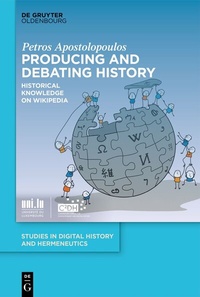
Producing and Debating History
Description

In 2021, the American Historical Association published a study on how the American public perceives and understands the past. Almost half of the respondents argued that they turn to Wikipedia to learn about history and acquire a historical understanding of the past. Wikipedia was ranked higher than other historical activities, such as "Historic site visit," "Museum visit," "Genealogy work," "Social media," "Podcast/radio program," "History lecture," and "History-related video game." These findings combined with the appropriation of Wikipedia's corpus by ChatGPT and Wikipedia's partnership with the most central search engine in the digital world, Google, and other digital assistants, such as Siri and Alexa, make clear how crucial the role of Wikipedia in how the public learns about history and makes sense of the past is.
But how is historical knowledge produced on Wikipedia? How do Wikipedia editors engage with historical events of the past and transform the past into historical knowledge? Why do they decide to contribute to the production of history? By placing Wikipedia editors at the center of research inquiry and using multiple methodologies and different kinds of data, this book explores how historical knowledge is produced in one of the most central digital communities of knowledge, Wikipedia.
More details
Other editions
Additional editions
Person
Petros Apostolopoulos , Centre for Contemporary and Digital History (C²DH), Esch-sur-Alzette, Luxemburg.
