

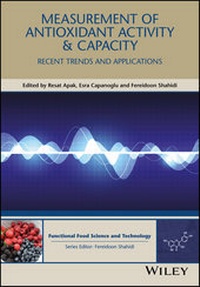
Measurement of Antioxidant Activity and Capacity
Description

Measurement of Antioxidant Activity and Capacity offers a much-needed resource for assessing the antioxidant potential of food and includes proven approaches for creating healthy food products. With contributions from world-class experts in the field, the text presents the general mechanisms underlying the various assessments, the types of molecules detected, and the key advantages and disadvantages of each method. Both thermodynamic (i.e. efficiency of scavenging reactive species) and kinetic (i.e. rates of hydrogen atom or electron transfer reactions) aspects of available methods are discussed in detail.
A thorough description of all available methods provides a basis and rationale for developing standardized antioxidant capacity/activity methods for food and nutraceutical sciences and industries. This text also contains data on new antioxidant measurement techniques including nanotechnological methods in spectroscopy and electrochemistry, as well as on innovative assays combining several principles. Therefore, the comparison of conventional methods versus novel approaches is made possible. This important resource:
* Offers suggestions for assessing the antioxidant potential of foods and their components
* Includes strategies for the development of healthy functional food products
* Contains information for identifying antioxidant activity in the body
* Presents the pros and cons of the available antioxidant determination methods, and helps in the selection of the most appropriate method
Written for researchers and professionals in the nutraceutical and functional food industries,academia and government laboratories, this text includes the most current knowledge in order to form a common language between research groups and to contribute to the solution of critical problems existing for all researchers working in this field.
More details
Other editions
Additional editions

Persons
About the editors
Resat Apak is Professor of Analytical Chemistry Division, Department of Chemistry, Faculty of Engineering, Istanbul University, Turkey.
Esra Capanoglu is Associate Professor at the Food Engineering Department, Faculty of Chemical and Metallurgical Engineering, Istanbul Technical University, Turkey.
Fereidoon Shahidi is a University Research Professor at the Department of Biochemistry, Memorial University of Newfoundland, St. John's, Canada.
Content
List of contributors xi
1 Nomenclature and general classification of antioxidant activity/capacity assays 1
Yong Sun, Cheng Yang, and Rong Tsao
1.1 Introduction 1
1.2 Nomenclature of antioxidant activity/capacity assays 2
1.3 Classification of antioxidant activity/capacity assays 2
1.4 Conclusions 15
References 15
2 Assays based on competitive measurement of the scavenging ability of reactive oxygen/nitrogen species 21
Dejian Huang and Restituto Tocmo
2.1 Introduction 21
2.2 Kinetics is more important than thermodynamics when it comes to scavenging ROS 22
2.3 Peroxyl radical scavenging capacity assay based on inhibition of lipid autoxidation 23
2.4 Application of molecular probes for quantification of antioxidant capacity in scavenging specific ROS/RNS 26
2.5 Conclusion: a unified approach for measuring antioxidant capacity against different ROS? 35
Acknowledgment 36
References 36
3 Evaluation of the antioxidant capacity of food samples: a chemical examination of the oxygen radical absorbance capacity assay 39
Eva Dorta, Eduardo Fuentes?]Lemus, Hernan Speisky, Eduardo Lissi, and Camilo Lopez?]Alarcon
3.1 Introduction 39
3.2 Chemical assays to evaluate the antioxidant capacity of food samples 41
3.3 Chemical examination of the ORAC assay: advantages and drawbacks 46
3.4 Future perspectives to improve the antioxidant capacity evaluation of food samples 50
3.5 Conclusions 52
Acknowledgments 52
References 52
4 Electron transfer?]based antioxidant capacity assays and the cupricion reducing antioxidant capacity (CUPRAC) assay 57
Resat Apak
4.1 Introduction 57
4.2 ET?]based TAC assays 58
4.3 CUPRAC assay of antioxidant capacity measurement 64
References 71
5 The ferric reducing/antioxidant power (FRAP) assay for non?]enzymatic antioxidant capacity: concepts, procedures, limitations and applications 77
Iris F.F. Benzie and Malegaddi Devaki
5.1 Introduction: concepts and context 77
5.2 The ferric reducing/antioxidant power (FRAP) assay: a brief overview 79
5.3 Working concepts, what results represent, potential interferences, and limitations 80
5.4 Method outline and detailed procedures for manual, semi?]automated, and fully automated modes 83
5.5 Technical tips for the FRAP assay 89
5.6 Issues of standardization (calibration) and how results are expressed 93
5.7 Issues of sample handling, storage, and extraction 94
5.8 Modifications to the FRAP assay 94
5.9 Illustrative applications 99
5.10 Cautions and concluding remarks 99
Acknowledgments 102
References 102
Further Reading 104
6 Folin-Ciocalteu method for the measurement of total phenolic content and antioxidant capacity 107
Rosa M. Lamuela?]Raventos
6.1 Introduction 107
6.2 Is the Folin-Ciocalteu method an antioxidant assay? 107
6.3 Folin-Ciocalteu assay to quantify phenolic compounds 108
6.4 Folin-Ciocalteu index in wines 109
6.5 Improving the method: more sustainability, less time, and lower cost 110
6.6 Beneficial effects of polyphenols measured by the Folin-Ciocalteu assay in human biological samples: a biomarker of polyphenol intake 114
References 114
7 ABTS/TEAC (2,2'?]azino?]bis(3?]ethylbenzothiazoline?]6?]sulfonic acid)/ TroloxR?]Equivalent Antioxidant Capacity) radical scavenging mixed?]mode assay 117
Antonio Cano and Marino B. Arnao
7.1 Introduction 117
7.2 Use of ABTS as a sensor of antioxidant activity: the TEAC assay 119
7.3 Advantages and disadvantages 125
7.4 TEAC assay in hyphenated and high?]throughput techniques 126
7.5 TEAC in pure compounds 128
7.6 TEAC in foods 130
7.7 Future perspectives 134
References 135
8 DPPH (2,2?]di(4?]tert?]octylphenyl)?]1?]picrylhydrazyl) radical scavenging mixed?]mode colorimetric assay(s) 141
Nikolaos Nenadis and Maria Z. Tsimidou
8.1 Overview 141
8.2 Characteristics of the DPPH radical 142
8.3 The concept behind the development of the DPPH. colorimetric assay 144
8.4 How can antioxidants scavenge the DPPH.? 144
8.5 The evolution of ideas on the underlying mechanism 145
8.6 The DPPH. colorimetric assay(s) 152
8.7 Toward the standardization of a DPPH. assay to address structure-activity relationship issues 154
8.8 Toward the establishment of a DPPH. assay for regulatory and market needs 158
8.9 Concluding remarks - A la recherche du temps perdu 160
References 161
9 Biomarkers of oxidative stress and cellular?]based assays of indirect antioxidant measurement 165
Cheng Yang, Fereidoon Shahidi, and Rong Tsao
9.1 Introduction 165
9.2 Oxidative stress 166
9.3 Biomarkers of oxidative stress 169
9.4 Cell?]based assays of indirect antioxidant measurement 175
9.5 Conclusion 180
References 181
10 Nanotechnology?]enabled approaches for the detection of antioxidants by spectroscopic and electrochemical methods 187
Ryan T. Rauhut, Gonca Bulbul, and Silvana Andreescu
10.1 Introduction 187
10.2 Spectroscopic nano?]based approaches for antioxidant detection 190
10.3 Electrochemical detection 195
10.4 Conclusions and future research needs 200
Acknowledgments 200
References 204
11 Novel methods of antioxidant assay combining various principles 209
Takayuki Shibamoto
11.1 Introduction 209
11.2 Lipid peroxidation and formation of primary and secondary oxidation products 210
11.3 Use of gas chromatography for antioxidant assays 211
11.4 Novel gas chromatographic antioxidant assays 213
11.5 Conclusion 218
References 218
12 Physico?]chemical principles of antioxidant action, including solvent and matrix dependence and interfacial phenomena 225
Katarzyna Jodko?]Piorecka, Jakub Cedrowski, and Grzegorz Litwinienko
12.1 Introduction 225
12.2 Mechanism and kinetics of peroxidation 226
12.3 Initiation of lipid peroxidation chains 227
12.4 Antioxidants 232
12.5 How to recognize a good chain?]breaking antioxidant 234
12.6 Determination of reactivity of a CBA towards peroxyl radicals 236
12.7 Basic mechanisms of antioxidant action 247
12.8 Interfacial phenomena - studies in heterogeneous lipid systems 252
12.9 Effect of temperature 265
Acknowledgments 267
References 267
13 Evaluation of antioxidant activity/capacity measurement methods for food products 273
Esra Capanoglu, Senem Kamiloglu, Gulay Ozkan, and Resat Apak
13.1 Introduction 273
13.2 Antioxidant assay selection for different food products 276
13.3 General conclusions and future perspectives 281
References 283
14 Antioxidants in oxidation control 287
Fereidoon Shahidi and Priyatharini Ambigaipalan
14.1 Introduction 287
14.2 Oxidation 287
14.3 Antioxidants 288
14.4 Synthetic antioxidants 289
14.5 Natural antioxidants 289
14.6 Tocols 290
14.7 Ascorbic acid 291
14.8 Carotenoids 292
14.9 Polyphenols 295
14.10 Bioavailability of phenolic antioxidants 307
14.11 Structural and other modification of phenolic antioxidants 308
14.12 Protein?]derived antioxidants 309
14.13 Phospholipids 309
14.14 Other antioxidants 310
References 310
15 Kinetic matching approach for rapid assessment of endpoint antioxidant capacity 321
Luis M. Magalhaes, Ines I. Ramos, Luisa Barreiros, Salette Reis, and Marcela A. Segundo
15.1 Introduction 321
15.2 Kinetic matching strategy 323
15.3 Expression of results as common standard 323
15.4 Application to samples 324
15.5 Conclusion 329
Acknowledgments 329
References 330
Index 333
1
Nomenclature and general classification of antioxidant activity/capacity assays
Yong Sun, Cheng Yang, and Rong Tsao
Guelph Research and Development Centre, Agriculture and Agri-Food Canada, Guelph, Ontario, Canada
1.1 Introduction
In the last three decades, significant changes have been made to the definition of "antioxidants." These changes have largely reflected the tremendous advances in food science, nutrition, and molecular and cell biology. Antioxidants are no longer mere chemical substances that make a food last longer or phytochemicals such as polyphenols and carotenoids that show stronger antioxidant activity/capacity (AOA/TAC) than vitamin C or E in a chemical reaction. Antioxidants were broadly defined as "any substance that, when present at low concentrations compared to that of an oxidizable substrate, significantly delays or inhibits oxidation of that substrate" (Halliwell & Gutteridge 1995) in 1995, but later the word "oxidation" was altered to "oxidative damage" that suggests an in vivo biological process: "any substance that delays, prevents or removes oxidative damage to a target molecule"(Halliwell 2007). Most recently, Apak et al. (2016a) gave a more specific definition: "natural or synthetic substances that may prevent or delay oxidative cell damage caused by physiological oxidants having distinctly positive reduction potentials, covering reactive oxygen species (ROS)/reactive nitrogen species (RNS) and free radicals (i.e. unstable molecules or ions having unpaired electrons)." These definitions demonstrate the roles of antioxidants at cellular levels in humans as they are related to oxidative stress and free radicals and further to potential health effects in humans.
Oxidative stress (OS), defined as the imbalance between prooxidants and antioxidants, is characterized by the inability of endogenous antioxidants to counteract the oxidative damage on tissues and organisms owing to overproduction of cellular ROS/RNS that are highly reactive and can cause oxidative modification of biological macromolecules, such as lipid, protein, and DNA, leading to tissue injury, accelerated cellular death (Trevisan et al. 2001), and various diseases such as atherosclerosis, diabetes mellitus, chronic inflammation, neurodegenerative disorders, cardiovascular disease, Alzheimer's disease (Smith et al. 2000), mild cognitive impairment (Guidi et al. 2006), Parkinson's disease (Bolton et al. 2000), and certain types of cancer. OS from ROS/RNS is important in the etiology of these chronic diseases. Abundant evidence suggests that antioxidants play a pivotal role in the maintenance of human health and prevention and treatment of these diseases because of their ability to reduce OS. Measuring the AOA/TAC of foods and biological samples is therefore not only crucial for assuring the quality of functional foods and nutraceuticals, but more importantly for efficacy of dietary antioxidants in the protection and treatment of oxidative stress-related diseases.
Many AOA/TAC assays have been developed over the years, based on different chemical, physicochemical, and biochemical mechanisms. While the mechanisms of some assays are clearly understood, some are complex systems with multiple modes of action. Several attempts have been made to categorize the various AOA/TAC assays (López-Alarcón & Denicola 2013; Niki 2010), but thus far there is no unified and standardized system for the nomenclature and classification of these assays. This chapter intends to find a way to reconcile the different views and provides a relatively simplified approach to the nomenclature and general classification of various AOA/TAC assays currently in use for the assessment of AOA/TAC in diets and biological fluids.
1.2 Nomenclature of antioxidant activity/capacity assays
The concept of AOA/TAC may be traced back to its origin in chemistry and then its applications in food science, in biology and medicine, and in nutrition and epidemiology. Many terms have been used for this concept over the years, including antioxidant activity (Rice-Evans et al. 1995), antioxidant capacity (Sies 1999), antioxidant power (Benzie & Strain 1996), and antioxidant potential (Jovanovic et al. 1995), to mean almost the same thing - the ability of a compound or a mixture of compounds to prevent or stop oxidative reactions occurring to another molecule. Other terms such as total antioxidant performance (Hollman et al. 2011), antioxidant effect (Talegawkar et al. 2009) and antioxidant status (Bouanane et al. 2009) have also been used, albeit relatively less widely.
Meanwhile, regardless of these terminologies, even more names have been given to the assay methods used to measure antioxidant activity or similar terms crowned with the word "total". Because these AOA/TAC assays have their origin in chemistry, the majority of the currently used methods are seriously limited in that they preclude meaningful application to in vivo conditions, so critical appraisal is needed to reassess the inherent flaws in the nomenclature and classification of these assays (Sies 2007). Also, due to the large number of different assay methods, comparison of different foods or the physiological effects of different foods can be very challenging, and often one compares apples with oranges. A systematic approach to this is critically important to the food, functional food and nutraceutical, and dietary supplement industries, and to better understanding of the relationship between diet and chronic diseases. Most of the current AOA/TAC assays are named based on the reactants, the reaction mechanism and/or the corresponding techniques, and these are summarized in Table 1.1.
Table 1.1 Nomenclature of antioxidant activity/capacity assays.
Name of assay Abbreviations Hydrogen atom transfer-based assays HAT-based assays Oxygen radical absorbance capacity assays ORAC assays Total radical-trapping antioxidant parameter assay TRAP assay Total oxyradical scavenging capacity assay TOSC assay Crocin bleaching assay - Single electron transfer-based assays SET-based assays Ferric reducing antioxidant power FRAP assay FRAP assay Cupric reducing antioxidant capacity assay CUPRAC assay Ferricyanide-Prussian blue assay - Ce(IV) reducing antioxidant capacity assay CERAC assay Cr(VI) reducing antioxidant capacity assay CHROMAC assay Acidic potassium permanganate chemiluminescence - Cyclic voltametry-based assay CV based assay Differential pulse-based assay DPV based assay Square-wave voltametry-based assay SWV based assay Dropping mercury electrode-based assay DME based assay Silver nanoparticles-based assay SNPAC-based assay Gold nanoparticles-based assay AuNPs-based assay 2,2´-azinobis(3-ethylbenzothiazoline-6-sulfonic acid)/Trolox-equivalent antioxidant capacity assay ABTS/TEAC assay 2,2-diphenyl-1-picrylhydrazyl radical scavenging assay DPPH radical scavenging assay N,N-dimethyl-p-phenylenediamine dihydrochloride radical scavenging assay DMPD radical scavenging assay Galvinoxyl radical scavenging assay - (2,6-di-tert-butyl-4-(4'-methoxyphenyl) phenoxyl radical) scavenging assay - Luminol-based chemiluminescence - Nitroblue tetrazolium-based chemiluminescence NBT-based chemiluminescence Electron spin resonance (ESR) spin trapping method (ESR) spin trapping method Hydrogen peroxide scavenging assay - Hydroxyl radical scavenging assay - Hypochlorous acid scavenging assay - Singlet oxygen scavenging assay - Nitric oxide radical scavenging assay - Peroxynitrite anion scavenging assay - Peroxyl radical scavenging assay - ß-Carotene bleaching assay - Iodometric hydroperoxide measurement - Ferric thiocyanate and ferric xylenol orange...