

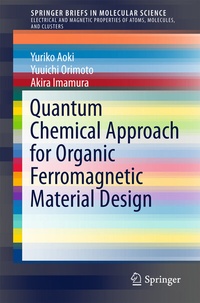
Quantum Chemical Approach for Organic Ferromagnetic Material Design
Published on 20. December 2016
XVI, 138 pages
978-3-319-49829-4 (ISBN)
Description

This brief provides an overview of theoretical research in organic ferromagnetic material design using quantum chemical approaches based on molecular orbital theory from primary Hückel to ab initio levels of theory. Most of the content describes the authors' approach to identify simple and efficient guidelines for magnetic design, which have not been described in other books. Individual chapters cover quantum chemistry methods that may be used to find hydrocarbon systems with degenerate non-bonding molecular orbitals that interact with each other, to identify high-spin-preferred systems using an analytical index that allows for simple design of high-spin systems as well as to analyze the effect of high-spin stability through orbital interactions. The extension of these methods to large systems is discussed.This book is a valuable resource for students and researchers who are interested in quantum chemistry related to magnetic property.
More details
Series
Edition
1st ed. 2017
Language
English
Place of publication
Cham
Switzerland
Publishing group
Springer International Publishing
Target group
Professional and scholarly
Product notice
Reflowable
Illustrations
XVI, 138 p. 64 illus., 8 illus. in color.
File size
6,85 MB
ISBN-13
978-3-319-49829-4 (9783319498294)
DOI
10.1007/978-3-319-49829-4
Schweitzer Classification
Other editions
Additional editions
Yuriko Aoki | Yuuichi Orimoto | Akira Imamura
Quantum Chemical Approach for Organic Ferromagnetic Material Design
Book
01/2017
Springer
€58.84
Shipment within 10-15 days
Persons
Yuriko Aoki
is a Professor at the Department of Energy and Material Sciences, Kyushu University (Japan). She is also a guest professor at the South China Normal University, Guangzhou, China. Prof. Aoki published more than 140 scientific articles in peer-reviewed journals and contributed to several books. Her current research focuses on the application of highly accurate order-N computational method for gigantic systems and on the material design for nano-bio systems.
Yuuichi Orimoto is working as an Assistant Professor at the Green Asia education center, Kyushu University (Japan), after several postdoctoral stages and defending his PhD in Chemistry at Hiroshima University in 2003.
Akira Imamura was born in 1934, Shiga Prefecture, Japan. After his retirement as Professor of Physical Chemistry from Hiroshima University, he was involved in educational and administrational issues at Hiroshima Kokusai Gakuin University. Professor Imamura has been a pioneering researcher in the development and application of quantum mechanical methods for large systems. Initially, he developed semiempirical methods for analysis of organic molecule and large bio-systems and extended them in collaboration with other scientists, especially in molecular biophysics field.
Yuuichi Orimoto is working as an Assistant Professor at the Green Asia education center, Kyushu University (Japan), after several postdoctoral stages and defending his PhD in Chemistry at Hiroshima University in 2003.
Akira Imamura was born in 1934, Shiga Prefecture, Japan. After his retirement as Professor of Physical Chemistry from Hiroshima University, he was involved in educational and administrational issues at Hiroshima Kokusai Gakuin University. Professor Imamura has been a pioneering researcher in the development and application of quantum mechanical methods for large systems. Initially, he developed semiempirical methods for analysis of organic molecule and large bio-systems and extended them in collaboration with other scientists, especially in molecular biophysics field.
Content
- Intro
- Preface
- Acknowledgments
- Contents
- Acronyms
- 1 Survey of Organic Magnetism
- Abstract
- 1.1 Overview
- 1.1.1 Ferromagnetism
- 1.1.2 Paramagnetism and Diamagnetism
- 1.1.3 Effect of Temperature on Magnetism
- 1.2 Why Organic Ferromagnetism?
- 1.2.1 Inorganic Magnets
- 1.2.2 Advantages and Potential Applications of Organic Magnets
- 1.3 Development of the Disjoint and Non-disjoint Concepts in Organic Systems
- 1.3.1 Alternant and Non-alternant Hydrocarbons
- 1.3.2 Kekulé and Non-Kekulé Molecules
- 1.4 Index for Finding High-Spin State
- 1.4.1 Molecular-Orbital-Based Index
- 1.4.2 Valence-Bond-Theory-Based Index
- 1.5 Strategy for Ferromagnetism
- 1.5.1 Approach to Radical Crystals
- 1.5.2 Approach to Radical Polymers
- 1.6 Ising Model: Theoretical Approaches to Large High-Spin Systems (I)
- 1.7 Quantum Chemistry Approach: Theoretical Approaches to Large High-Spin Systems (II)
- 1.7.1 Open-Shell Ab Initio Molecular Orbital Methods for Larger Systems
- References
- 2 Nonbonding Molecular Orbital Method and Mathematical Proof for Disjoint/Non-disjoint Molecules
- Abstract
- 2.1 Introduction
- 2.2 Atomic-Orbital-Based Proof for Disjoint and Non-disjoint Hydrocarbons
- 2.2.1 Hydrocarbons Disjoint (HC-AO-D)
- 2.2.2 Non-disjoint Hydrocarbons Non-disjoint (HC-AO-N)
- 2.3 Molecular-Orbital-Based Proof for Disjoint and Non-disjoint Hydrocarbons
- 2.3.1 Hydrocarbons Disjoint (HC-MO-D)
- 2.3.2 Hydrocarbons Non-disjoint (HC-MO-N)
- 2.4 Atomic-Orbital-Based Proof for Disjoint and Non-disjoint Heteroatom-Included Hydrocarbons
- 2.4.1 Heteroatom-Included Hydrocarbon Type-I Disjoint (HHC-AO-I-D)
- 2.4.2 Heteroatom-Included Hydrocarbon Type-I Non-disjoint (HHC-AO-I-N)
- 2.4.3 Heteroatom-Included Hydrocarbon Type-II Disjoint (HHC-AO-II-D)
- 2.4.4 Heteroatom-Included Hydrocarbons Type-II Non-disjoint (HHC-AO-II-N)
- 2.5 Molecular-Orbital-Based Proof for Disjoint and Non-disjoint Heteroatom-Included Hydrocarbons
- 2.5.1 Heteroatom-Included Hydrocarbons Type-I Disjoint (HHC-MO-I-D)
- 2.5.2 Heteroatom-Included Hydrocarbons Type-I Non-disjoint (HHC-MO-I-N)
- 2.5.3 Heteroatom-Included Hydrocarbons Type-II Disjoint (HHC-MO-II-D)
- 2.5.4 Heteroatom-Included Hydrocarbons Type-II Non-disjoint (HHC-MO-II-N)
- References
- 3 Simple High-Spin Index Lij for Ferromagnetic Organic Molecules
- Abstract
- 3.1 Introduction
- 3.2 High-Spin Stability Index Lij (Computational Approach)
- 3.2.1 Lij for Diradical Systems
- 3.2.2 Lij for Polyradical System
- 3.2.3 Alternate Explanation of Lij
- 3.2.4 Effects of Electron Correlation on High-Spin Stability
- 3.2.5 Comparison Between {\rm L_{ij}}^{{\rm min} } and Ab Initio MP2 Calculations
- 3.3 Analytical Approach to Lij
- 3.3.1 Closed and Open Non-disjoint (0-*) Linkages
- 3.3.2 Closed (0-*) Linkage: Benzyl Radical Dimer (Diradical Model)
- 3.3.3 Closed (0-*) Linkage: Benzyl Radical Trimer (Triradical Model)
- 3.3.4 Closed (0-*) Linkage: Benzyl Radical Pentamer (Pentaradical Model)
- 3.3.5 Closed (0-*) Linkage: Tetraradical Model Including Methylene and Methylidyne Radical Units
- 3.3.6 General Procedures for the Analytical Prediction of Lij for Closed (0-*) Linkage Models
- 3.3.7 Analytical Prediction of Lij for Quasi-One-Dimensional Closed (0-*) Benzyl Radical Systems
- 3.3.8 Comparison Between {\rm L_{ij}^{AP}} and Direct Quantum Chemistry Calculations for Quasi-One-Dimensional Closed (0-*) Benzyl Radical Systems
- 3.3.9 Analytical Prediction of Lij for Open Non-disjoint (0-*) Benzyl Radical Systems
- 3.4 (2 × 2) Unitary Rotation for Minimizing Lij and Its Comparison with the Edmiston-Rüdenberg Method
- References
- 4 Through-Space/Bond Interaction Analysis of Ferromagnetic Interactions
- Abstract
- 4.1 Introduction
- 4.2 Ab Initio Through-Space/Bond Interaction Analysis Method
- 4.2.1 How to Analyze Orbital Interactions Using the Through-Space/Bond Method
- 4.2.2 Procedures for the Through-Space/Bond Interaction Analysis Method
- 4.2.3 Features of the Through-Space/Bond Interaction Analysis Method
- 4.3 Analysis of Inter-radical Interactions Using the Through-Space/Bond Method
- 4.3.1 Through-Space/Bond Analysis of a Non-disjoint (0-*) Benzyl Radical Dimer
- 4.3.2 Spacer Size and Number of Radicals: Effects on High-Spin Stability
- References
- 5 O(N) Ab Initio Open-Shell MMELG-PCM Method and Its Application to Radical Polymers
- Abstract
- 5.1 Introduction
- 5.2 Method
- 5.2.1 Elongation Method for Closed-Shell Systems
- 5.2.2 Open-Shell Elongation Method with Polarizable Continuum Model
- 5.2.3 Minimized Mixing Molecular Orbital Localization and Minimized Mixing Elongation Methods
- 5.3 Applications and Comparison with the Conventional Method
- 5.3.1 Application of the Open-Shell Elongation Method
- 5.3.2 Application of the Minimized Mixing Elongation Method
- 5.3.3 Application of the Minimized Mixing Elongation-Polarizable Continuum Model Method
- 5.3.4 Application of the Minimized Mixing Elongation Method to a Dendrimer Model
- References
- 6 Conclusions and Future Prospects
